Love Catcher, a public sculpture by Jaime Hayon about love as visual resistance
The contemporary city leaves little room for the sensitive. Almost everything urges us towards the immediate, the useful, the productive. To pause and encounter a figure stretching delicately to reach a heart is, without doubt, an uncommon invitation within today’s urban landscape.
Love Catcher, the new public sculpture by Jaime Hayon, is presented as part of Madrid Design Festival 2026 as a quiet yet firm statement: love is not a passive state, but a conscious act of reaching, of effort, and of resistance.
Installed from 18 February 2026 in the gardens of Hotel Villa Magna, along Madrid’s emblematic Paseo de la Castellana, the piece does not seek to impose itself or dominate its surroundings. Quite the opposite. Love Catcher integrates into the city’s daily life as a poetic presence that dialogues with movement, haste and routine. A work that does not demand to be understood, but to be felt.
Love as visual resistance
Hayon himself defines it as an act of visual resistance. It is not a grand statement nor an empty slogan. In a context saturated with messages appealing to confrontation and constant productivity, speaking about love in the public sphere becomes an almost political gesture. “We are living in a moment of saturation — of noise, of conflict, of messages that lean more towards confrontation than encounter. In that context, I felt that speaking about love, as an active force, was almost a political act”, the creator explains.
“We are living in a moment of saturation, and I felt that speaking about love, as an active force, was almost a political gesture.” J. Hayon
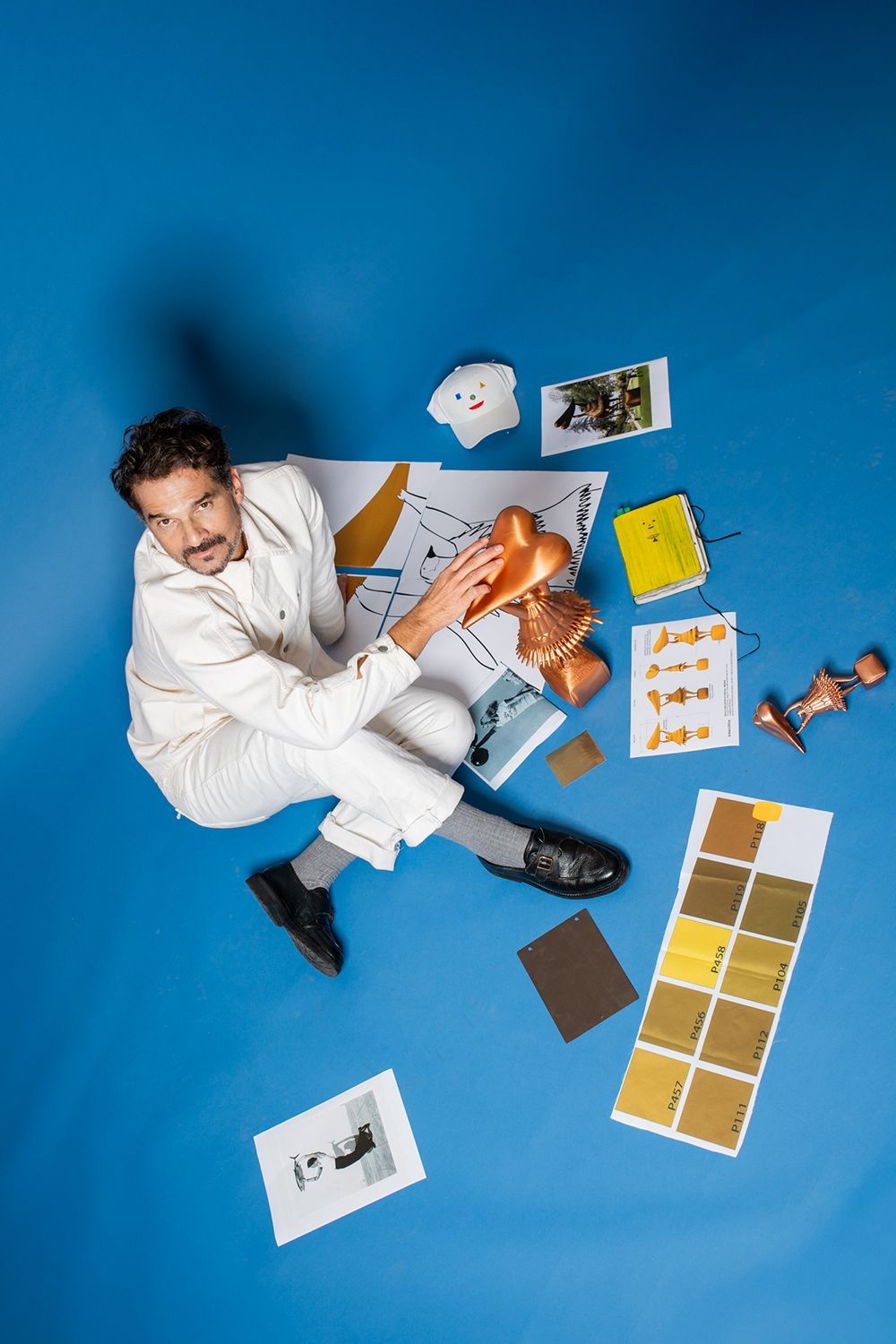
Love Catcher thus arises from an intimate yet shared need: to remind us that even — or especially — in times of uncertainty, love remains what sustains us. Not as an abstract concept, but as a daily practice. As something that requires decision, vulnerability and commitment.
“We are more flexible, more sensitive than we believe, and therein lies our capacity to resist and to love.” J. Hayon
A figure stretching: love as a position
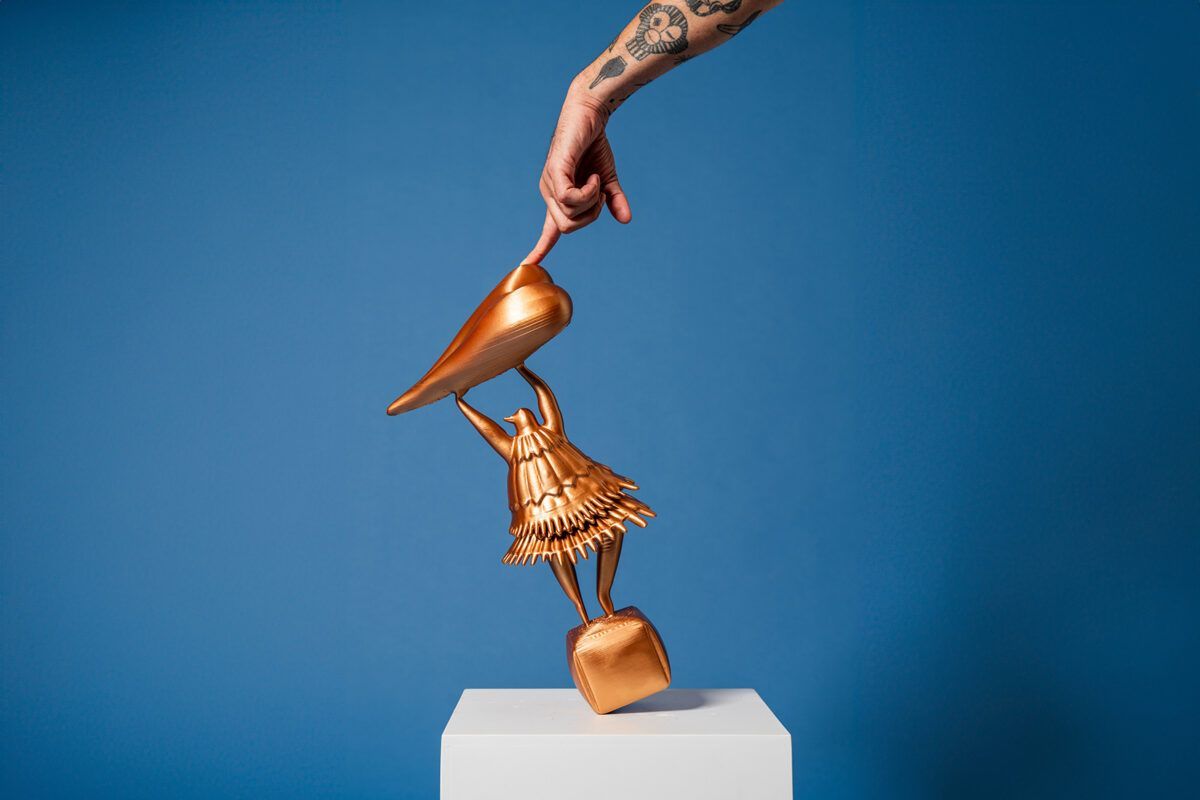
The sculpture portrays a character typical of Hayon’s universe: approachable, recognisable, with a hint of fantasy. Yet here the gesture is different. The body stretches, elongates, destabilises itself in a visible effort to reach a suspended heart. There is no heroism, no epic narrative. There is fragility.
“Loving today means exposing oneself, stepping outside comfort, stretching towards the other. The gesture of the figure is not heroic or grand; it is vulnerable. And that vulnerability is, for me, a form of courage.” says Hayon.
In Love Catcher, love does not fall from the sky nor is it offered unconditionally. One must go in search of it. That simple act — stretching — becomes a powerful metaphor for our time. In a society that rewards emotional distance and self-protection, choosing to love is a stance.
Soft Bronze: softness as symbolic strength
The piece forms part of the new sculptural series Soft Bronze, a material and conceptual investigation in which Hayon explores the tension between appearance and essence, monumentality and softness, permanence and fragility.
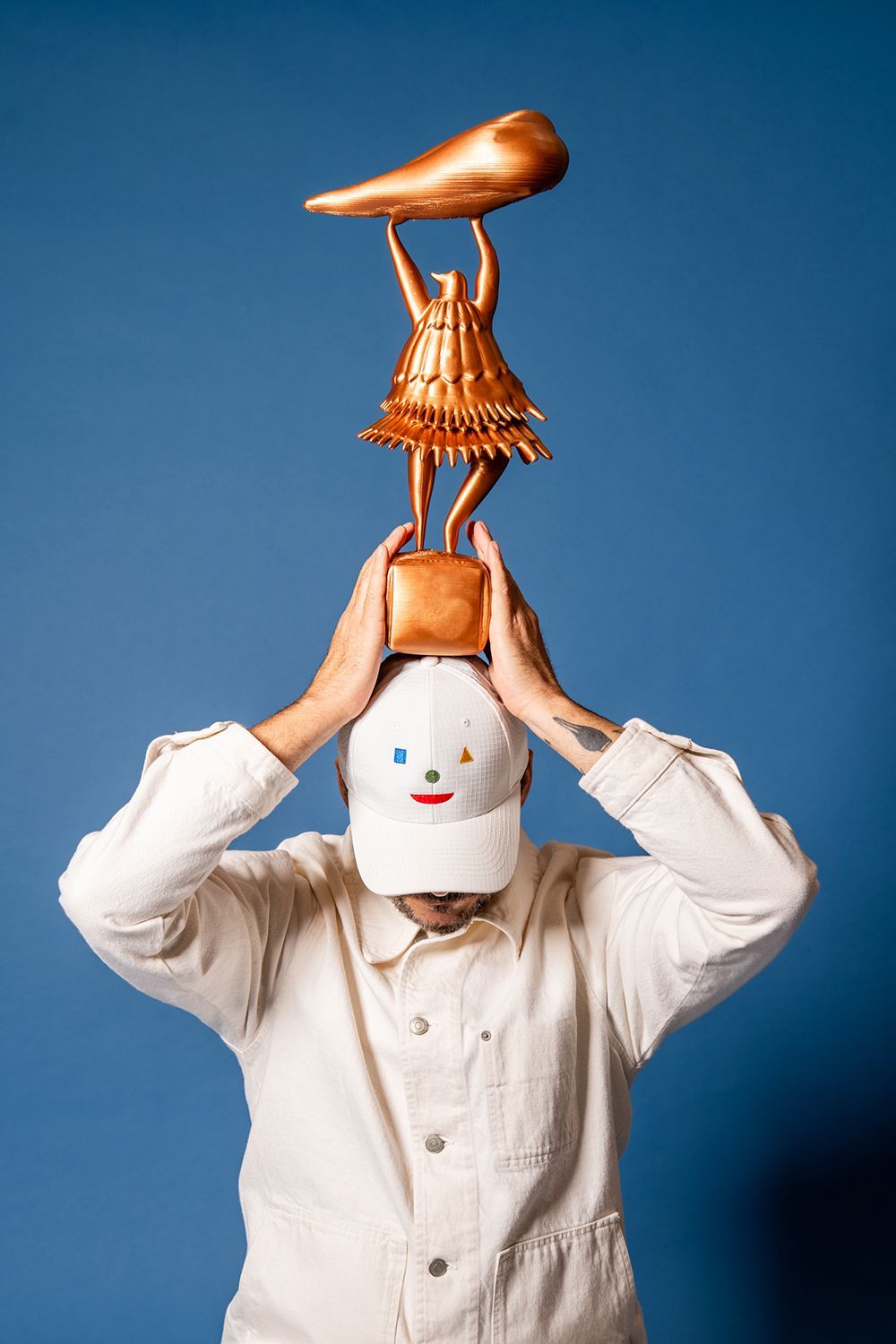
At first glance, Love Catcher evokes the solidity of bronze, marble or brass. Yet this solidity is merely visual. The materials are lightweight, flexible, almost soft.
“What appears solid is not always so, and what seems fragile can hold enormous symbolic strength. Emotionally, Soft Bronze speaks of our own condition: we are more flexible, more sensitive than we think — and therein lies our ability to resist and to love.” notes the artist.
Within this contrast lies one of the project’s most compelling keys. Lightness does not diminish importance; it amplifies it. Fragility does not weaken the message; it humanises it.
Public space as a place for pause
Placing Love Catcher in the gardens of Hotel Villa Magna, along the Paseo de la Castellana, is far from neutral. This is one of Madrid’s most symbolic axes — power, business, speed, representation. Introducing a figure stretching towards a heart creates a poetic fissure in the urban logic.
“I am interested in the work coexisting with daily movement, with people who perhaps have not gone out to ‘see art’ but encounter it. That someone might pass by, lift their gaze and, for a few seconds, connect with something more intimate.” Hayon explains.
That accidental encounter is essential. Love Catcher requires no prior explanation. It functions as a silent reminder of something fundamental, activated in the most unexpected moment.
Fantasy, humour and a more intimate poetics
Throughout his career, Jaime Hayon has been associated with humour, fantasy and playfulness. Love Catcher retains these elements, yet introduces a more contained, reflective tone — perhaps quieter, more intimate.
“Fantasy and a certain formal lightness are still present, but the message comes from a very personal place. Love Catcherspeaks about what, for me, is essential — what we return to when everything else falters: love”, he acknowledges.
The work may therefore be read as an intimate manifesto. It does not seek to explain or instruct. It accompanies. It offers itself as presence.
Jaime Hayon: at the intersection of art, design and public space
Born in Madrid in 1974, Jaime Hayon is one of the most influential figures in contemporary international creativity. With over two decades of practice, his work sits at the intersection of art, design and public space.
His pieces form part of the permanent collections of institutions such as the Centre Pompidou in Paris and the High Museum of Art in Atlanta. He has received numerous accolades, including Spain’s National Design Award, and has been recognised by international publications such as Wallpaper and Time as one of the defining creative icons of his generation.
Beyond awards and recognition, Hayon has built a distinctive language that connects with diverse audiences without renouncing complexity or emotion.
Love Catcher and the city: a lasting legacy
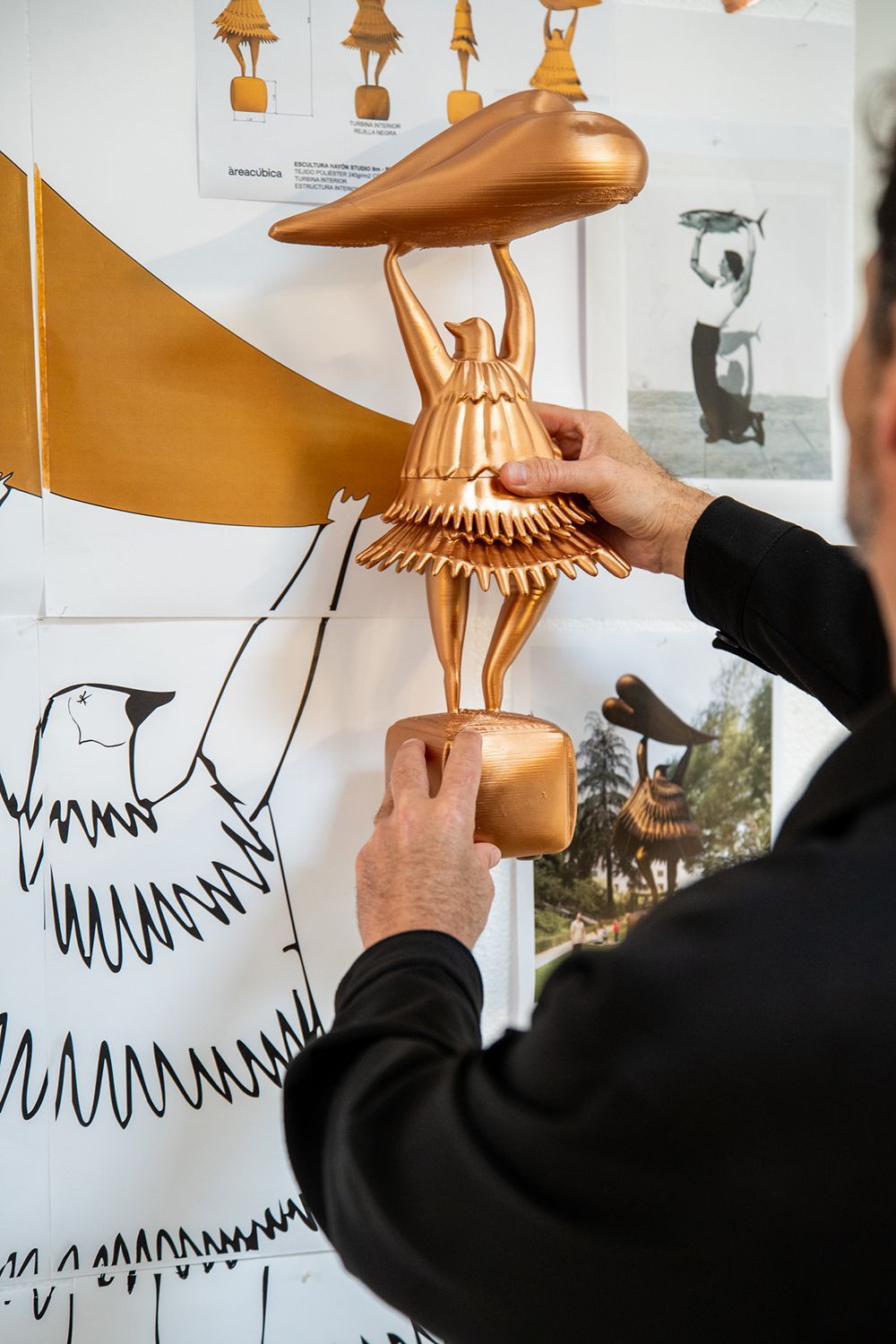
Although conceived as a temporary intervention within Madrid Design Festival 2026, Love Catcher aspires to leave a more enduring emotional legacy. It is not merely about occupying space, but activating an experience.
At a time when the city is often lived as a space of friction, Love Catcher proposes something else: a pause, a gesture of care, an invitation to remember that loving — in all its forms — remains a profoundly revolutionary act.
“I am interested in the work coexisting with daily movement, with people who perhaps have not gone out to ‘see art’ but encounter it.” J. Hayon
Perhaps that is the true strength of this sculpture: not its monumentality, nor its technique, nor even its formal beauty — but its ability to remind us, amidst daily movement, that in the midst of noise and conflict, love is still what sustains us.
(*) Photos: Giovanni Ricco.