Gagosian presents “Japanese Art History à la Takashi Murakami”

“Japanese Art History à la Takashi Murakami” showcases extraordinary new paintings presented in a series of historical screens. All of these can be viewed at Gagosian Grosvenor Hill (London).
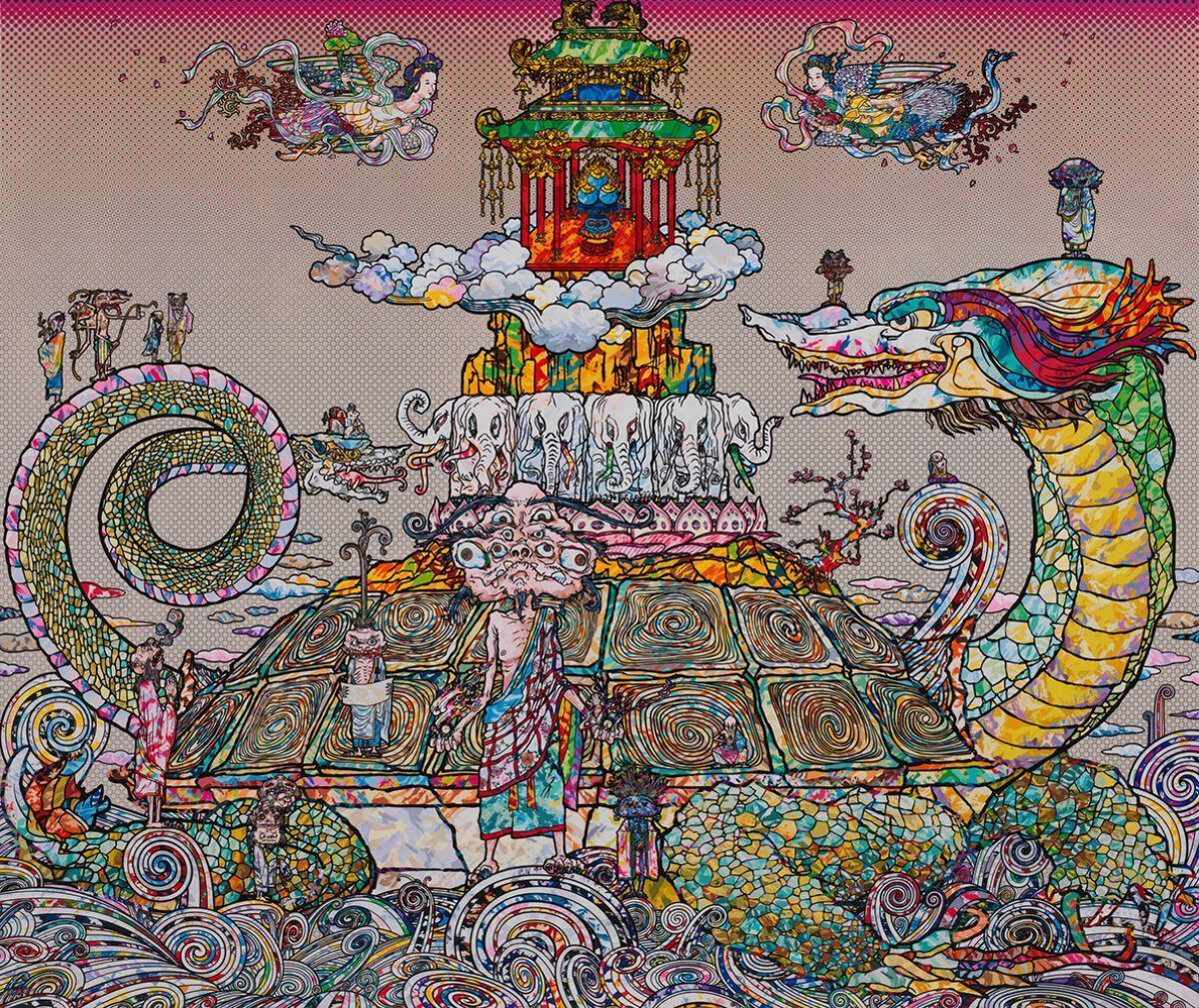
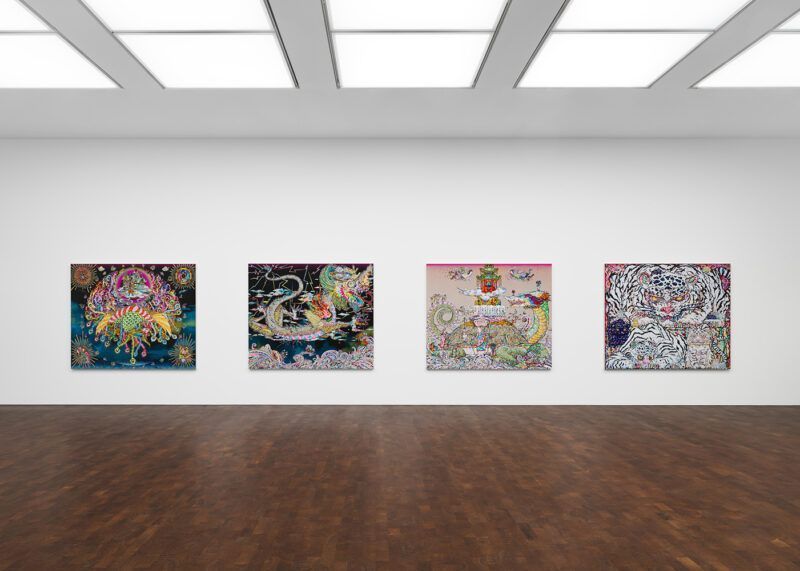
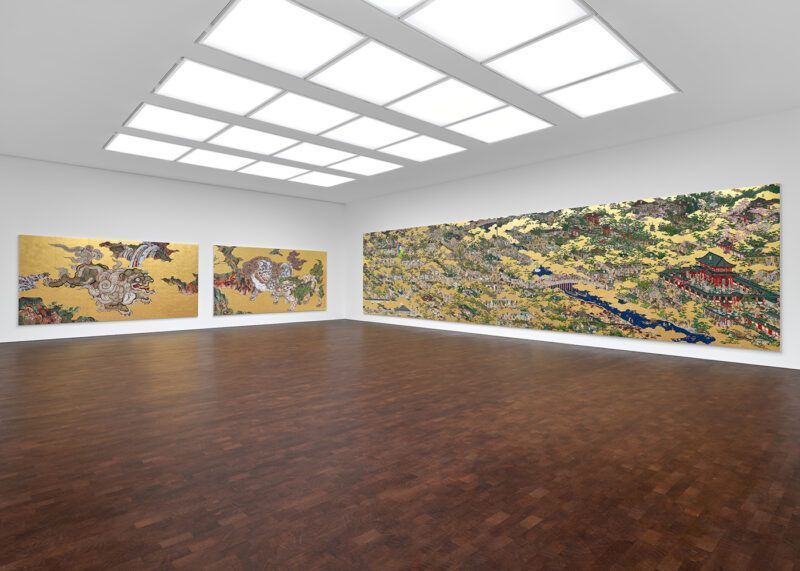
In this exhibition, the artist continues his fascination with the narrative of Japanese art, offering his own interpretations of historical paintings. By “Murakamizing” these iconic images, he simultaneously reflects on the erosion of the nation’s ancient splendor and the impact of new aesthetics and values associated with Japan’s opening to the West after the end of the Edo period (1603–1868).

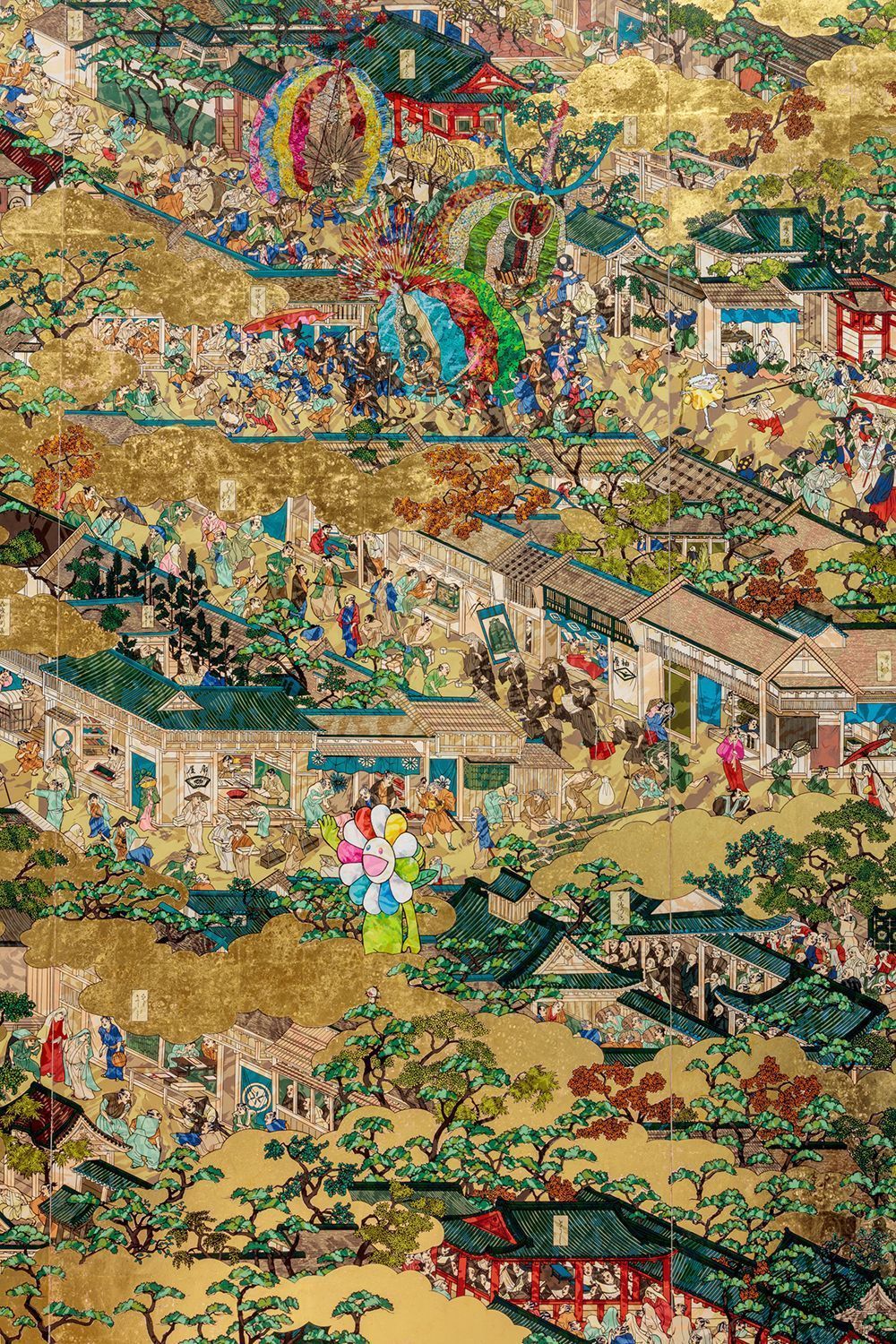
Rakuchu-Rakugai-zu Byobu: Iwasa Matabei RIP (2023–24) is modeled on Rakuchu-Rakugai-zu Byobu (Scenes in and around Kyoto) (Funaki Version) from the collection of the Tokyo National Museum. The original 17th-century work depicts the city in extraordinary detail across two six-panel folding screens. Murakami‘s version, commissioned for his Mononoke Kyoto exhibition at the Kyoto City Kyocera Museum of Art, populates its gold-leaf clouds with skulls, a memento mori inspired by a visit to the Toribeno burial ground. He also integrates examples of his own iconography, including smiling flower-faced characters and his familiar Mr. DOB figure.
Murakami‘s paintings of the “Four Symbols”, mythical guardians of Kyoto, pair each of their subjects with metropolitan locations aligned with the four cardinal directions: the Black Tortoise is associated with Mount Funaoka and Mount Kitayama in the north of the city; the Blue Dragon with the Kamo River in the east; the Vermilion Bird with Ogura Pond in the south; and the White Tiger with the San’indo Highway in the west.
To achieve these juxtapositions, Murakami combined his own sketches with AI-generated images and fragments of his earlier works, in a process that parallels the inventiveness of earlier artists in depicting unknown or imaginary creatures.
Another striking diptych portrays the gods of wind and thunder in a blend of classical Japanese painting techniques with pop art, anime, and otaku graphics that Murakami terms “Superflat”. This paired depiction employs the same motifs and compositions that Tawaraya Sotatsu (c. 1570–c. 1640), Ogata Korin (1658–1716), and Sakai Hoitsu (1761–1828) each revisited roughly a century apart. At the same time, it allows viewers to observe the development of the Kyoto-based Rinpa school. In the premodern artists’ paintings, the subjects are depicted as Buddhist deities or attendants; today, they sometimes even appear on commercial packaging as cartoon-like icons, a transformation reflected in Murakami’s approach.
Other notable works in the exhibition include figure and flower paintings, as well as a tondo. In one, Murakami reworks a set of Daigo Hanami-zu screens from the collection of the National Museum of Japanese History in Sakura, which depicts a cherry blossom viewing event at Kyoto’s Daigoji Temple; in another, he reinterprets a pair of Kiku-zu screens by Korin that portray chrysanthemums in white, green, black, and gold.
A version of another screen by the same artist features bunches of hollyhocks in red, pink, and white, while a work inspired by a screen from the collection of the Artizon Museum in Tokyo reproduces a composition of hollyhocks and peacocks.
The tondo— a circular painting composition as opposed to the traditional rectangular format—features aqueous patterns, or “Korin Water” , and repeated chrysanthemums, motifs developed by Korin that sometimes also appear on kimono fabric. In this bridge between art and fashion, Korin, who was the son of a kimono merchant, could be considered Murakami’s creative predecessor.
Alongside the exhibition, Murakami’s art will also be on view at Gagosian Burlington Arcade, with four new paintings of his iconic smiling flowers.
Lastly, a limited number of copies of the catalog documenting the 2022 exhibition of the same title at Gagosian New York will be available. The catalog includes a collectible postcard designed by the artist.
Highly recommended.
About Takashi Murakami
Takashi Murakami was born in Tokyo, where he lives and works. His works are part of collections at institutions such as the Museum of Modern Art, New York; Museum of Fine Arts, Boston; Museum of Contemporary Art, Chicago; Museum of Contemporary Art, Los Angeles; The Broad, Los Angeles; San Francisco Museum of Modern Art; and 21st Century Museum of Contemporary Art, Kanazawa, Japan.
Exhibitions include Murakami Versailles, Château de Versailles, France (2010); Murakami: The 500 Arhats, Mori Art Museum, Tokyo (2015); Murakami by Murakami, Astrup Fearnley Museet, Oslo (2017); The Deep End of the Universe, Albright-Knox Art Gallery, Buffalo, NY (2017); Under the Radiation Falls, Garage Museum of Contemporary Art, Moscow (2017); The Octopus Eats Its Own Leg, Museum of Contemporary Art, Chicago (2017, which traveled to Vancouver Art Gallery, Canada, and Modern Art Museum of Fort Worth, Texas, in 2018); Murakami vs. Murakami, Tai Kwun Contemporary, Hong Kong (2019); MurakamiZombie, Busan Museum of Art, South Korea (2023); Mononoke Kyoto, Kyoto City Kyocera Museum of Art, Japan (2024); and Hiroshige’s 100 Famous Views of Edo (featuring Takashi Murakami), Brooklyn Museum, New York (2024).