Interview with artist Sergio Roger

Artist Sergio Roger (Barcelona, 1982) reinterprets classical iconography with a series of spectacular and beautiful hand-woven sculptures made from antique linen, a material closely tied to the ancient civilizations of the Mediterranean in the making of garments. He sources this linen from specialized antique dealers and markets in Barcelona and southern France. What’s most surprising is that the texture of his work resembles stone.
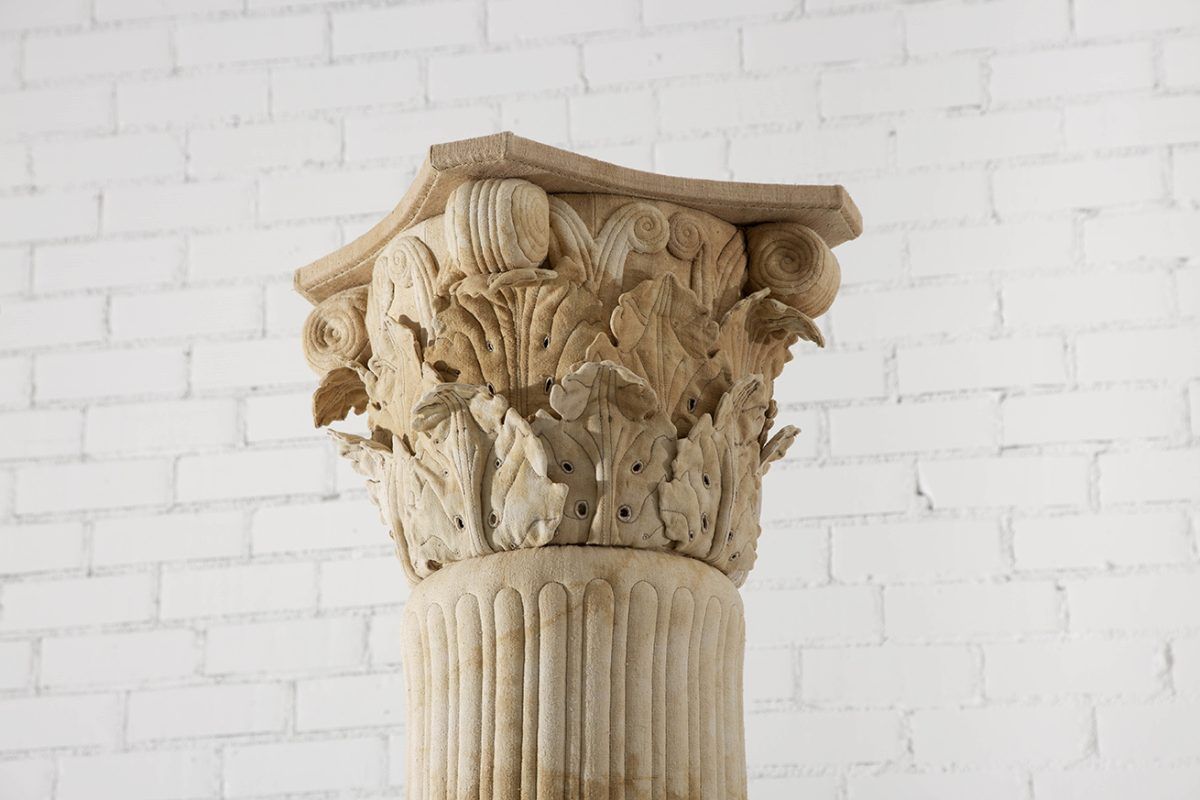


As you’ll see, Roger hasn’t only managed to bring a renewed and contemporary vision to these forms from the past, but he also uses them to reflect on the permanence and idealism associated with traditional art. We recently had the chance to chat with him about his career, creative processes, and projects, and here’s what he had to say. Enjoy the interview.
How do you like to define yourself?
I like to define myself as a tailor-archaeologist.
What did you want to be when you grew up as a child?
As a child, I dreamed of never growing up. When I realized that wouldn’t be possible, I chose to try to become an artist.

Do you remember when your first connection with art was?
Not with art with a capital “A”. But I do remember having a strong interest in exploring any form of expression that allowed me to escape reality and expand my imagination, whether through play, drawing, cinema, or literature.

Through your project, you reinterpret classical iconography with hand-woven sculptures. How did this idea come about?
My relationship with textile art developed very intuitively. At a very young age, I taught myself how to sew and began experimenting with soft sculpture.
Through my work, I’m able to merge two of my greatest passions: history and textile art.
What is the purpose of your work? And what concepts do your works revolve around?
The classical world is a theme that has been constantly revisited throughout the history of art.
It’s a common ground that allows us to discuss notions of beauty and idealism from a Western perspective.

Through my work, by replacing marble with a soft material, I aim not only to question traditional sculpture but also to invite reflection on our notion of history as handed down to us by archaeology. The past should be a living object, open to constant reinterpretation.
Where do the materials and fabrics you work with come from? What characteristics must they have to be chosen and become part of your creations?
I’m interested in stories, and behind every fabric, there’s one, along with the time, place, and people involved in its creation. For this reason, I try to work with antique or sustainably produced fabrics. I primarily work with antique linen or hemp sourced from antique dealers or individuals.
“I primarily work with antique linen or hemp.”
Where did you learn to sew, and when did you start researching ancient crafting techniques?
Around the age of 13, I began hand-sewing rag figures, and when I was 18, I bought my first sewing machine.
Do you make all your pieces yourself, or do you have a team?
I work with the help of three assistants.
How long does it take to create each piece?
My creative process is very artisanal and meticulous. The average time to complete a piece is between one and four months.
What is the creative process you follow to start one of your pieces?
The creative process I follow depends on the piece. I usually start by searching for references and sketching. Then I choose the type of fabric and technique, and the work is then crafted.
You’ve exhibited your works in some of the most prestigious galleries in the world, such as Galleria Rossana Orlandi or Robilant + Voena in Milan. And a couple of years ago, you collaborated with the legendary auction house Christie’s in London. How do you feel about such recognition of your work?
I feel incredibly fortunate, and at the same time, I’m surprised that it all happened so quickly. Recognition, when it comes, often comes all at once, and it can be a bit overwhelming.
It’s important to keep professional success in perspective and highlight the true motivations behind it. In my case, it’s about continuing to evolve artistically and enjoying the process as much as possible.
By the way, what value do awards hold for you?
I believe they can be very helpful in giving visibility to people who are just starting out, and on the other hand, awards that recognize a long professional career are also important. All the others don’t interest me much.
Your beautiful studio is located in an 18th-century manor house in the Gothic Quarter, notable for its large windows and the mosaic floors typical of Catalan Art Nouveau. How did you find this gem?
My previous studio was very close by. One day, while walking my dog, I saw a sign on the door and called. I fell in love with the place and decided to move in immediately.
What are your main influences?
My main influences are art history and archaeology. I can spend entire days getting lost in ancient art collections in museums, such as those in Rome or Vienna, for example.
“My main influences are art history and archaeology.”

How do you feel at this point in your career?
Currently, I’m at a turning point. I’m stepping away from external expectations and looking inward to understand my deepest desires and try to be true to them.
“I’m stepping away from external expectations and looking inward to understand my deepest desires.”
Can you tell us anything about the projects you’re currently working on and what’s coming in the future?
The next thing will be a solo exhibition in New York with the Robilant + Voena gallery in April 2024, and another one at De Renava – Biennale de Bonifacio II (Corsica), from May 10 to November 2, 2024.
(*) Photographs provided by Sergio Roger.