Maurizio Cattelan’s night in Berlin
A boy beats a drum on the roof of the Neue Nationalgalerie while thousands of pigeons perch on the beams of Mies van der Rohe’s pavilion. With NIGHT, his first major solo exhibition in Germany, Maurizio Cattelan turns the Berlin museum into a contemporary church.
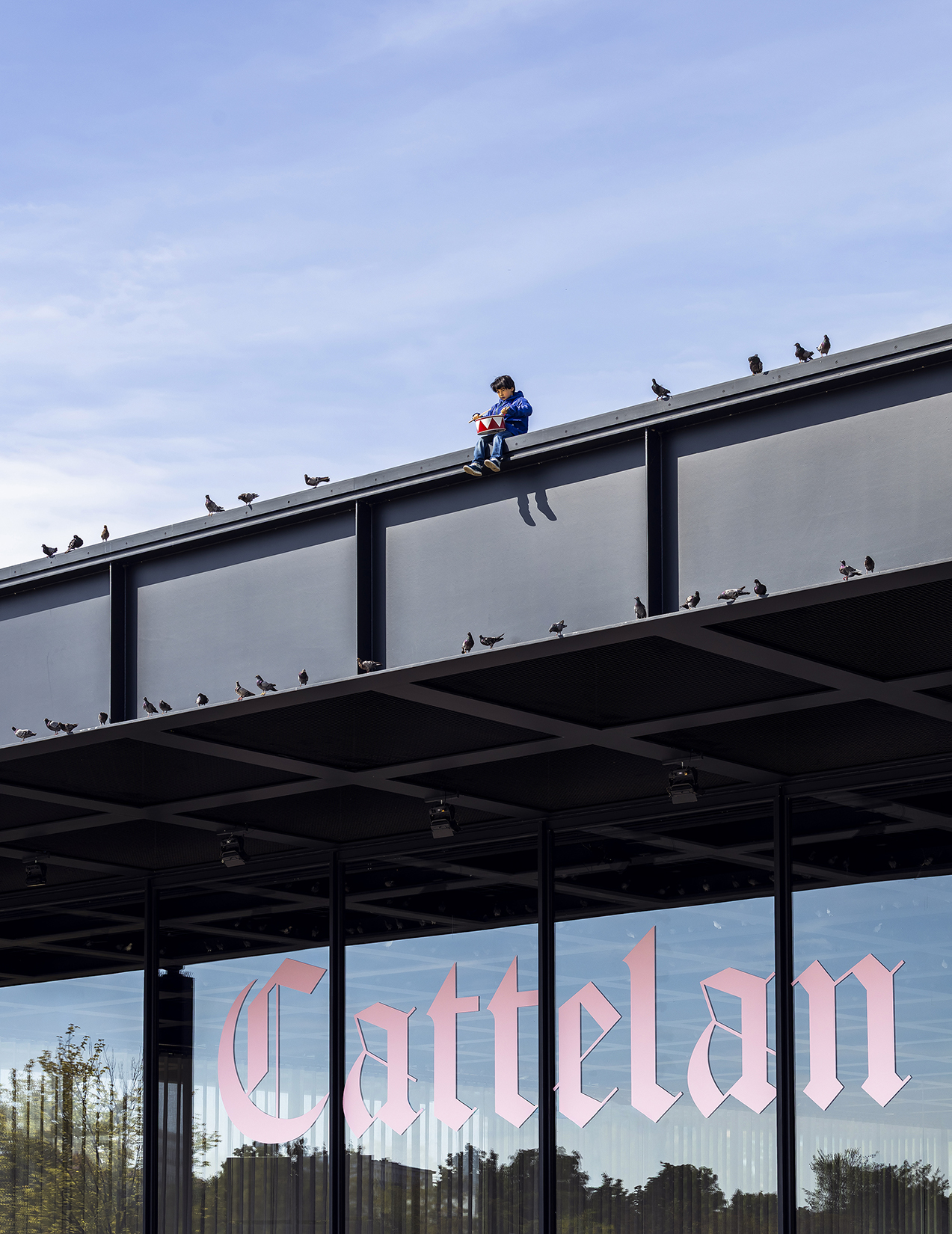
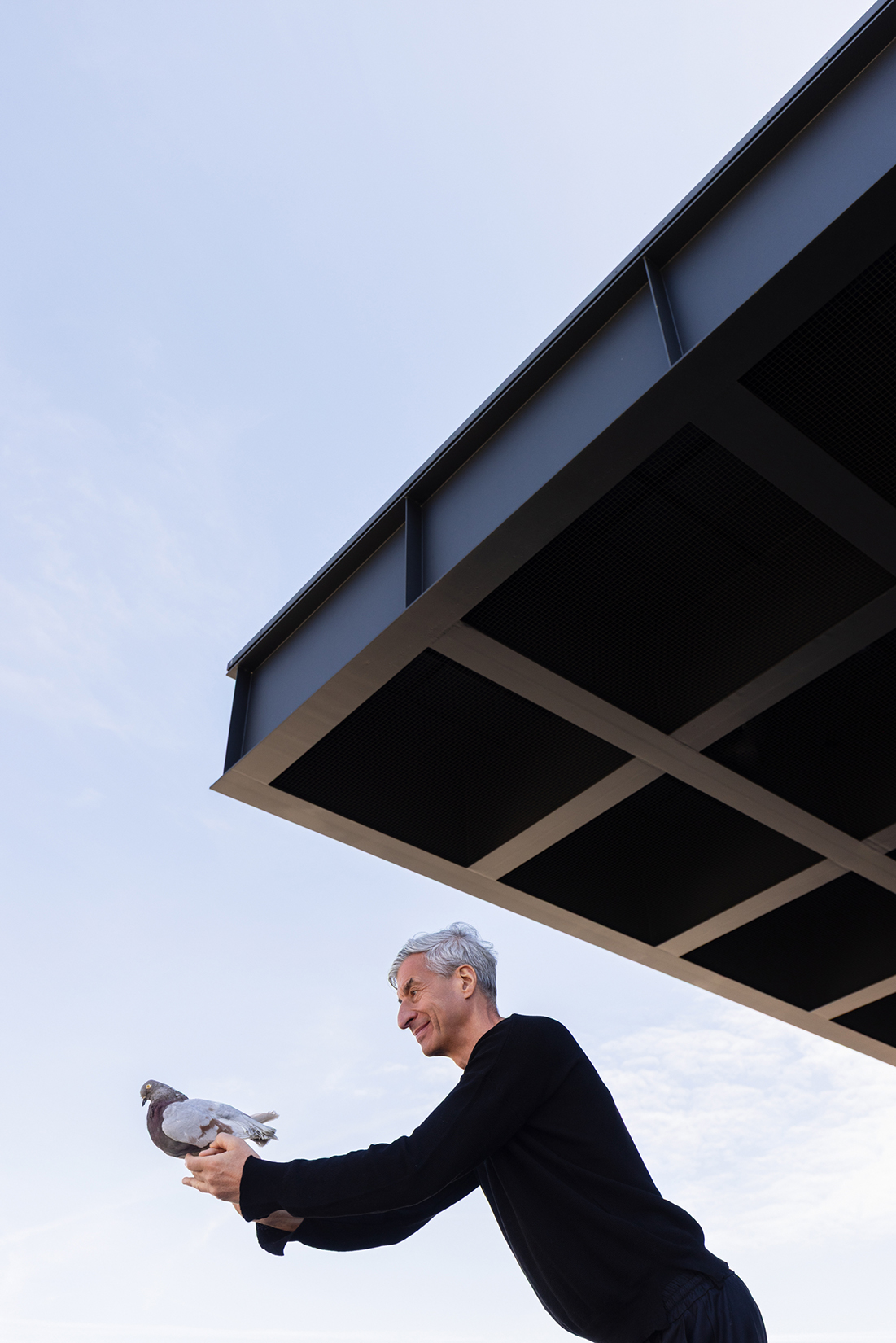
The first thing Maurizio Cattelan asks of anyone approaching the Neue Nationalgalerie is to listen. An uneven drumbeat comes from the top of the building, where the Italian artist has installed a mechanical boy on the roof. Depending on when you catch it, his drumming might herald a passing parade or sound a warning. As you look up in search of the young musician, it is easy to miss the other sign Cattelan has left outside. It is on the terrace, at your feet.
Scar (2026) is a cast-iron manhole cover inscribed with the titles of every work in NIGHT. Cattelan has turned a piece of the pavement into an index to the exhibition. On the way in, words such as Him, Dust or Never give little away about what awaits inside. They are worth reading again on the way out, once each has acquired a face, an object or, in the case of Never (2003), a sound. It is the title of the drummer boy, inspired by the protagonist of Günter Grass’s The Tin Drum.
A Brandenburg Gate inside the museum
Awarded the Preis der Nationalgalerie 2026, Cattelan returns to Berlin twenty years after co-curating the city’s fourth Biennale. This time he has worked with Lisa Botti and Klaus Biesenbach, the curators of NIGHT, in a building whose scale, symmetry and silence put him in mind of a church. That gave him a way to arrange the sculptures. In Mies van der Rohe’s vast glass hall, he imagined a central nave flanked by side aisles, with figures to pause before along the way.
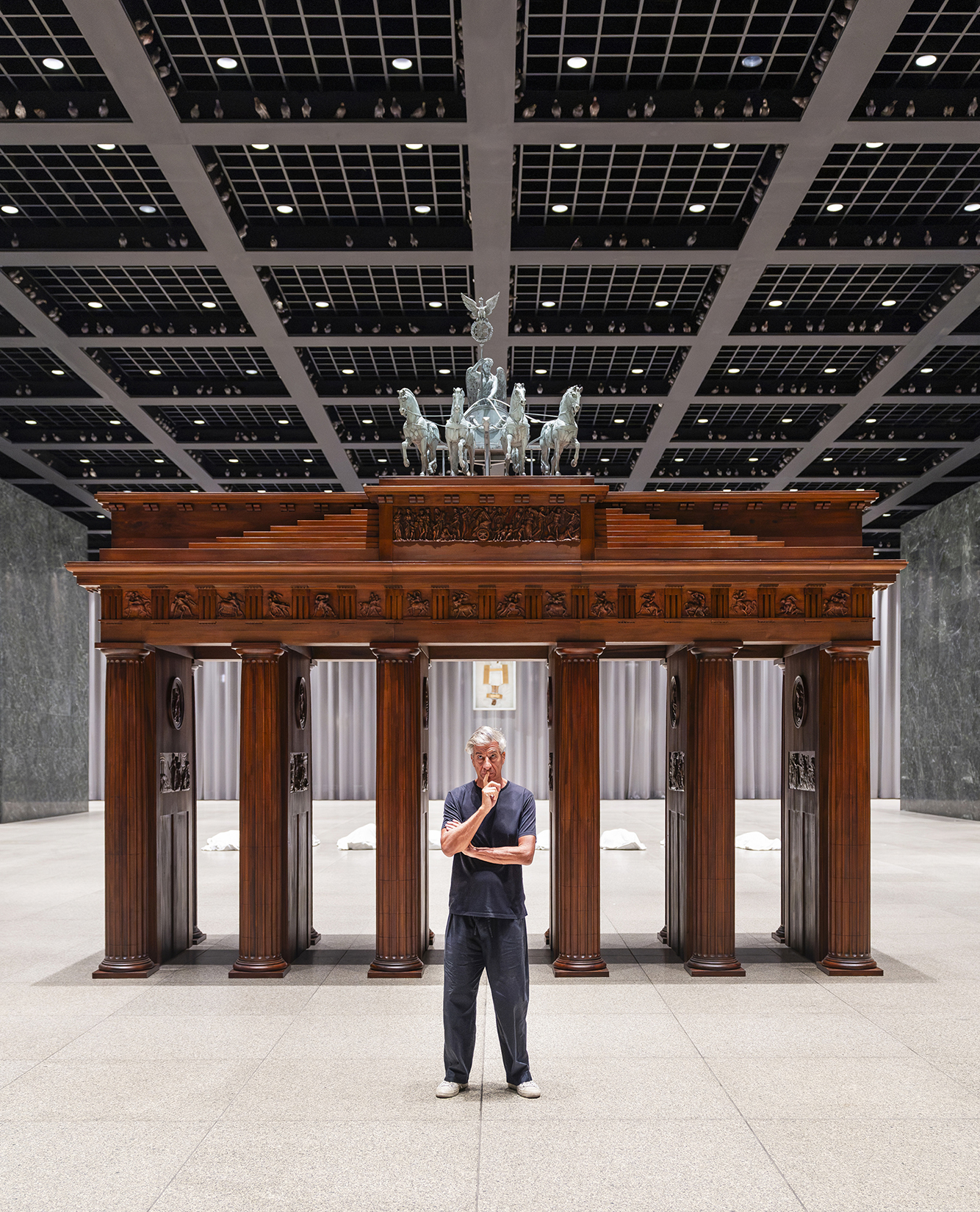
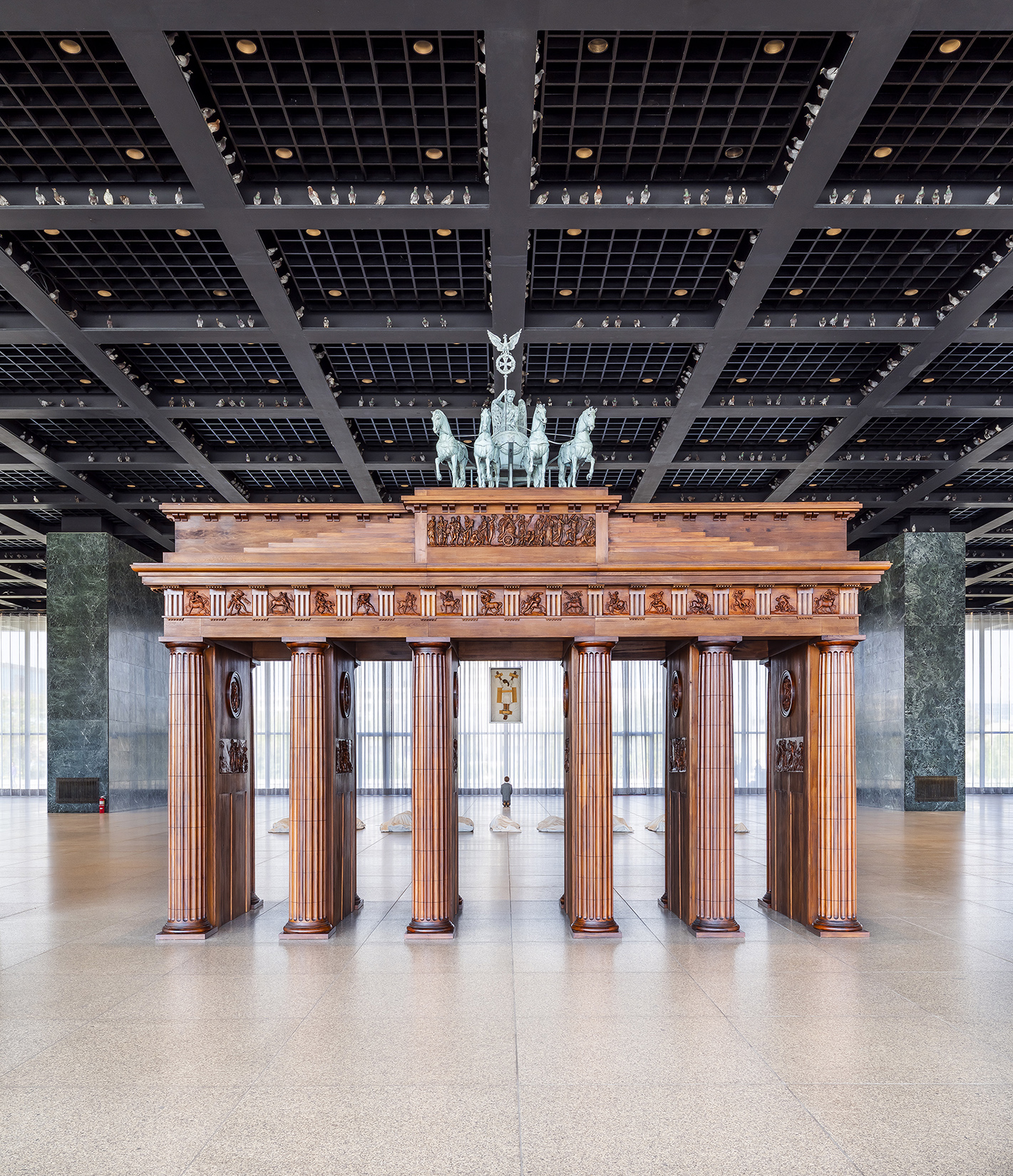
To enter this church, you pass through Purgatory (2026), a scaled-down version of the Brandenburg Gate. In its usual setting, the monument has served time and again as a backdrop to German history. Here it fits beneath a single roof, and you can walk all the way round it before deciding which opening to pass through. The shift in scale restores something that fame had all but erased. Before it became an image of Berlin, the gate was a way of getting from one place to another.
“Night is also temporary. It always contains the possibility of morning, even if you cannot see it yet.” M. Cattelan
The time it takes to recognise a face
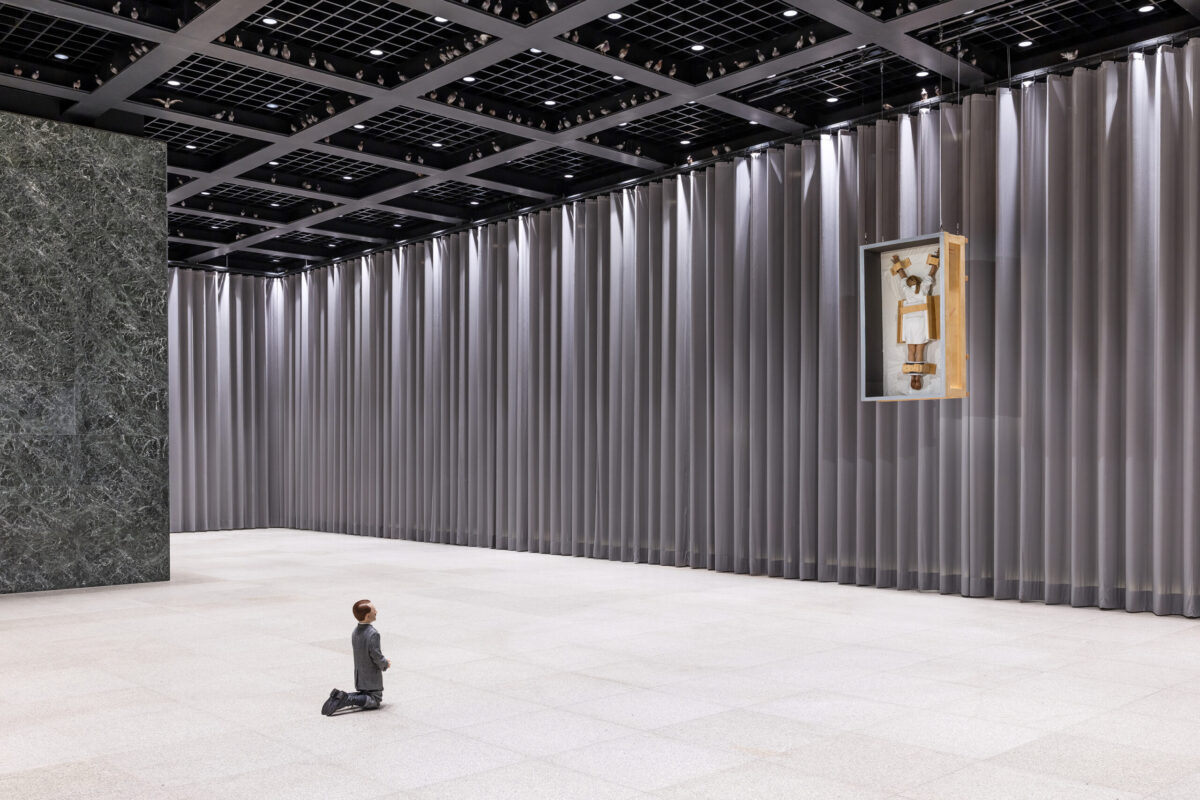
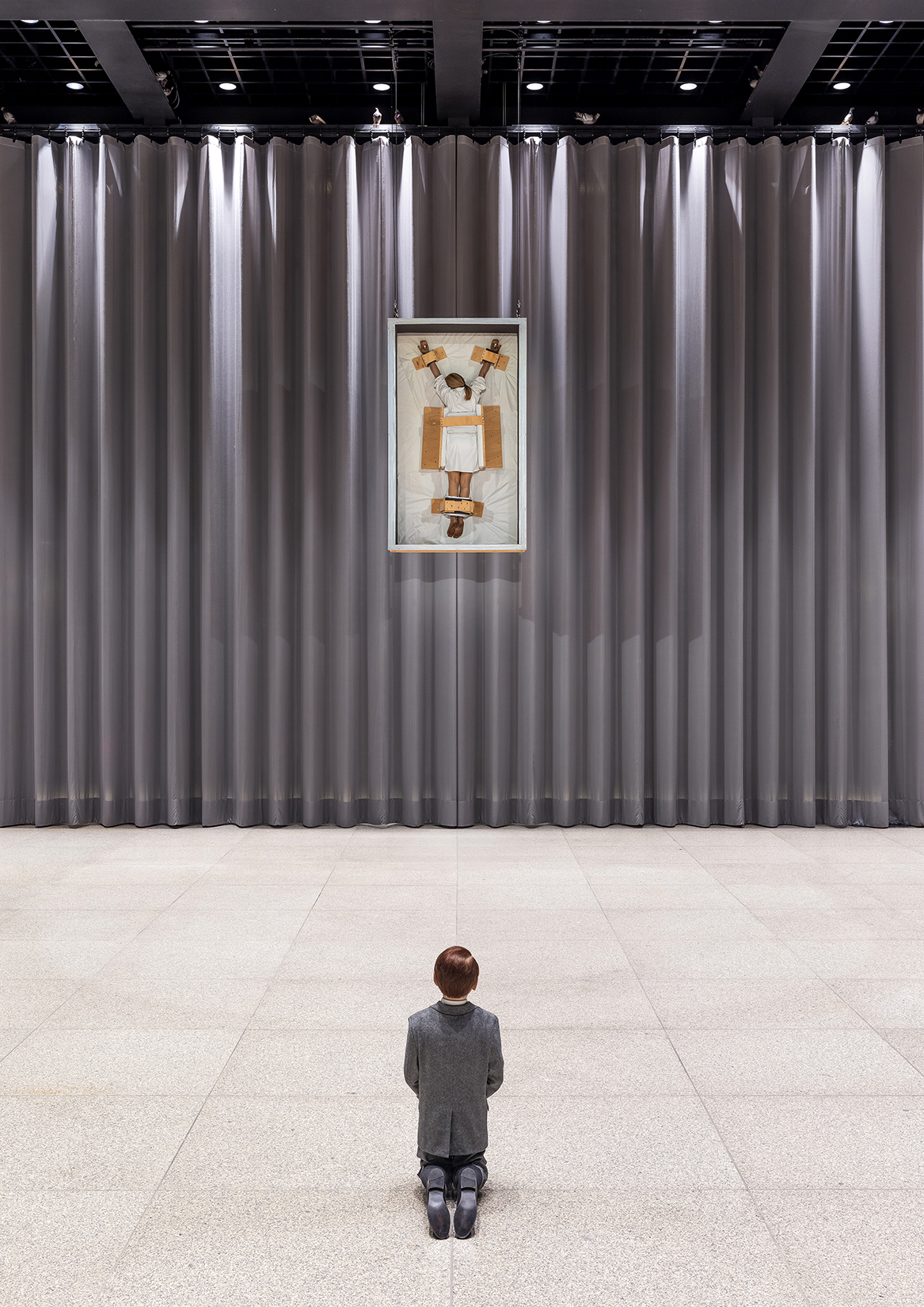
The positioning of Him (2001) relies on the visitor approaching from behind. From that distance, the figure’s size and the way it kneels suggest a child at prayer. To see its face, you have to walk a few steps past it and turn round. Then you recognise Adolf Hitler. The difficult moment comes just afterwards, when you remember how readily you read innocence into that posture only seconds earlier.
In Berlin, the curators point to another echo of the gesture. In 1970, the German Chancellor Willy Brandt knelt before the Monument to the Ghetto Heroes in Warsaw. The memory of that act of homage makes the question raised by Himparticularly uncomfortable. How much of a gesture’s meaning lies in the posture itself, and how much depends on who makes it, where and before whom?
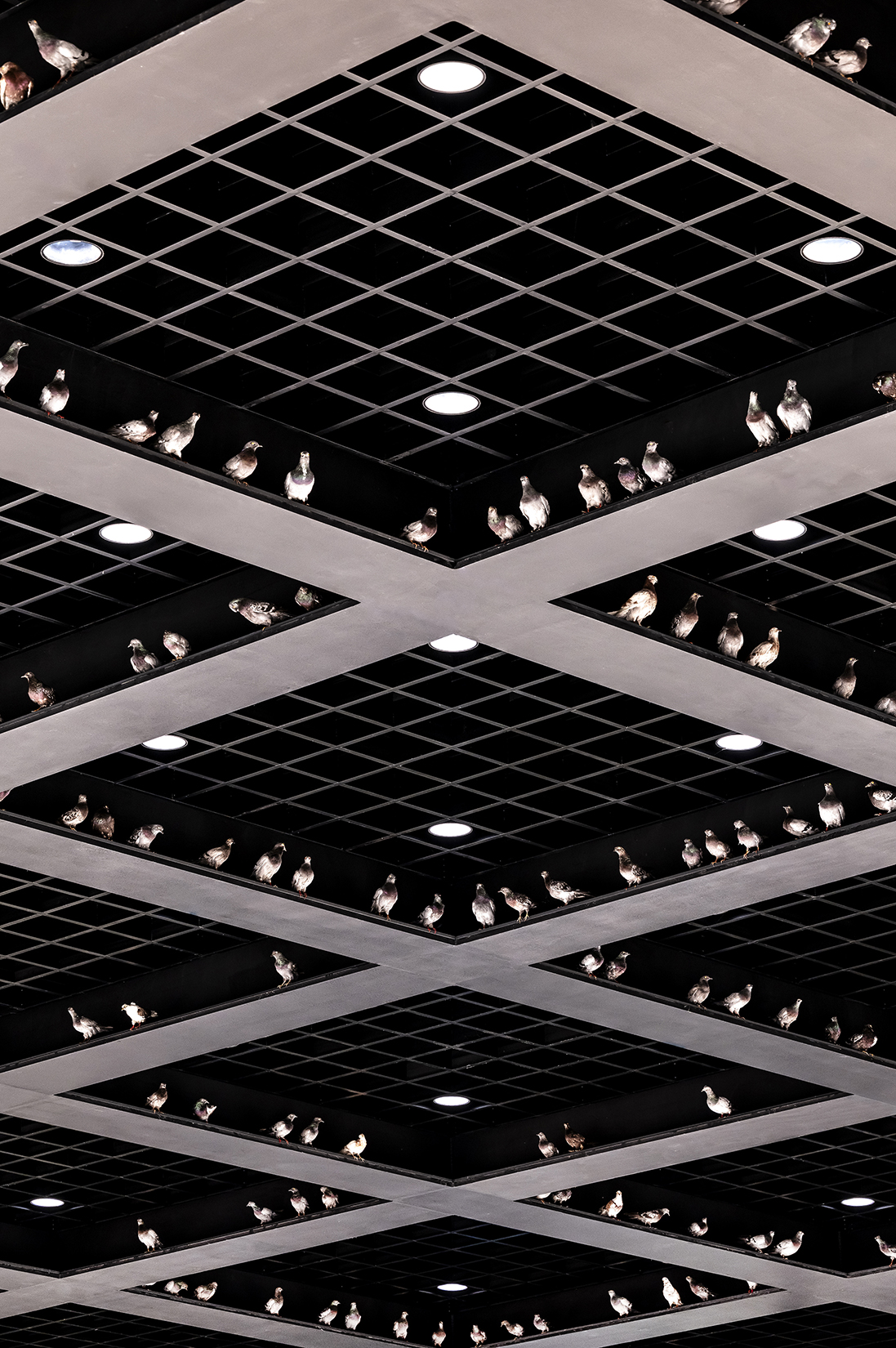
On the same axis, Dawn (2007) shows a female figure suspended inside a transport crate, her arms outstretched in the shape of a cross. Higher still, thousands of taxidermied pigeons perch on the roof beams. Cattelan first brought pigeons to the Venice Biennale in 1997 and revisits that intervention in People (2026).
After spending so long looking at other figures, you need only glance up to feel the strangeness of being watched by an audience far larger than the one walking through the hall.
The weight of a marble eagle
At floor level, All (2007) brings together nine life-size bodies. Each lies beneath a shroud through which you can make out the shape of the figure. Up close, you see that every fold of cloth, like the body beneath it, has been carved from Carrara marble. A material so often entrusted with preserving a face is used here to keep nine identities out of sight.
In Bones (2025), by contrast, the animal is instantly recognisable. A monumental eagle carved from Statuario marble lies fallen on the ground. It is hard to think of another emblem of power that depends quite so much on our picturing it in flight.
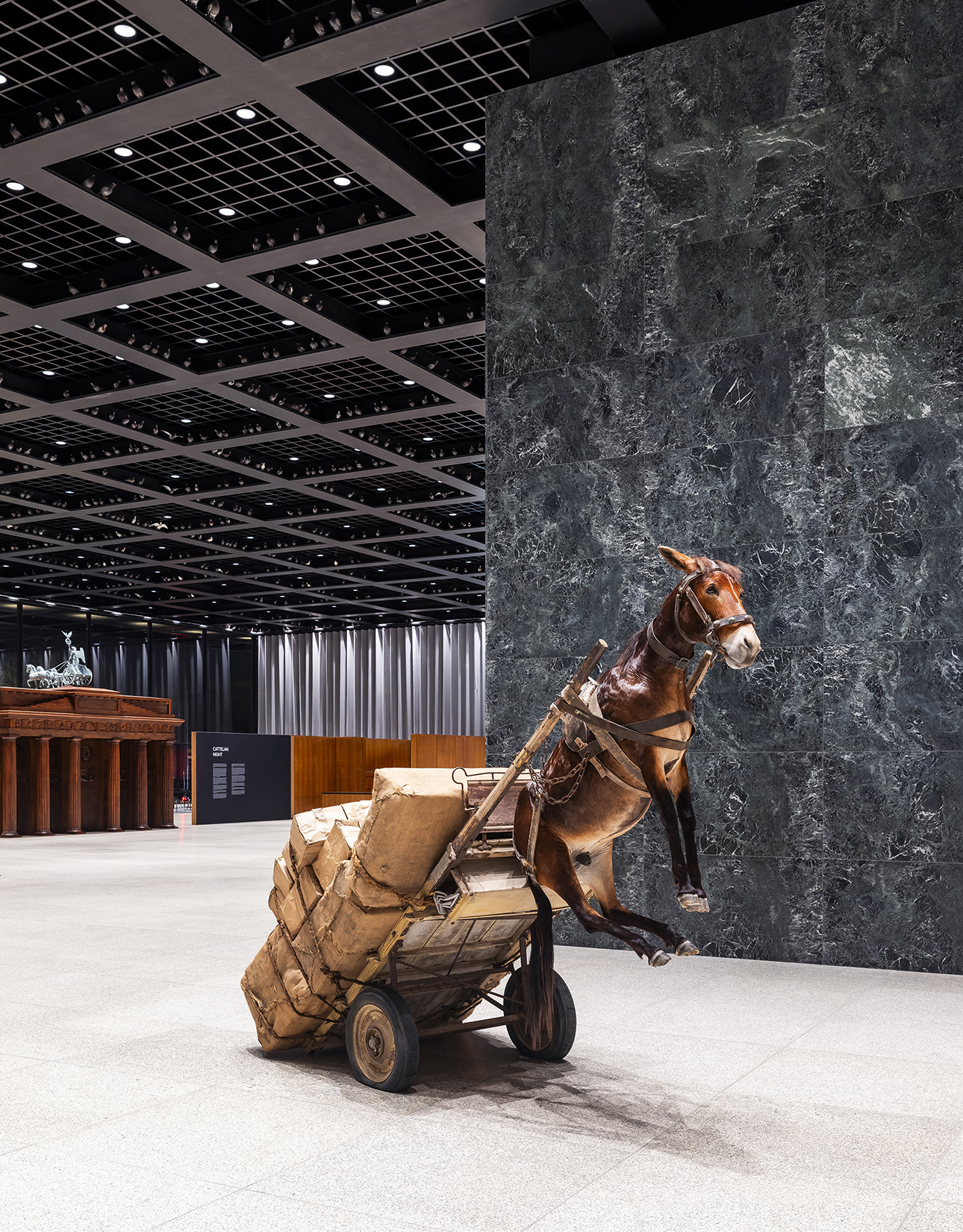
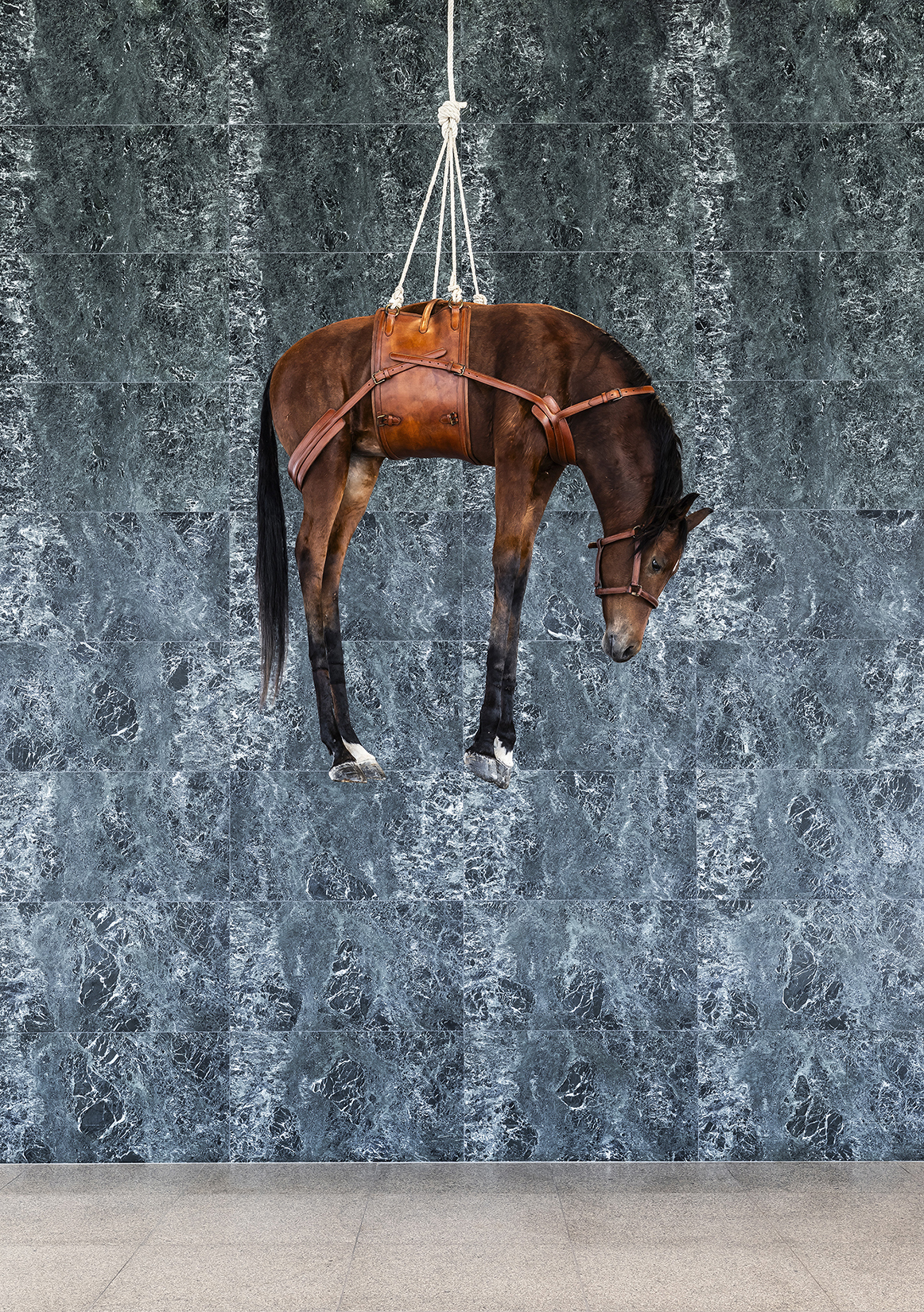
Beside the eagle, it is particularly telling to think of Novecento (1997), the taxidermied horse that Cattelan keeps suspended in mid-air. He has taken flight from the bird and the ground from beneath the horse’s hooves. The donkey in Pentecost (2002), harnessed to an overloaded cart, also seems to have reached the limit of its strength. These animals lend the exhibition a palpable sense of exhaustion, one you can feel even if you have never thought of Novecento as an allegory for a century worn out.
Cattelan in the cloakroom
The artist himself makes an appearance in one of Mies van der Rohe’s cloakrooms. A miniature Cattelan, dressed in a felt suit by Joseph Beuys, hangs from a coat rack. The work is called La Rivoluzione Siamo Noi (2000), ‘We are the revolution’, quite a declaration from someone who could do with a hand getting down.
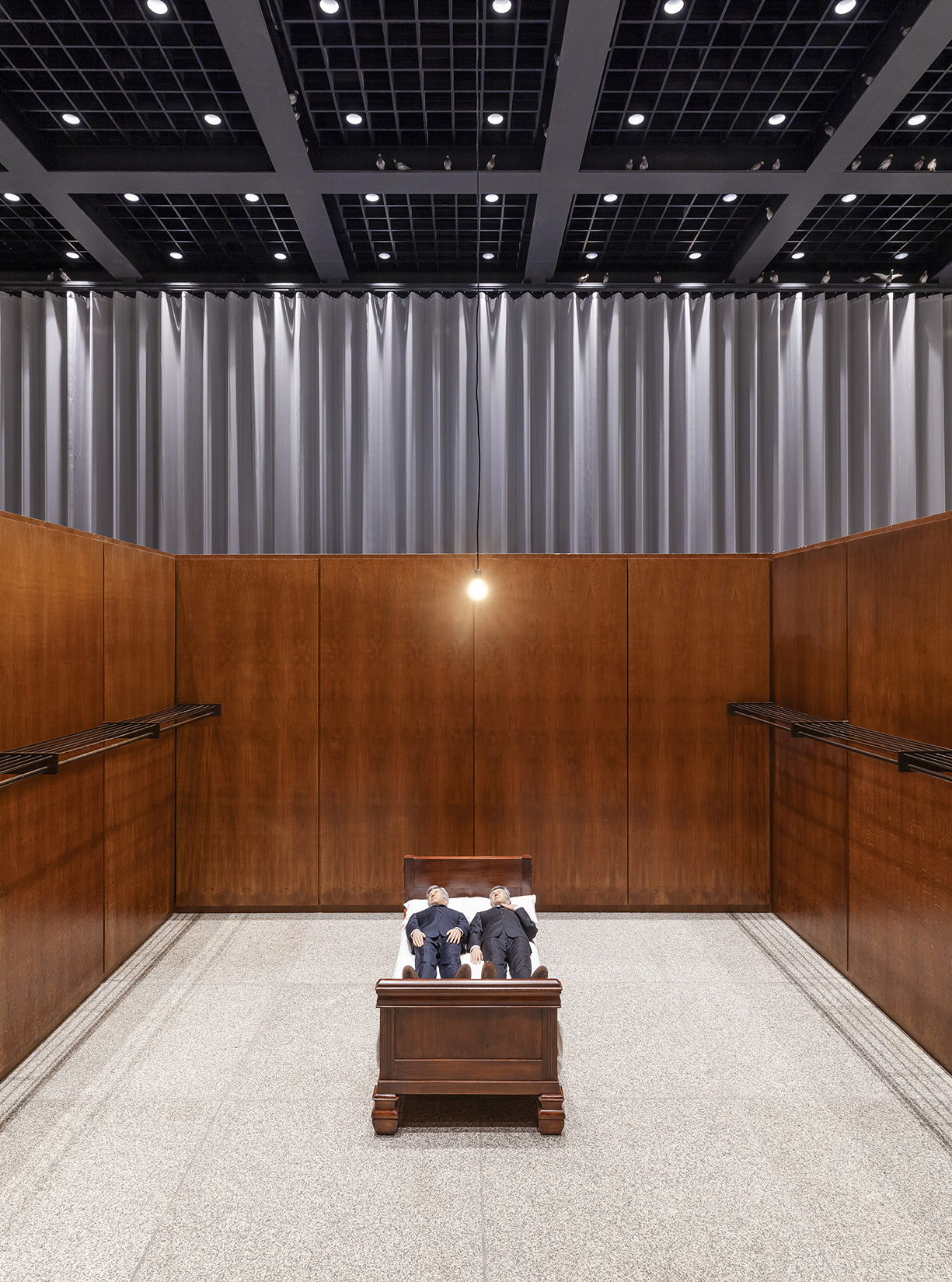
Ten years later, in We (2010), Cattelan portrays himself again, this time in duplicate. The two figures lie side by side on the same bed. Anyone looking for the artist among the figures in this church will find him playing a rather less solemn role than the one the architecture has claimed for itself.
Towards the end, two new works offer very different ways of sensing an absence. In After (2026), a six-metre iron pipe is struck like a bell, with a sleeping dog at its centre. Dust (2026) calls for a different kind of closeness. At first glance, it is a fire extinguisher. Knowing that it holds the ashes of a friend of Cattelan’s, and that the work was made in accordance with his friend’s wishes, changes how long you might want to stand before it. In an exhibition you can hear from the street, one of the most intimate works needs little more than an object and that one detail of a life.
On the way out, the iron cover on the terrace is still in the same spot. You can now pick out Dust among the other titles and consider the distance between reading the word ‘dust’ and knowing the story of that fire extinguisher. Perhaps it is here, in broad daylight and already outside the museum, that the exhibition’s title makes most sense. For Cattelan, what night brings is a loss of certainty. In Berlin, all it takes to experience that is to retrace your steps.
Visiting NIGHT in Berlin
NIGHT is on view until 7 March 2027 at the Neue Nationalgalerie, Potsdamer Straße 50. The museum is open Tuesday to Sunday from 10am to 6pm, with late opening on Thursdays until 8pm.
(*) Photographs courtesy of the Neue Nationalgalerie. Photos by David von Becker and Ivan Erofeev.