Marjane Satrapi and the art of breaking down prejudice
By Cecilia Camacho, Founder of CC/magazine and Strategic Consultant at CC/studio
I first discovered Marjane Satrapi — recipient of the Princess of Asturias Award for Communication and Humanities — more than fifteen years ago thanks to the Iranian partner of a colleague. I remember him recommending that we read Persepolis and watch the film with unusual conviction.
He wasn’t speaking simply about an outstanding graphic novel or an award-winning cinematic adaptation. He was talking about a work that was essential for understanding a reality many of us observed from a distance and, to a large extent, through a lens of limited knowledge. He was right.
When I finished reading Persepolis, I realised that Satrapi had achieved something extraordinary. Her story was deeply personal, yet it never confined itself to autobiography. Through memories of her childhood, the contradictions within her family and her experiences between Iran and Europe, she managed to illuminate far broader themes relating to freedom, identity, exile, memory and the way political events shape everyday lives.
“You cannot judge an entire nation by the actions of a few extremists.” Marjane Satrapi
For years, much of the image that the West constructed of Iran was shaped by headlines, geopolitical conflicts and oversimplifications that left little room for human complexity.
Persepolis opened a different window. Satrapi wasn’t trying to justify or condemn an entire country; she simply showed how a child, a teenager and later a woman attempted to find her place within a reality that was constantly shifting and, at many moments, profoundly hostile.
That ability to bring readers closer to unfamiliar experiences without resorting to victimhood or grandiose rhetoric remains one of Marjane Satrapi’s greatest strengths. Her work never sought to impose a singular vision of the world. Instead, it offered something far more valuable: the possibility of understanding the experiences of others more deeply.
Over the years, I read everything she published. I was always struck by the clarity with which she approached complex issues and by the honesty with which she revealed her own contradictions.
Political criticism, humour, irony and profound humanity coexist throughout her books. This combination goes a long way towards explaining why her work resonated with readers from such diverse cultures, generations and perspectives.
“Perhaps before educating our children to achieve economic and social success, we should teach them that true success lies first and foremost in humanism.” Marjane Satrapi
The news of her passing at the age of 56, which emerged last week, has caused deep sadness among those of us who admired her work. According to her family, she died following the loss of Mattias Ripa, the great love of her life. Beyond the personal circumstances, her death invites us to revisit an artistic legacy whose impact cannot be measured solely through awards, sales figures or institutional recognition.
Persepolis permanently transformed the way many people viewed the graphic novel. It demonstrated that comics could engage with historical, social and political issues with the same depth and sophistication as literature or cinema. It also confirmed that the most universal stories are often born from highly specific experiences.
Satrapi didn’t write to represent an entire nation or to become the spokesperson for a generation. She wrote from her own lived experience, and it was precisely for that reason that millions of readers found something of themselves within her pages.
“If someone hurts you, think that it is because they are foolish. It will help you avoid responding to their cruelty. Because there is nothing worse than bitterness and revenge. Always preserve your dignity and remain true to yourself.” Marjane Satrapi
At a historical moment marked by polarisation and an increasing tendency to reduce complex realities to irreconcilable positions, Marjane Satrapi’s work remains extraordinarily relevant. Her books remind us that behind every conflict are individual human beings, that identity is rarely straightforward, and that freedom can be lost gradually if we stop paying attention to it.
Rather than offering answers and certainties, Satrapi provided context and nuance. In an era where extreme positions often dominate public discourse, that ability to observe the world through complexity represents a form of courage that is both rare and deeply necessary.
This is precisely why her work remains so important. Not only because it allowed millions of readers to engage with a reality they may not have previously understood, but because it championed a way of looking at the world based on curiosity, empathy and the willingness to challenge one’s own prejudices.
That was perhaps one of Marjane Satrapi’s greatest contributions: reminding us that art can build bridges where politics, ideology and geography erect borders.
“Fear is what turns us into prisoners. Courage is what keeps us free.” Marjane Satrapi
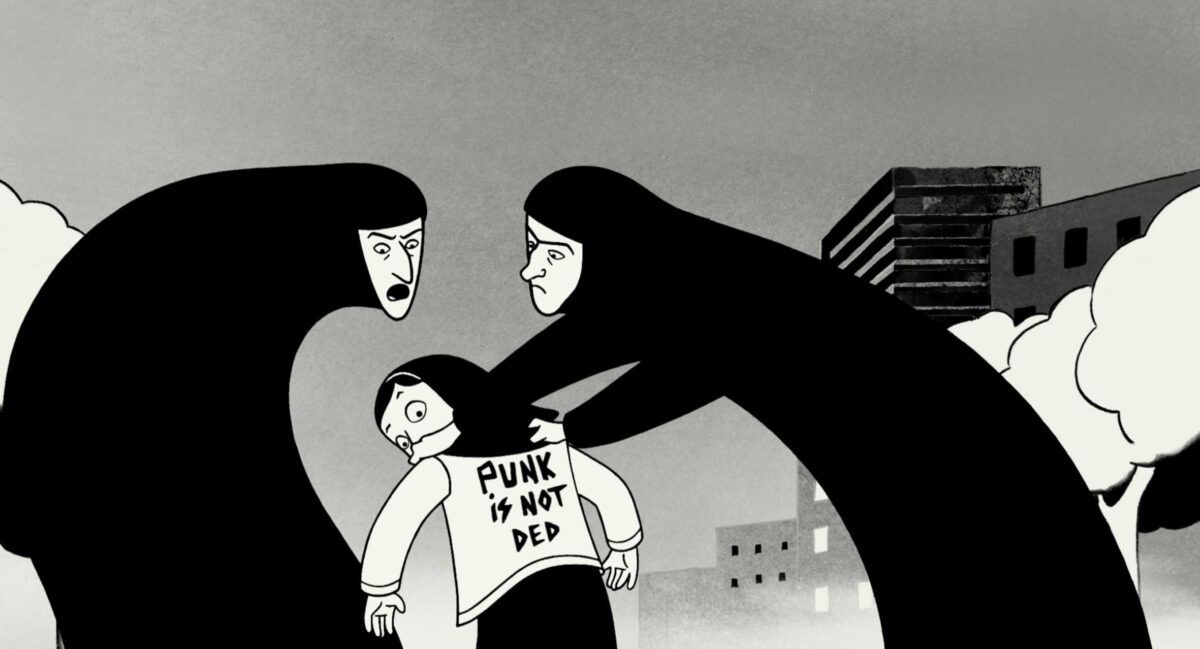
(*) Cover image taken from the film Persepolis.