“The Chimaera”: the new and brilliant film of Alice Rohrwacher
“The Chimaera” is director Alice Rohrwacher‘s fourth fiction film, which has been shot in various analog formats (35mm, 16mm, and Super 16) and stands out for its unmistakable visual style, marked by beautiful landscapes and evocative photography thanks to the talented Hélène Louvart, with whom she has created a raw and earthly yet dreamlike, beautiful, and magical atmosphere.
Through it, she immerses us in a surrealist story where viewers are transported to a universe where the boundaries between reality and imagination blur, and where the adventures and misadventures of a group of “tombarolis”, aka tomb raiders, led by Josh O’Connor, make us reflect on the loss of cultural rationalization and devaluation of mysticism present in modern society, as well as the plundering of profaned Italy and the ravages of wild capitalism.
“We all have a chimaera, something we wish to do, to have, but that we never find.”
The plot
Arthur (superbly played by Josh O’Connor) is a young English archaeologist who, in the 1980s, leads a band of rogues surviving by plundering Etruscan tombs and archaeological sites with the aim of becoming immensely rich by auctioning off those pieces again. However, unlike the rest of the group, Arthur‘s interest in these relics responds to other questions since, in addition to admiring them and feeling fascinated by them, he possesses the extraordinary ability of the diviners, who are people attributed with the faculty to discover what is hidden, even if in this case it is ancestral fortunes.
After spending some time in prison, he returns to a small town in the Tuscan countryside, where his henchmen reside and the family of Benjamina, his beloved deceased, whom he cannot forget. Although at first, he wants nothing to do with past matters related to looting, he quickly returns to the fold and to his obsession with discovering treasures and ancient objects.
The boundaries between the living and the dead
Since childhood, we have all been told repeatedly that it is forbidden to cross the boundary that separates the living from the dead. Primarily out of respect, but also out of superstition, fearing that the afterlife may somehow curse us.
However, this Italian “Indiana Jones”, who also lives tormented, turns a deaf ear to these imprecations and persists in his desire to reunite with the woman he lost.
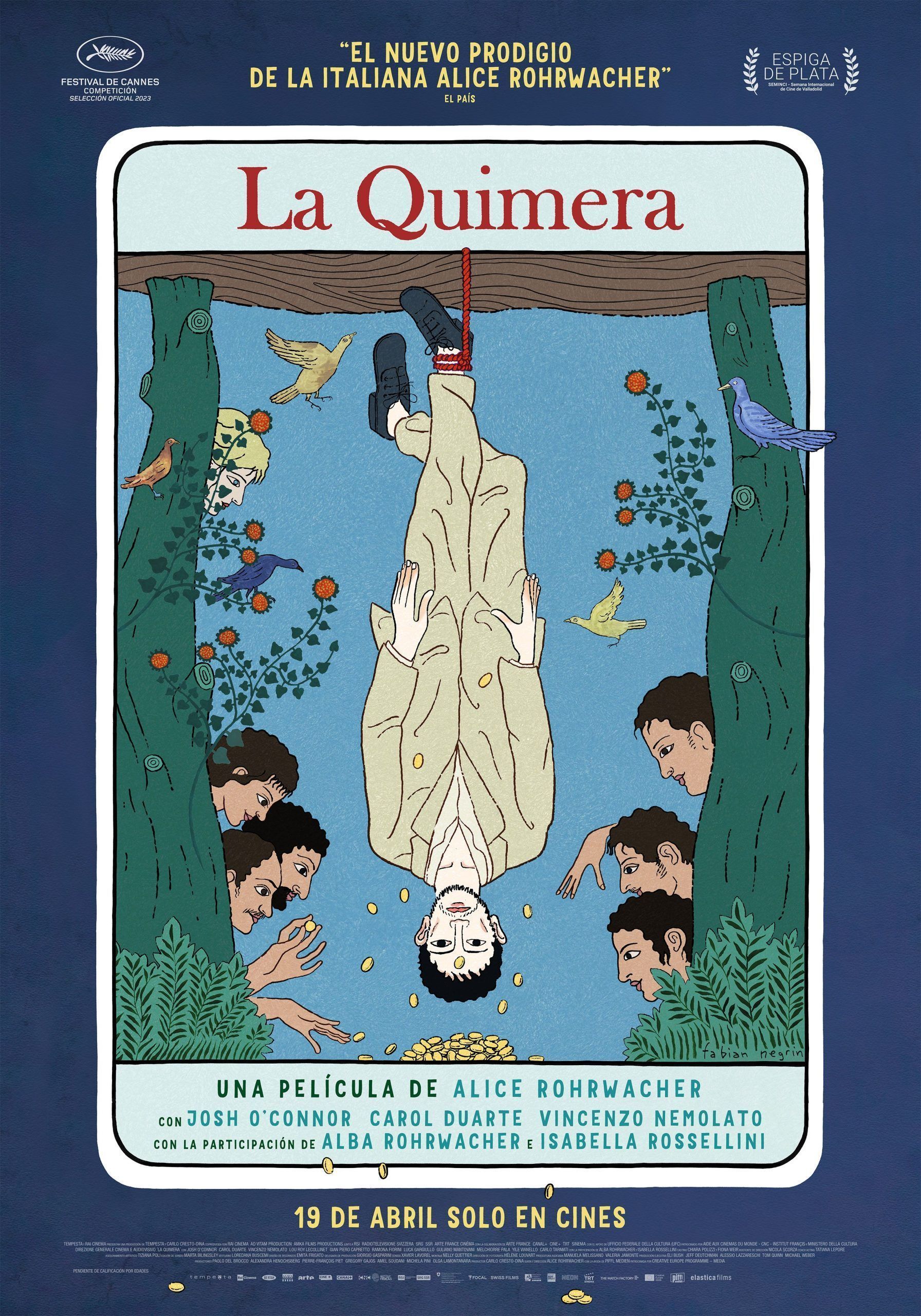
In relation to this, the poster aptly depicts its protagonist portraying the “Hanged Man” tarot card, while observing the world in a sort of limbo. And it is precisely this sensation of a non-place with which Rohrwacher plays in the film.
Reality surpasses fiction
Despite being a work of fiction, this story is based on a reality that the director herself experienced in her childhood.
In fact, she has confessed that these tomb raiders lived in the village and often went to the bar, discussing the findings they had unearthed the night before. She remembers being frightened by the knowledge that they were stealing from the dead, but despite that fear, her need to understand why led her to establish a relationship with them to comprehend why they were capable of usurping something so sacred.
And as reality often surpasses fiction, we must remember that the illegal trafficking of artworks and archaeological antiquities grew so much from the 1980s onwards that it moved more money in the world than drugs…
Feminism and patriarchy
Another interesting aspect of the film is that it questions the sense of ownership, both of heritage and of the world in general. Hence, through an abandoned train station, it makes us reflect on this, on capitalism in museums, and on patriarchy. Because as she herself attests, patriarchy is not a natural condition of human beings, but rather a historical decision.
“We take many things for granted that are not natural but have been a historical decision. Fascism is a consequence of sexism.”
In this case, this place that seems to belong to no one is converted into a commune of women, where they help and protect each other. And it is these women who, through Italia, Isabella Rossellini’s assistant who portrays an aristocratic matriarch of five daughters, evoke this great truth:
“Life is temporary.”
Curiosities about the Etruscans
Beyond their beliefs in the afterlife, the Etruscans created a fairly serene civilization, where men and women lived in equality. Therefore, Melodie, one of the characters in the film, breaks the fourth wall and asserts at one point in the movie that if the Etruscans had survived, sexism would not exist.
On the other hand, regarding their tombs, the truth is that these were showcases of their wealth and refined artistic tastes, as has been discovered through tombs such as those of Caere and Tarquinia. These tombs, perfectly preserved, contained extensive funerary goods and splendid frescoes. After conducting various studies, they concluded that the Etruscans loved luxury and beautiful objects and placed great importance on the afterlife and religious and funerary rituals.
An exceptional cast of actors
From Josh O’Connor to Isabella Rossellini, they all deliver exceptional performances. And to this must be added the chemistry between O’Connor (Arthur) and Carol Duarte (Italia).
In conclusion, “The Chimaera” is a unique and fascinating film, and although at times it is uneven, it is very inspiring and brilliant. Highly recommended.
Check movie listings.