Berlin Design Week 2025: design as a compass in times of change
From 15 to 18 May, the German capital becomes the epicentre of creative thinking with an edition that reclaims common sense as a driving force for innovation. As official media partners, CC/magazine is here to tell you why this is a must-attend event.
Where design meets the now
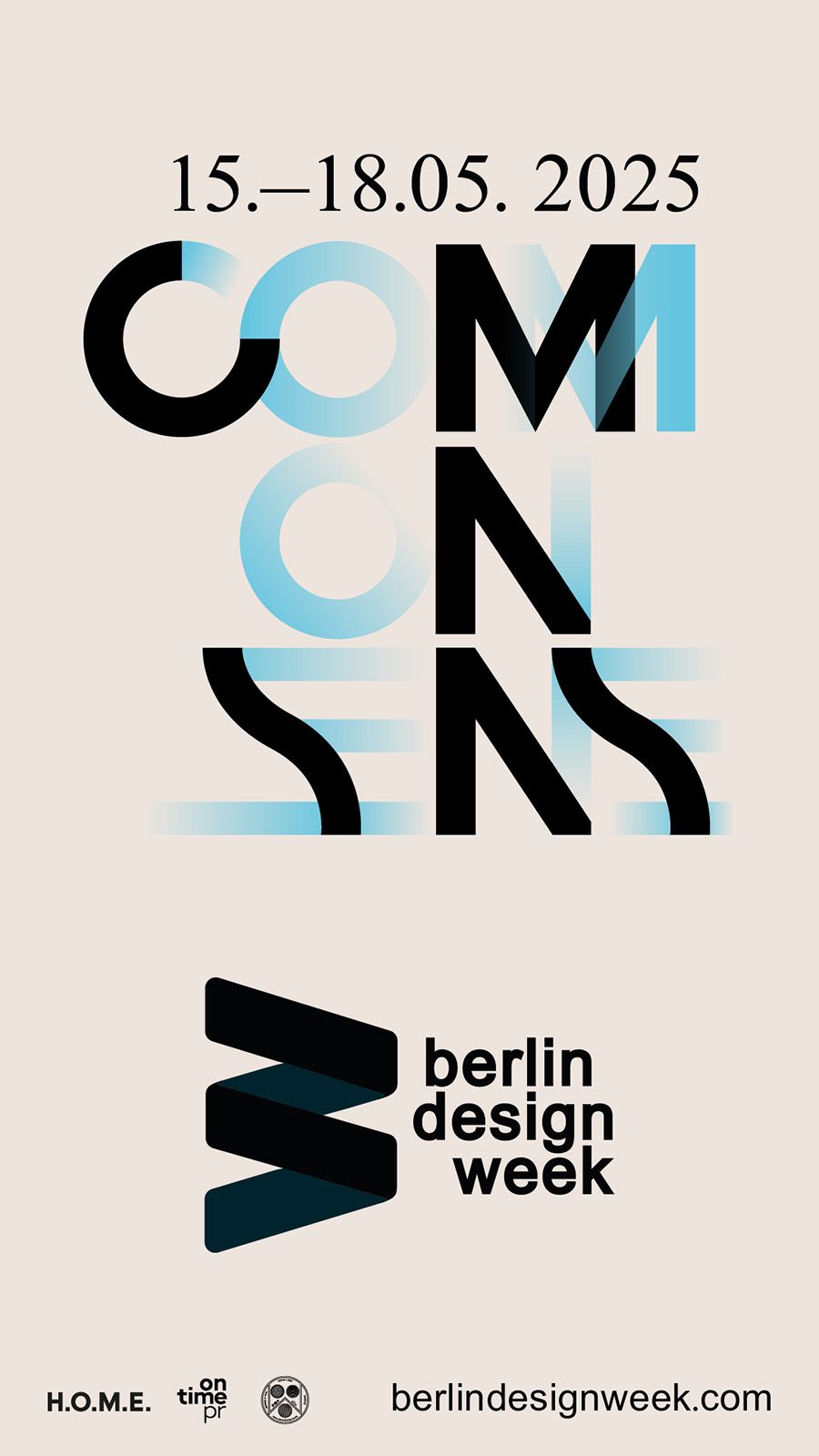
In a world shaped by technological transformation, climate crises and new ways of living, Berlin Design Week 2025 proposes a simple yet powerful idea: to bring back COMMON SENSE as a tool to design the future.
Over the course of four days — from 15 to 18 May — Berlin opens its doors to design in all its forms. Emerging and established brands, architectural studios, designers, cultural agents, universities, museums and visionaries will gather to share ideas, processes and solutions driven by applied creativity.
COMMON SENSE: A motto with purpose
This year’s motto is no coincidence. In an increasingly polarised world, COMMON SENSE focuses on what unites us: the need to create solutions that work for everyone — sustainable, accessible and deeply human.
BDW 2025 doesn’t just celebrate the shape of design, but its transformative potential. It reminds us that designing is also an act of care — for people, the planet and the ideas we put out into the world.
A city in creative motion
Berlin Design Week is much more than a fair. It is an urban, collective experience that turns the city into a living network of showrooms, pop-ups, installations, workshops, panel talks and sensory experiences, spread across multiple creative districts.
Every space, every event, is an invitation to reflect on the present and future of design: How can we inhabit more consciously? What role does technology play? What is the designer’s responsibility in today’s world?
The vibrant and diverse programme also includes contributions from leading cultural and academic institutions such as national museums and design schools, using the event as a platform to showcase emerging talent that is reimagining the way we live.
A global, connected community
More than 15,000 international visitors are expected this year — and it’s no surprise. BDW is a meeting point where designers, brands, researchers, entrepreneurs and curious minds come together to think differently, and to create accordingly.
With a digital reach exceeding 3 million people across social media and press, BDW is firmly established as one of Europe’s most influential design platforms, already paving the way for 2026, when Berlin celebrates its 20th anniversary as a UNESCO City of Design.
Why you shouldn’t miss BDW 2025?
This year’s theme is “COMMON SENSE” — a simple yet powerful idea. What inspired you to choose this concept, and how does it resonate with the current design landscape?
Design is a discipline that reacts quickly — not only to trends, but also to the societal mood, to shifts in knowledge, in tools, in materials, and in the way we collaborate. It observes, reflects, and responds. In that sense, design is a keen observer of its time.
We chose “Common Sense” because it felt timely — grounded and relevant. It’s a reminder that in the face of constant disruption and complexity, clarity and responsibility matter. It’s about making choices that don’t just look good, but make sense — socially, ecologically, and ethically. We believe in “Common Sense” as a design attitude: responsible, connecting instead of dividing, and always aiming for solutions that serve the many, not the few.
In a time of global uncertainty and fast-paced change, how do you see design acting as a form of reflection, resistance, or even healing?
Design can point out directions and suggest new paths. But ultimately, it’s up to us to walk them. Design cannot make the decision for us — it can inspire, provoke thought, and visualize alternatives. In that sense, design is a mirror and a map, but not the movement itself. Its strength lies in offering clarity where confusion reigns, and possibility where there is doubt.
“The strength of design lies in offering clarity where confusion reigns, and possibility where there is doubt.”
Berlin has long been a hub for experimentation and creative thinking. How does the city’s cultural and social fabric shape the identity of Berlin Design Week?
A design week is never a template you can apply to any city. Berlin Design Week is deeply rooted in its context — we create an authentic Berlin experience by not only involving international players, but also by actively engaging the local design scene.
The city itself becomes part of the program: through Berlin Design Nights, through countless studios and showrooms that open their doors, and through moments that allow people to experience not just design, but Berlin itself. That’s what makes it unique — raw, diverse, and real.
What are some of the key highlights or must-see experiences for this 2025 edition that you’re particularly excited about?
That’s a tough question — because the program is so rich and diverse! One definite highlight will be the Berlin Design Night, which brings the city to life in a very special way.
We’re also very excited about the talks happening at Fotografiska and at WPP Campus — those promise to spark some important conversations.
Exhibitions at venues like Amtsalon and Kalle Halle, as well as the many studio openings, showrooms, and the Design Pool, offer a wide spectrum of design experiences. It’s this mix that makes the Berlin Design Week so vibrant and layered.
How do you balance showcasing big names and emerging talent? And how important is that diversity of voices to the spirit of BDW?
On the one hand, we work with a variety of locations that each have their own focus — which means you can explore both established names and emerging voices in different contexts. For example, well-known international and national brands like Occhio, LAUFEN SPACE, SMEG, ENNE, Kaldewei, KPM, Lignet Roset, Roche Bobois, JASPER ARCHITECTS and others are part of this year’s edition.
But when it comes to diversity, it’s something that flows naturally from Berlin itself. The city is full of layers and directions, with radically free-minded designers and studios working across every imaginable field of design. That openness and mix isn’t something we have to construct artificially — it’s already there. And that’s what gives Berlin Design Week its unique spirit.
Berlin Design Week brings together everything from product design and architecture to fashion, tech and food. What role does cross-disciplinarity play in your curatorial vision?
Multidisciplinarity is essential for any innovation-oriented process — it helps us to step out of our own professional bubbles and gain new perspectives.
While fashion and food are not the main focus of Berlin Design Week, we see architecture, technology, and especially science as important counterparts to the design discourse. These fields expand the conversation, challenge designers to think more broadly, and foster collaborations that can lead to truly relevant and future-facing solutions.
“We see architecture, technology, and especially science as important counterparts to the design discourse.”
How is BDW addressing sustainability not just as a theme, but as a practice — in how the event is designed, produced and experienced?
We aim to integrate sustainability not just in content, but also in how Berlin Design Week is produced and experienced. Many of our exhibitions take place in locations that are already well equipped for design presentations — which means less material is needed for installations and staging.
Getting around the city is easy and low-impact: visitors can use public transport, bike, or even walk between venues. We also reuse our signage and branding materials from year to year, whenever possible. And we think twice — not just about how much material we use, but also what kind of material we use. It’s all about making thoughtful, responsible choices at every step of the process.
The event includes contributions from museums, universities and cultural institutions. How important is collaboration between education and the design industry in shaping the future?
Education has to adapt to the realities of the professional world — and at the same time, the industry must stay open to experimental, unconventional ideas coming from the next generation of designers. When we learn from each other, we avoid stagnation. That’s how we move forward — by creating space for dialogue, exchange, and mutual inspiration between academia and practice.
“We explore AI not just as a tool, but as a catalyst for rethinking design’s role in society.”
How is Berlin Design Week approaching the conversation around artificial intelligence — as a tool, a challenge, or a catalyst for rethinking the role of design in society?
We are featuring several AI-driven projects that address both the opportunities and challenges AI presents for design. For example, we have a prompt battle at wirdesign communication AG, which explores AI as a creative tool.
There’s also KI as Mediator, an experiment by Chantal Pisarzowski called Parallexe at Kalle Halle, and the exhibition Design Between Artificial Intelligence and Tradition at HTW Berlin. These projects allow us to explore AI not just as a tool, but as a catalyst for rethinking design’s role in society — challenging us to consider how we define creativity, authorship, and tradition in an increasingly digital world.
Berlin is set to celebrate its 20th anniversary as a UNESCO City of Design in 2026. How does this year’s edition pave the way for that milestone?
2025 marks a significant joint venture between Alexandra Klatt, the founder of Berlin Design Week and head of state of DESIGN, and two exceptional partners. Monika Dagree from on time pr will focus on strategic communication and content production, leveraging her 25+ years of experience to enhance BDW’s visibility and attract new audiences, including through her international agency network. Angelika Müller, renowned for her work at H.O.M.E., will lead the expansion into both the media and interior design sectors, creating innovative platforms and further elevating Berlin’s design scene with her extensive industry network.
Together, Alexandra, Monika, and Angelika are driving BDW forward, setting the stage for the city’s 20th anniversary as a UNESCO City of Design, alongside the wonderful partners of BDW, including program partners, sponsors, and collaborators.
For someone attending BDW for the first time, what’s the one feeling or message you’d love them to take home with them?
Mark Berlin Design Week in your calendar — this was just the beginning. It’s not just an event; it’s a movement, a glimpse into the future of design, and an invitation to be part of something bigger. The journey continues, and we hope to see you again next year!
See you in Berlin!
(*) Images provided by BDW.