Crystal Sauna: art to warm up in
In northern Sweden, Bigert & Bergström transform a lithium crystal into a public sauna and a former contaminated industrial site into a setting for reflecting on climate, technology and the contradictions of the green transition.
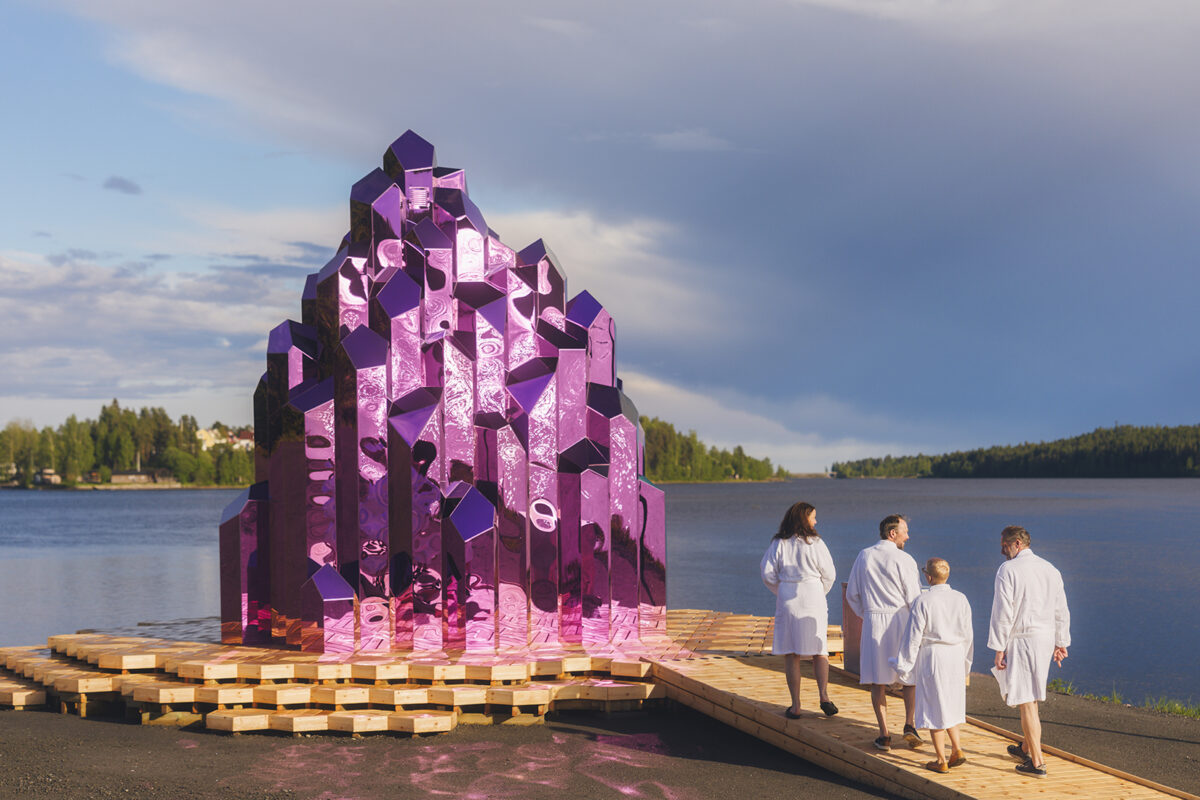
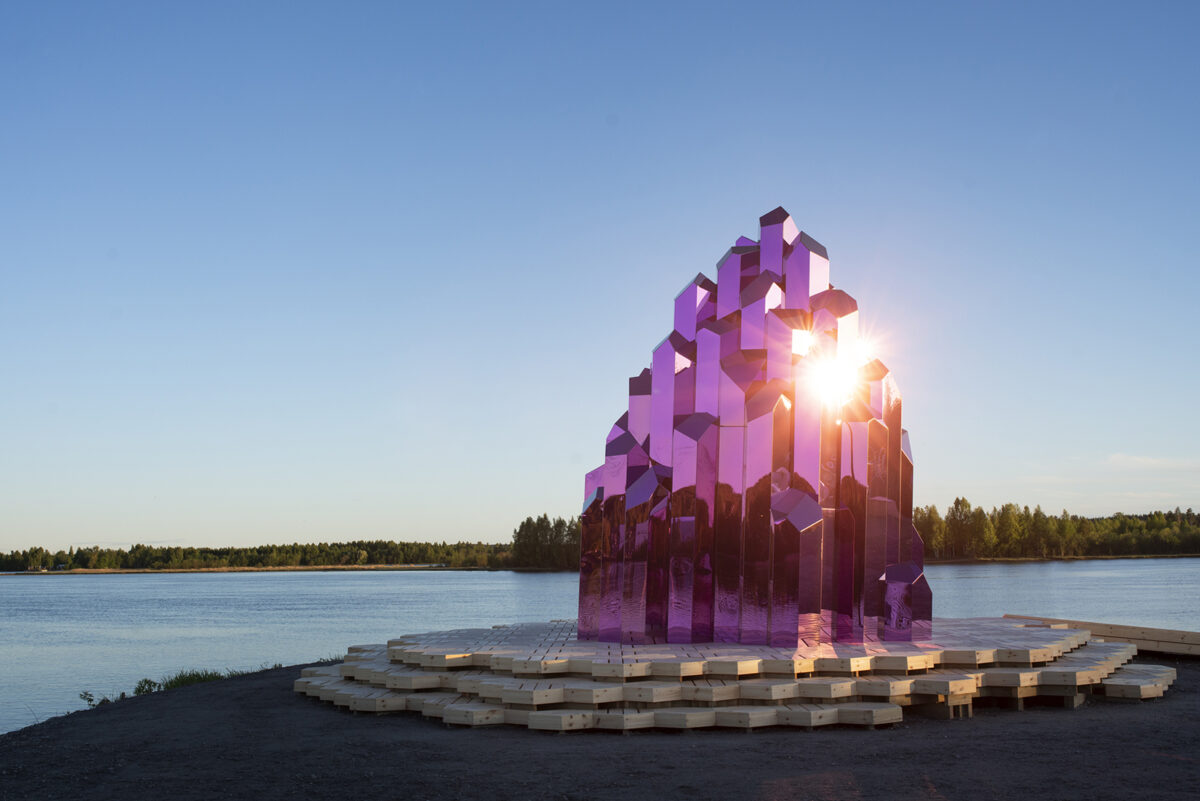
On the banks of the Skellefte River in northern Sweden, an enormous pink crystal now reflects the forest, the water and a landscape that, for much of the past century, carried a very different meaning. This was once the Scharin industrial site, one of the most contaminated areas in Västerbotten after decades of production and emissions associated with the pulp industry.
Seventeen years of remediation work have made it possible to reclaim the site and return it to public life with a new purpose. Since May 2026, the former industrial area has been home to WasteLand, a park where art, research, climate adaptation and urban development come together to explore how we might transform not only a damaged landscape, but also the way we imagine what can be done with it.
At its centre stands Crystal Sauna, a public sculpture by Bigert & Bergström that can be contemplated from the outside and experienced from within because, as well as being an artwork, it is a fully functioning sauna with capacity for between 12 and 15 people.
Its presence is difficult to ignore. A faceted, gleaming and deliberately strange volume rises from a wooden platform amid the regenerated vegetation. Behind its spectacular appearance, however, lies a story connecting mining, technology, ancestral rituals, the climate crisis and one of northern Europe’s most deeply rooted social traditions.
A lithium crystal beside the river
Mats Bigert and Lars Bergström have been working together since 1986, and much of their practice has explored our relationship with the climate and with those natural forces we attempt to understand, modify or control.
Crystal Sauna continues that investigation by taking as its reference one of the materials that best embodies the contradictions of the present: lithium.
Essential to the batteries powering much of today’s electrification, the mineral has become a central player in the energy transition, although its extraction also has a significant impact on the territories where it takes place. For the artists, this duality felt particularly appropriate in Skellefteå, a city closely associated in recent years with the development of the battery industry.
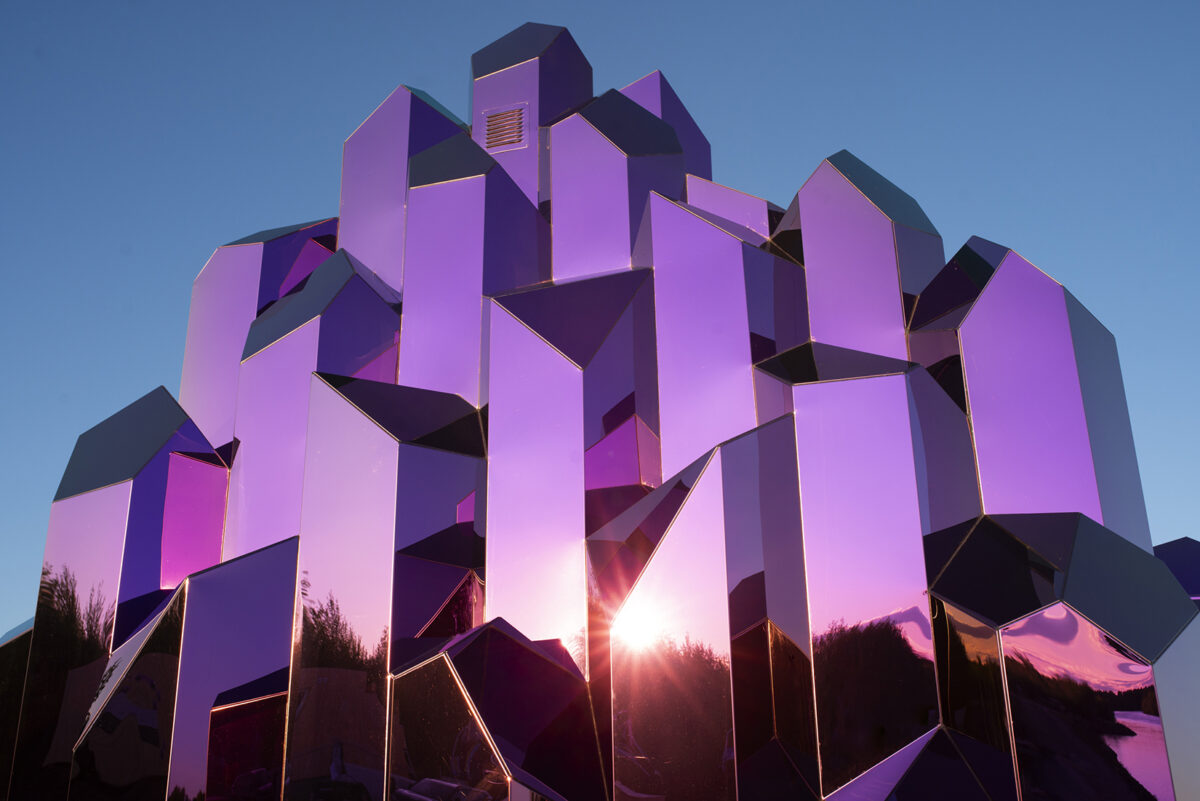
The sauna takes the form of a gigantic asymmetrical crystal constructed from hexagonal geometries. Its surface consists of approximately 280 prisms clad in pink mirror-finish stainless steel, the colour achieved through a titanium coating.
Crystal Sauna changes constantly. The river and trees fragment across the sculpture’s facets as visitors move around it, making the volume appear to absorb parts of the landscape and return them as reflections. The nature that has slowly re-emerged following the remediation process is literally inscribed onto the skin of the building.
The entire structure also leans backwards by four degrees, a decision that refers to the irregularity of natural rock formations and made its construction one of the most technically complex projects ever undertaken by Bigert & Bergström.
Building a rock with digital precision
The mineral appearance of Crystal Sauna conceals an extraordinarily precise manufacturing process.
The sculpture was developed digitally, and its more than 140 metal sheets — 58 upper sections and 86 side sections — were laser-cut before being assembled using more than 3,500 nuts and bolts. Every junction had to resolve a different set of angles so that the succession of prisms could form a continuous surface.
The entire process took around a year and a half from the initial sketches.
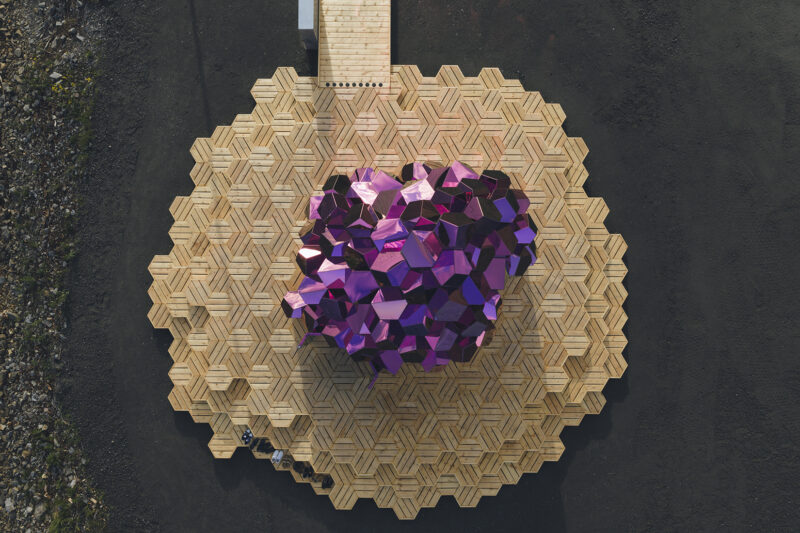
This technological sophistication meets a very different material in the platform beneath it: a hexagonal base made from locally sourced pine heartwood. The relationship between the two anticipates what happens on crossing the threshold, when the metallic, almost futuristic exterior gives way to a far more primal interior.
Entering a cave
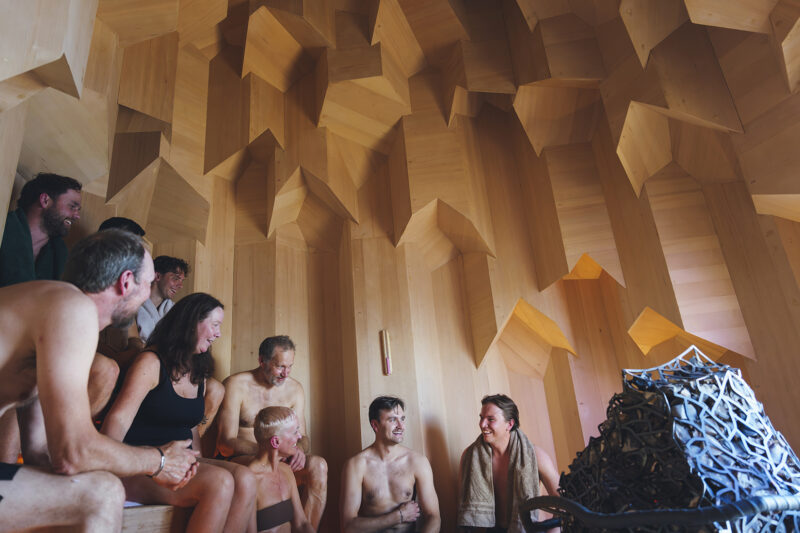
Bigert & Bergström conceived the interior as a wooden cave, and the contrast with the exterior is deliberately physical. Beyond the pink steel, reflections and sharp geometries, warm surfaces, timber and an enclosed space emerge, organised around the contemporary fire at the heart of every sauna: its stove.
The reference takes the work back to the earliest human shelters and to the moment when learning to control fire transformed the way we inhabited the world.
The interior walls are CNC-cut from thin, heat-resistant wood veneer over a certified spruce structure, while the floor is made from naturally resin-rich heartwood pine from northern Sweden. The timber is selected using X-ray technology to identify pieces capable of resisting moisture and decay without chemical treatments. The benches, meanwhile, are handcrafted from alder.
Technology therefore reappears where it is least visible. An interior conceived to evoke an ancestral experience also depends on contemporary tools, material research and digital fabrication.
A 700-kilogram stone
At the centre of the cave sits what is probably one of the project’s most distinctive elements.
The sauna stove is inspired by a chopper from the Oldowan culture of East Africa, a stone tool approximately 2.5 million years old and considered one of the earliest implements created by our ancestors.
Bigert & Bergström have transformed that early technology into the thermal heart of a contemporary infrastructure.
The piece is hand-forged, contains 260 kilograms of olivine and is clad in black flint sourced from the Normandy coast, a region historically associated with the production of stone tools. In total, it weighs around 700 kilograms.
Its primitive appearance conceals another innovation: Crystal Sauna incorporates a stove designed to run on batteries and capable of receiving energy both from independent storage systems and electric vehicles.
The Vehicle-to-Sauna project, developed together with Skellefteå Kraft, experiments precisely with the possibility of using the battery of an electric car to supply electricity to the sauna and other parts of WasteLand.
From a stone tool to an electric battery, millions of years of human technology converge around the same gesture: producing heat.
Feeling the temperature
The choice of a sauna is not incidental either. For Bigert & Bergström, temperature has been an artistic tool for decades. Their projects have approached climate change through installations, films, performances and experiments that seek to turn processes that are difficult to perceive into physical experiences.
Something particularly interesting happens in a sauna: heat ceases to be a number. The body experiences it directly and, moreover, does so in the company of other people. The Nordic sauna introduces a social dimension that transforms the work into a place of encounter, something the artists had already explored with Solar Egg, the golden egg-shaped sauna created in 2017 in connection with the transformation of Kiruna.
Crystal Sauna revisits that idea in a different context. Here, visitors voluntarily enter an environment of extreme heat while, outside, the conversation around rising global temperatures takes on ever greater urgency. And although the work does not attempt to turn a sauna session into a literal explanation of the climate crisis, its interest lies precisely in using an everyday, pleasurable experience to open up a space where body, perception and conversation can meet.
From WasteLand to a shared place
Crystal Sauna takes on its full meaning when understood as part of WasteLand, inaugurated on 28 May to coincide with Society Expo 2026.
The park’s name references The Waste Land, the poem published by T. S. Eliot in 1922, and revisits the idea of a devastated territory as a place where something new can also begin.
The park occupies the former Scharin site in Ursviken, around fifteen minutes from the centre of Skellefteå, where the river approaches the sea. Today, it is an open space dedicated to art, movement, sauna culture and dialogue around climate transformation.
Crystal Sauna shares the site with other interventions that broaden this conversation. Circle Walk, also by Bigert & Bergström, traces a 400-metre circular route through the vegetation designed for walking and conversation, while Broken Greenhouse disperses five large greenhouse structures throughout a forest labyrinth to give physical form, in collaboration with climate researchers, to five possible future scenarios.
They are joined by a viewing platform developed by master’s students from the Oslo School of Architecture and Designand First Came the Landscape, by Swedish artist Ingela Ihrman. The latter takes the form of a twelve-metre skeleton constructed from branches and roots, resting directly on ground marked by human exploitation and recalling that the landscape existed long before industry arrived.
WasteLand also incorporates spaces for playing, walking, gathering or simply spending time. Access is free and Crystal Sauna can be booked separately, allowing what began as an environmental remediation operation to function today as a new public place.
Building on the scars
There is something significant in the decision not to completely conceal the site’s industrial past. WasteLand uses that history as material for thinking about the future. The contamination is not reduced to a footnote preceding the park’s opening, but remains part of the narrative that explains why this place exists.
The form of Crystal Sauna, meanwhile, refers to the lithium powering the energy transition while recalling that mineral extraction also transforms landscapes. Its exterior requires highly precise digital fabrication, while its interior looks back to the first caves inhabited by humans. Its stove takes the form of a prehistoric tool and, at the same time, can receive electricity from a car battery.
Even the sauna ritual itself contains this tension. Entering means subjecting the body to extreme heat before stepping outside, cooling down and beginning again.
In Skellefteå, Bigert & Bergström have turned this cycle into a collective experience located on a site that is itself entering a new phase. The enormous pink crystal now reflects a forest growing back, a river continuing on its course and the traces of an industry that transformed the landscape for decades.
Crystal Sauna does not seek to erase any of these layers. It brings them together in one place and lets the heat do the rest.
(*) Crystal Sauna by Bigert & Bergström, WasteLand, Skellefteå. Photograpgy: Jonas Westling.