Who are we working for?
By Cecilia Camacho, Founder of CC/magazine and Strategic Consultant at CC/studio
I recently watched Salaryman (2021), the documentary directed by multidisciplinary artist Allegra Pacheco (1986, Costa Rica), and one question stayed with me long after the credits had rolled: at what point does work stop being part of life and begin to consume it entirely?
The film explores the figure of the salaryman, the Japanese office worker whose identity has, for decades, been closely tied to absolute devotion to the company. Men dressed in almost identical suits who fill Tokyo’s trains every morning and return home every evening with barely enough time left for anything other than sleep. Or, sometimes, not even that.
For many salarymen, the working day does not end when the computer is switched off. For decades, after-work drinking sessions with colleagues and senior managers — the well-known nomikai — have formed part of a corporate culture in which loyalty is demonstrated outside the office as much as within it. Although they are not a written obligation, in many companies they continue to function as an extension of the working day. Declining the boss’s invitation may be interpreted as a lack of commitment. Work continues; it simply changes location.
“At what point does work stop being part of life and begin to consume it entirely?”
That is why the documentary’s most striking images do not take place inside an office…
I am referring to the moments when the camera shows men asleep on benches, pavements, railway stations or slumped against walls, overcome by exhaustion after endless working days and those social gatherings that stretch the day well into the night. Some appear to have collapsed just a few metres from the station; others remain motionless, oblivious to the constant flow of a city that continues its rhythm without pause. These scenes have become such a familiar part of Tokyo’s urban landscape that they barely attract the attention of passers-by.
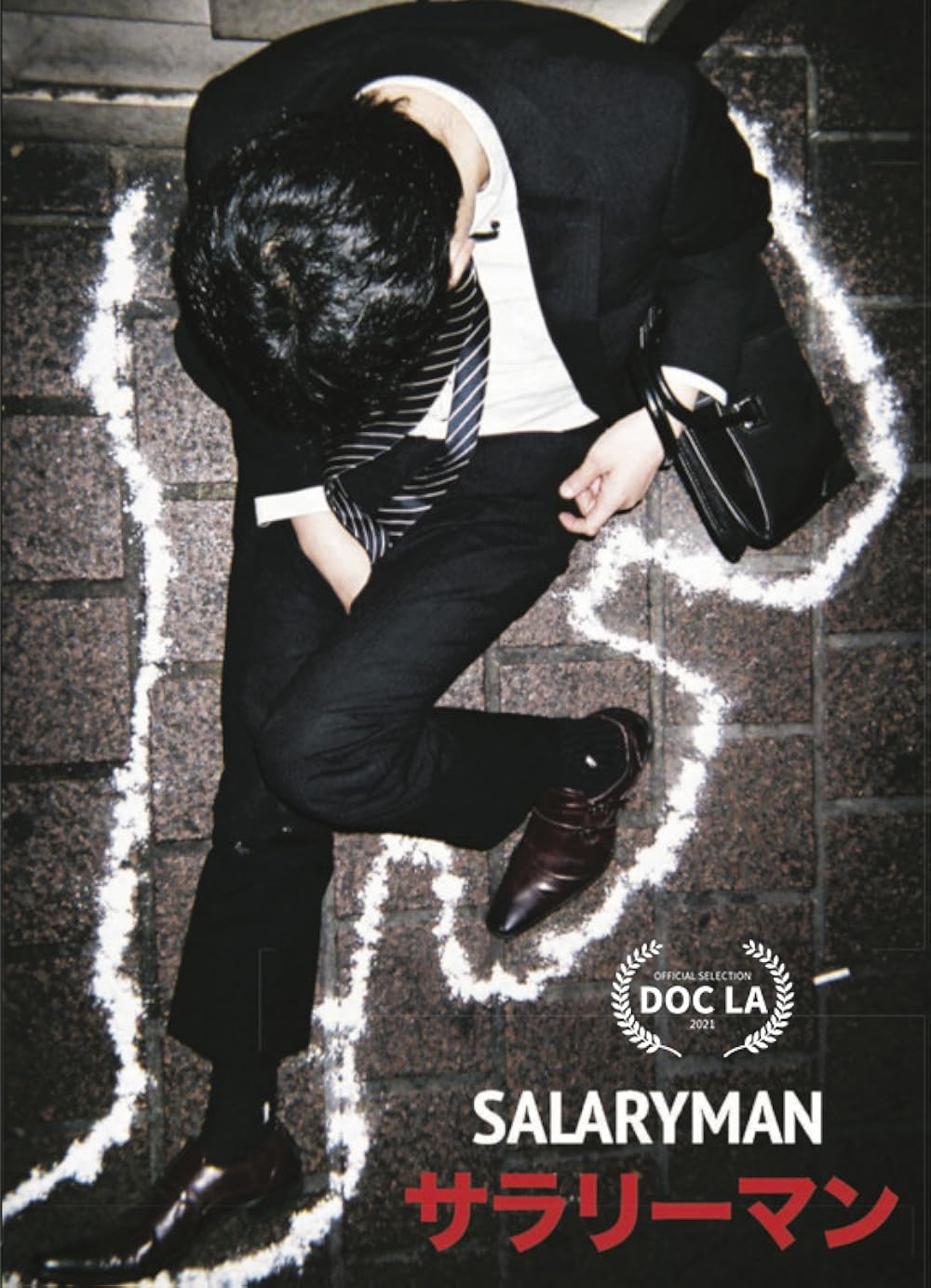
It is at this point that Allegra Pacheco intervenes. Using white chalk dust, she draws around these sleeping bodies the outline we instinctively associate with a crime scene. That single gesture completely transforms the image. What, only moments before, appeared to be an ordinary everyday scene suddenly takes on an entirely different meaning. The city continues moving, the men remain asleep, yet it becomes impossible not to wonder what we are really looking at.
With a visual proposal that is as poetic as it is unsettling, and a soundtrack composed by James Iha, member of The Smashing Pumpkins, Salaryman transcends the boundaries of documentary filmmaking to become a reflection on the place human beings occupy within the economic system. It is not solely about Japan, but about any society that begins to value productivity more than people.
For decades, the salaryman symbolised the success of what became known as Japan’s economic miracle. In exchange for near-total dedication, companies offered stability, promotion opportunities, benefits and, in many cases, employment for life. That relationship appeared exemplary until it no longer was. Every agreement ceases to be fair when it requires one of the parties to give up themselves.
The most extreme consequence of this model even has its own name: karoshi, the Japanese term used to describe death caused by overwork. It is not a symbolic expression but an officially recognised reality since the late 1980s, referring to deaths resulting from excessive working hours, extreme stress, heart attacks, strokes or suicides linked to workplace pressure.
It is deeply disturbing that a society should have needed to invent a word to describe dying from work.
Yet karoshi is not the true origin of the problem. It is merely its most dramatic consequence. The erosion begins much earlier, when professional success systematically demands sacrificing personal time, rest, family life or even the possibility of building a life beyond work.
It would be easy to assume this is an exclusively Japanese reality. Yet all it takes is a look around us to realise that the culture of constant availability no longer recognises borders.
We remain connected to work even when we are no longer working. We answer messages during dinner, check emails before going to bed and carry the office in our pockets. Technology promised to give us back time, yet all too often it has achieved precisely the opposite: it has found new ways for work to occupy it.
There is no need to work seventy hours a week for a profession to begin invading one’s life. All it takes is the constant feeling that we should always be doing something more. We have turned productivity into an almost moral virtue, while rest has become something we often feel compelled to justify.
The problem is not work itself. Work provides purpose, independence and can be an extraordinary source of personal fulfilment. The problem arises when it ceases to be one part of our identity and becomes the only one. The truth is that no person should ever be defined solely by what they produce.
In 2026, as artificial intelligence and automation promise to transform our relationship with employment profoundly, perhaps the most important conversation is not how much more we will be able to produce, but what kind of life we want to build with the help of these tools.
Because there is little point in automating tasks if the time we recover simply ends up being filled with even more work. Progress should not be measured solely by corporate efficiency, but also by people’s quality of life.
“True progress is not about producing more, but about building a society in which people can live better.”
Perhaps that is the greatest reflection Salaryman leaves us with. It is not simply a documentary about Japanese office workers, but an invitation to question a model that, in different forms, has spread across much of the world.
Societies are not defined solely by their economic growth, their capacity for innovation or their productivity figures. They are also defined by what they choose to protect.
And perhaps the time has come to remember that no company should ever require a person’s entire life in order to function. Because sooner or later, we should all ask ourselves the same question once again: who are we working for?
(*) Photo: Salaryman (2021), directed by Allegra Pacheco.