Belgrave road
By Cecilia Camacho, Founder of CC/magazine and Strategic Consultant at CC/studio
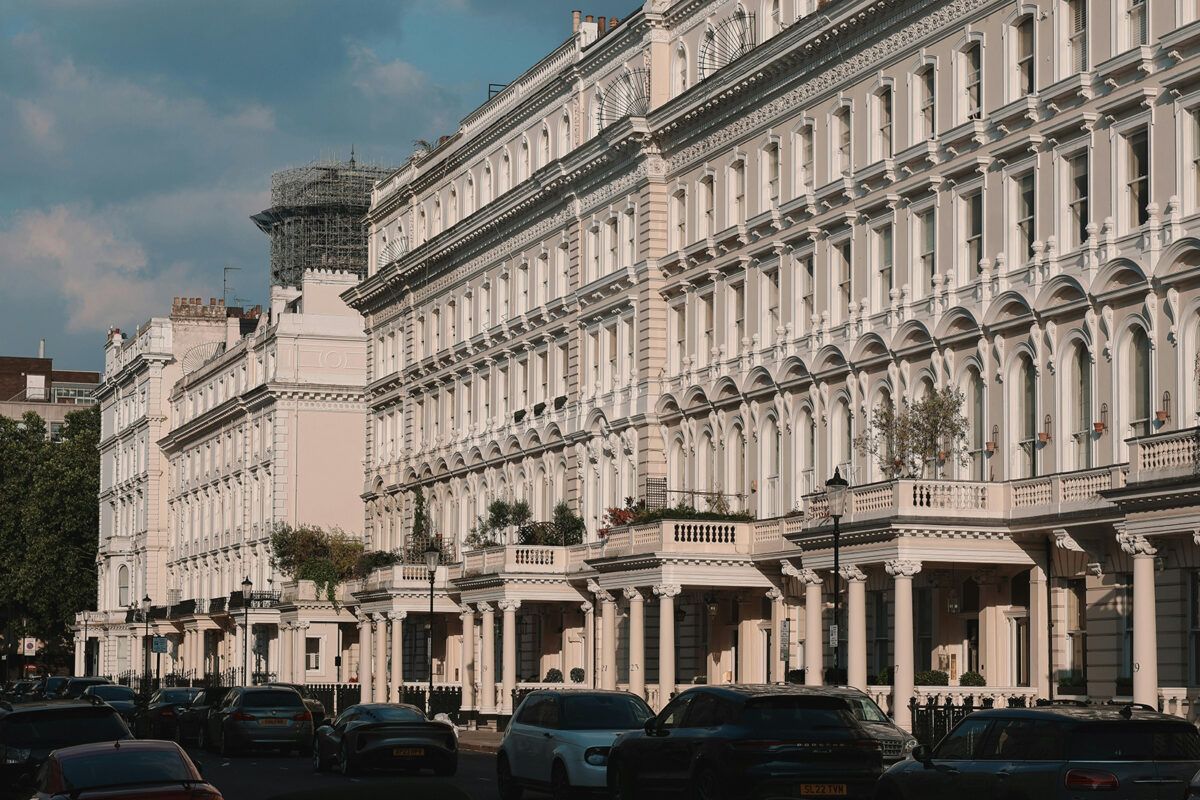
Arriving at Belgrave Road in London, one has the feeling that nothing is happening; it takes a few minutes to realise that, precisely because of that, something is. There is no obvious gesture that makes it memorable, no scene that demands attention, no detail that interrupts the continuity of those white façades that repeat themselves with an almost obstinate discipline, as if someone had decided that the city should be written in series and never revised. Everything seems correct, even pleasant, but as one moves forward, one begins to perceive that this harmony has something artificial about it, as if the street had been designed not to unsettle anyone and, in that attempt, had ended up deactivating any possibility of singularity.
That impression intensifies when one begins to read the names on the doorways and discovers that, behind that almost perfect uniformity, dozens of hotels are hidden, operating independently and, at the same time, identically, as if each were a minimal variation of the same model that has proven sufficiently effective not to require change. There is something unsettling in that repetition, not so much because of what it shows but because of what it avoids, because one cannot help wondering whether the difference is real or whether it is simply a strategy to simulate it, a way of multiplying options without altering the experience in the slightest.
History explains part of this paradox. These houses were conceived in the 19th century as residences intended for an affluent class that found in architectural regularity a form of stability and social recognition. Repetition was not then a symptom of anonymity, but a promise of belonging, a way of ensuring that everything remained in its place, that the city wouldn’t overflow or fall into disorder. However, over time, that same structure, originally designed to sustain everyday life, began to adapt to other needs, and what once accommodated extended routines gradually reorganised itself around brief, almost interchangeable stays, until the house ceased to be a home and became a room.
It is in this shift that the street acquires its current meaning, because it is no longer merely an accumulation of hotels, but the consolidation of a logic that turns space into something available, ready to be occupied and abandoned without consequence. Its proximity to Victoria Station and Buckingham Palace explains the profitability of this transformation, but does not fully describe its effects, which are less visible and therefore more revealing. What is lost is not only the residential function, but something harder to define: a certain human continuity that allows a street to be something more than a place of passage.
One cannot help wondering who lives there, or whether there is still anyone who can say they live there in a sense that is not provisional. Imagining a life on Belgrave Road implies accepting that neighbours change every day, that conversations are never repeated, that presences never fully consolidate because they are designed to disappear. There is something almost ghostly in this coexistence with people who are always on their way out, as if the street had replaced the idea of community with an endless succession of arrivals and departures that never quite meet.
And it is then that the question ceases to be urbanistic and becomes almost moral, because what is at stake isn’t only the use of a space, but the way we understand the city and, by extension, travel. For a long time, travelling was thought to imply exposure to the unknown, accepting a certain discomfort, allowing the place to alter, even slightly, the way one perceives oneself. However, streets such as Belgrave Road suggest that this model has been replaced by another, in which the priority is not discovery, but predictability; not transformation, but the continuity of what is already familiar to us.
In that sense, the hotel ceases to be a point of arrival and becomes a device that cushions the impact of its surroundings, a space that translates the city into a recognisable language so that nothing feels too out of place. One sleeps in London, but it could be anywhere; one crosses the street without the street ever quite happening. And perhaps the most unsettling thing is not that this occurs, but the naturalness with which we accept it, as if we had learned to value the absence of friction more than the possibility of being affected by something.
Belgrave Road doesn’t need to be exceptional to be significant, because in its apparent normality it concentrates a way of inhabiting and moving that is repeated in many other cities. It is not an anomaly, but a synthesis, a place where that process becomes visible—almost didactically—by which spaces cease to be built to be lived in and instead come to be designed to be used. One leaves with the feeling of having been in a place that functions perfectly and yet does not entirely exist, as if the city had decided to withdraw at the very moment we most expected to encounter it.