Punch and the need to be held
By Cecilia Camacho, Founder of CC/magazine and Strategic Consultant at CC/studio
There are images that stay with us not because they appeal merely to tenderness, but because they touch something more difficult to name. The image of Punch — a Japanese macaque born at Ichikawa Zoo and rejected by his mother within days — belongs to that rare category of scenes that appear small and yet open up far-reaching questions.
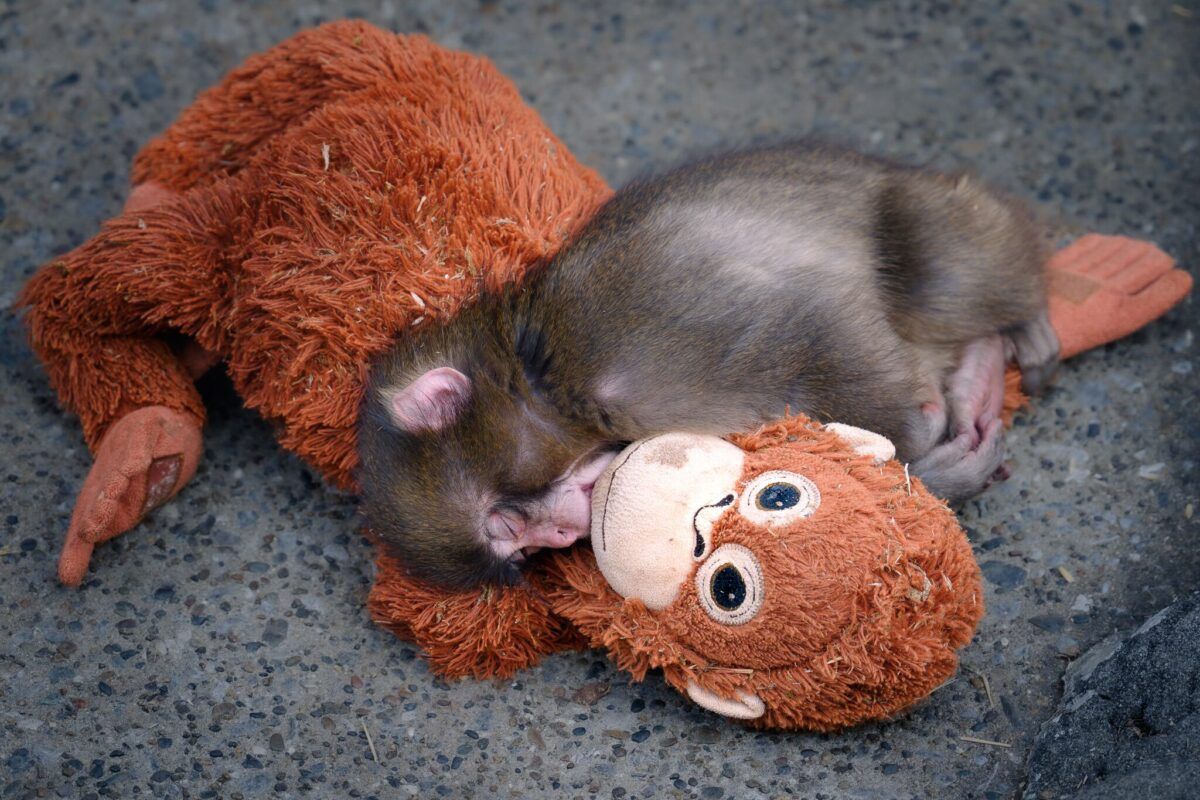
Since 19 February, his story has circulated with unusual intensity. Interest has not faded; on the contrary, it continues to grow. In the most widely shared video, he clings to a soft toy, turning to it while undergoing a process still in progress: his integration into a troop of 56 Japanese macaques. During feeding time, he attempts to approach another infant in the group; the attempt fails. Shortly afterwards, an adult reprimands him and drags him a few metres away. Punch runs back to his toy and embraces it.
The scene sparks immediate outrage on social media, where many interpret it as aggression. The zoo explains that the infant is not isolated and that such interactions are part of predictable dynamics in species with complex hierarchies. Later that same day, Punch resumes interacting normally. The process continues.
There is something revealing in the way we watch that sequence. We see abandonment, fragility, injustice. And in doing so, we inevitably project something of our own.
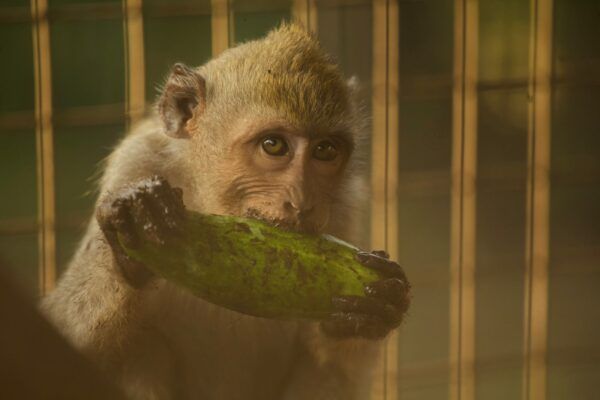
Punch belongs to the species Macaca fuscata, a highly social primate whose organisation revolves around constant contact, collective learning and bonds that determine future stability. In such contexts, early care does more than ensure immediate survival; it establishes the foundation from which the individual learns to orientate within its environment. When that reference disappears, the organism seeks another.
The soft toy — an IKEA model that sold out after the story went viral — functions as a transitional support. It doesn’t replace the mother or the troop, but it offers physical and emotional continuity while the group finishes situating him. In ethological terms, it represents an adaptive response to the absence of the primary attachment figure.
Scientific research has described this phenomenon for decades. Harry Harlow — the influential American psychologist known for his experiments on attachment, love and maternal deprivation in rhesus monkeys — demonstrated that infant primates prioritise soft contact over food when forced to choose between the two. John Bowlby — author of “Attachment” and “The Making and Breaking of Affectional Bonds” — explained, in developing attachment theory, that early bonding forms the scaffolding from which exploration and emotional regulation emerge.
It is tempting to assume that humans have refined this mechanism beyond recognition. Yet we too arrive in the world in a state of radical vulnerability and continue to require stable environments that organise our experience. Over time, we replace the soft toy with other structures: routines, professional hyperactivity, relationships that compensate for insecurity, projects that sustain identity. The object changes, but the underlying logic remains.
Punch doesn’t conceal his need. When overwhelmed, he seeks support. That transparency — so foreign to our culture of self-sufficiency — partly explains the intensity of the collective reaction.
Amid the digital conversation, another quieter yet significant detail emerges: an adult macaque, previously rescued from a circus where he suffered mistreatment, now remains closer to Punch with greater tolerance than other members of the troop. It is not a symbolic adoption nor an idealised scene; it is a sustained proximity that facilitates the youngster’s adaptation.
In social species, care does not depend solely on biological bonds. It often appears where someone recognises vulnerability in another because they have experienced their own.
Part of Punch’s continuing impact may relate to the moment in which his story unfolds. In an environment saturated with conflict and troubling news, millions pause before a scene that demands no ideological positioning. Attention focuses on something elemental: the need for support when the environment feels uncertain.
Punch’s integration will not conclude in a day or a week. It unfolds through approaches, hierarchical corrections, trials and setbacks. The soft toy appears and disappears in different moments. Sometimes he clutches it. Sometimes he leaves it aside and explores. The process remains open.
And precisely because it remains open, the surrounding conversation expands. Amid the collective enthusiasm and tenderness, some voices invite us to view the scene from another angle. Animal rights organisations such as PETA Asia remind us that what many describe as adorable may also be the manifestation of early trauma and a forced adaptation to an environment that is not natural. The warning does not invalidate the emotion we feel, but it introduces an uncomfortable question: what part of what we celebrate as resilience is, in fact, a response to deprivation?
This nuance opens another layer of reflection. If attachment is a condition of equilibrium in social species, it is also true that when it becomes rigid or exclusive, it can become a source of tension. Not only in macaques. In us as well.
Certain philosophical traditions, such as Buddhism, have long insisted on this ambivalence: attachment — understood as the tendency to cling to what provides security — can generate suffering when that support changes or disappears. This does not mean denying the need for connection, but recognising the delicate boundary between connection and dependence, between support and fixation.
In that sense, Punch’s story offers no simple moral. It confronts us with a paradox that runs through both biology and culture: we require bonds in order to develop and, at the same time, must learn not to become trapped within them. We seek support without relinquishing autonomy; we desire closeness without losing freedom.
Perhaps that is what transforms this into more than a viral episode. It does not present a closed image or a comforting conclusion. It shows a process in progress, full of adjustments and frictions, as occurs in any complex social system.
Punch continues attempting to find his place. We continue observing. And within that observation emerges a silent identification with something we rarely acknowledge explicitly: the persistent need to feel supported while learning to move within structures larger than ourselves.
Perhaps what matters is not only the tenderness Punch awakens — evident as it is — but what that reaction reveals about something that belongs not solely to the emotional realm, but also to the biological: the need for attachment as a condition of equilibrium.