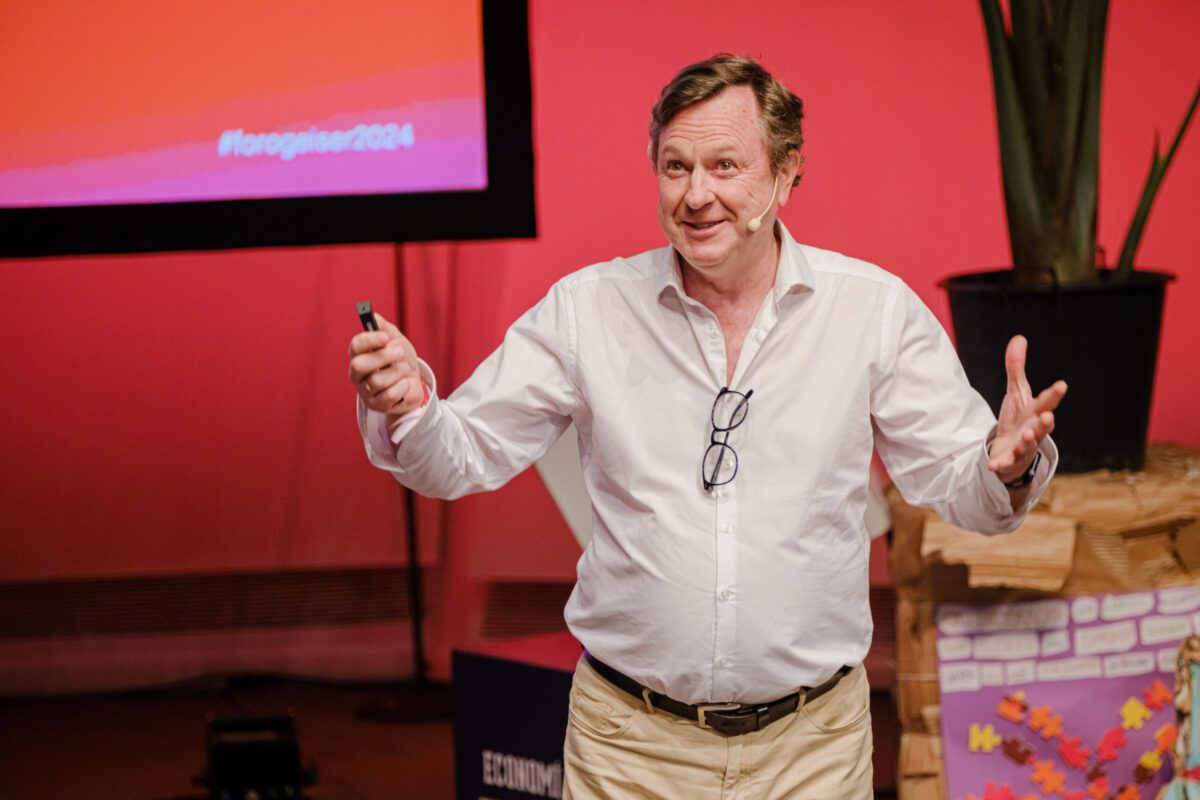
Interview with Daniel Truran, social innovator, speaker, and change facilitator
Last year, during Interihotel, we had the pleasure of meeting Daniel Truran, a prominent figure in the business and social spheres, and a leader committed to transforming business models toward a more ethical and sustainable economy. He is currently the CEO of EBBF (Ethical Business Building the Future), a global organization that promotes the integration of ethical values into business strategies. In addition, Truran serves as a board member of B Lab Spain, the entity responsible for advancing the B Corp movement in our country, a community of businesses seeking to create a positive impact on both society and the environment. His career also includes co-founding Impact Hub Madrid, a key space for social and business innovation.
Throughout his career, Truran has proven to be much more than a successful professional: his work has been characterized by a strong commitment to social change, sustainability, and the creation of partnerships that generate shared value. A regular speaker at international forums, he is an indefatigable facilitator of projects that seek to reconfigure the traditional economic model, aligning it with ethical and responsible principles. However, beyond his professional achievements, those who know him highlight his warmth, integrity, and his ability to inspire others to build a fairer and more sustainable future. In a business world that often prioritizes short-term profit, Truran stands as a staunch advocate for a change that not only transforms organizations but also creates a positive impact on people’s lives and the environment.
What did you want to be when you grew up?
I didn’t know what it was called, but I always liked the idea of being a kind of middleman, an intermediary. In other words, someone who connects people in one way or another. Honestly, I don’t know how this idea came into my mind, but it’s what I’ve ended up doing: connecting people and communities.
Looking back, after all this journey, do you feel satisfied? And we’re not referring to success, as we already take that for granted given your professional trajectory, but are you happy, fulfilled, content with life? And if not, what would you need to feel that way?
I feel happy and satisfied because all the pillars are in place. My family is doing well, and that brings me a lot of happiness. I’m in a comfortable situation, doing what I love, and living my purpose. For me, that’s success. It’s not about being a millionaire, but about being able to live my purpose and feeling that people are interested in what I do and say, and that they want to be part of it. On the other hand, I need to exercise more, haha! That’s my weak spot.
“For me, success is not about being a millionaire, but about being able to live my purpose.”
On LinkedIn, you self-identify with these labels: TOP 20 Entrepreneurs, Motivational Speaker | Chief Learning Officer, General Director at EBBF | Partner at NOW Partners | Founding Team at B Lab Europe | Business School Professor at EOI, ESADE, IESE. And personally?
Professionally, the word that best defines me is CLO (Chief Learning Officer), the person responsible for learning within a company, whose mission is to manage training and continuous learning based on the company’s needs. I also consider myself a motivational speaker. I really enjoy giving talks, and I feel that people enjoy them as well.
My personal brand is “Open Value”, and through it, I focus on the idea of co-creating futures and creating value. For me, the value is already in people and organizations; the key is to “open” it, allow it to express itself, and guide it in the best direction. That’s what my talks focus on—helping people become aware of the value that already exists but isn’t being properly directed or exploited. I could say that creating the desire for change is truly my mission—the desire to open value, to co-create…
“Creating the desire for change is really my mission.”
On another note, I am a Bahá’í and I am guided by the values of my spirituality, which brings me friends, community, and many good things. More outwardly, people generally say that I am a good person, that I have good energy, that I have a good sense of humor, and that I am a great motivator… but no one ever tells me that I am intelligent, haha! Anyway, I don’t think people are flattering me, but rather my talents, those that have been given to me.
(*) Bahá’ísm is a monotheistic Abrahamic religion that defends the existence of a transcendent and unknowable divinity, which manifests through prophets, including its own founder.
You recently mentioned in a post that “we are all role models for someone.” Who are yours at this stage of your life?
I try not to have human beings as role models, but rather ways of being. Humans are very imperfect, but there are attitudes and ways of being that really inspire me.
One of the people who inspires me a lot is Pablo Sánchez, co-founder of B Lab Spain, as well as the Integralia DKV Foundation and the startup Qida. But he’s not my role model—he’s someone I admire, read, and always agree with everything he says. I also really admire José Luis Blasco, CEO of Acciona Carbon Technologies and Global Director of Sustainability at Acciona. I also love Nieves Segovia, an educator and expert in educational innovation, and president of SEK Education Group, or José Armando Tellado, whose ethical leadership I admire.
Again, it’s not about seeing these people as role models, but about admiring certain behaviors of theirs. This makes me feel very good because we are not alone. There’s a wave of good people out there, and I truly believe every human being has a noble nature, but there’s a minority that shouts very loudly and, with their attitude, gives the impression that they are many more. What interests me is what unites us, because even though we are different, we have the ability to agree.
I was recently in a company talking about futures, and when I asked them about it, I realized that this is where we all look alike. That is, the future we want is exactly the same. We all want health, peace, prosperity… For me, the starting point is to build from the future, from that shared desire.
“For me, the starting point is to build from the future, from that shared desire.”
You are also a founding member of B Lab Spain, whose purpose is to help companies become more sustainable. What is the main argument to convince a company to invest in sustainability?
In general, companies have a mindset of scarcity rather than abundance. And by scarcity, I mean they feel they have to choose between being sustainable and being profitable. The concept of de-growth has also been proven not to work because humans always aspire to more. Therefore, we need to focus on abundance, growth, ambition, pride, and, of course, doing things more sustainably. We need to focus on everything that is “more” and rethink everything we do as a company.
This shift in mindset is always backed by numbers, to debunk the prejudice that being sustainable doesn’t lead to good economic results. In fact, there are many examples of B-Corp companies that earn 30% more than non-B-Corp companies. A great example is Patagonia. Furthermore, companies with a sustainable DNA earn 21% more in EBITDA (Earnings Before Interest Taxes Depreciation and Amortization). This is the financial proof that the abundance model is the way to go.
“There are many examples of B-Corp companies that earn 30% more than others that are not.”
Technological changes are happening faster than ever. AI, quantum chips, and countless other innovations are here, initially to help us, but should we be worried? Just this week, I read an article in El País by quantum physicist and writer Sonia Fernández Vidal, who said, “advanced technology and ignorance are an explosive mix.” What is your attitude toward this?
In 2002, Nobel Prize-winning economist Daniel Kahneman highlighted the dichotomy between the two modes of thinking humans have: System 1 (fast, instinctive, emotional, and subconscious) and System 2 (slower, deliberative, logical, and conscious). He confirmed that humans are more focused on the fear of loss than the desire to gain. And we know this mindset doesn’t serve us, because while the brain is wired to protect us, staying in survival mode for too long paralyzes us and prevents us from progressing. Therefore, we need to stop worrying excessively, as it doesn’t help and actually works against our best interests. So, what should we do? Instead of complaining, we need to be curious, explore, and learn. Being against AI doesn’t help—it’s here, whether we want it or not, and it’s not going away.
For us, travel is essential for everything it offers: new inspirations, experiences, learnings, perspectives, and connections. What value does travel have for you, considering you’re someone who travels a lot?
Traveling is incredibly valuable to me. We met at Interihotel in Barcelona last year, where the theme was “The Journey of Change”, and this concept is exactly what we need to apply to our lives. Travel, as a process, and life, as a journey—it’s always more enjoyable and interesting to live it that way than as something tough and burdensome.
“Travel, as a process, and life, as a journey.”
Travel doesn’t always have to mean going to another country or city. For instance, I feel like I’m traveling when I go to the park next to my house. The mindset is about being in motion—not an exhausting motion, but one that nourishes us. And this depends on the narrative we tell ourselves. That same trip can be draining or, on the other hand, quite stimulating, depending on the perspective.
You said in another post (LinkedIn) something very true: “Today, uncertainty is our new normal. And far from being an obstacle, it can be our greatest opportunity.” But how can we see it as an opportunity when our brains are wired to seek certainty, patterns that repeat systematically and give us the feeling that we can anticipate the future, knowing what the next move will be in the long chess game that is our life?
I think the key lies in perspective. Nowadays, business models are being created that didn’t exist before, and they’re being developed very quickly—like creating a podcast or your own YouTube channel. On the one hand, there are uncertainties, but on the other, there are far more opportunities now than at any other time in history. And within uncertainty, things can be created.
Another interesting point is that if everything were certain, nothing new could be created. That’s why the beauty of uncertainty is that it allows us to create the future we want.
What also helps is being collaborative, being able to inspire others and unite forces. This is a unique era where we can connect and co-create directly and quickly with people from all over the world—something that was previously unimaginable and impossible. That’s why I get frustrated with people who complain and fail to see the opportunities, because they are always there.
One of the things that surprised us most when we met you is that you asked us many questions from the very first moment. This is uncommon, especially since with the advent of social media, people seem more focused on showing what they do and have, rather than listening, getting to know, or genuinely being interested in others. What’s your relationship with social media, and what do you think about its use and this premise?
Regarding social media, there are people more focused on showing their achievements in relation to what they do, rather than showing who they are. The narrative that interests me is the one about being. That’s what connects me with people. If you show yourself and express who you are and what matters to you, you will probably lose “friends” or acquaintances, because in reality, they have nothing to do with your values or aspirations… but you’ll also attract more fitting opportunities and people who will truly resonate with you.
For me, the question is: How can we learn if we’re always talking? I’m clear on this, because what interests me is learning. Social media does exactly what we want. Those who thrive on social media are those who ask questions and co-create. Individualism leads nowhere. A few days ago, José María García wrote an article on status, where he mentioned the concept of the “smart” status—being the one who does things that benefit us all. Very interesting.
With everything you know now, what would you have done differently?
With everything I know now, I would have doubted less. I used to doubt more, but now I feel calm because I’m not attached to what will happen, or to the results. I used to worry more, but not anymore. Regardless of what happens, I always do what aligns with my values.
“I used to doubt more, but now I feel calm because I’m not attached to the results.”
What is the meaning of life for you?
To serve a civilization in continuous progress. To be of service to allow things to happen. And as I mentioned before, to allow the value in others to “open up”.
Recommend us 1 book, a movie, 1 podcast, and anything else that inspires you.
A book: “The Overstory” by Richard Powers, Pulitzer Prize-winning author. This novel is about activism and resistance, but it’s also an ode to trees. The book is quite unique, but I got lost in it, and it changed the way I see trees. I no longer view them the same way.
A movie: “Casablanca”. I know the dialogue by heart, haha! For me, it’s the anthem of friendship, ideals, what truly matters, and coherence.
A podcast: “The Expansive” by John Sanei. This man has amazing positivity. He helps thousands of people and organizations rethink their approach and redefine success. He talks about business strategy, creative problem-solving, personal development, and much more. It’s really interesting.
And anything else that inspires me…: My Bahá’í faith and my wife. They are my greatest inspirations.
A dream
I would love for every human being to realize the impact they are having and the impact they could have. And for all of us to join forces to make those positive futures possible for everyone.