Backrooms and the fear of the familiar
Some places seem to be waiting for something even when they are empty. An office corridor after the working day, a waiting room without patients, a shop where the lights remain on after the staff have left. We recognise their materials, sense what they are for and trust that some door will lead us back to the street. Backrooms, the film by Kane Parsons, turns that trust into a source of unease. We loved its ability to make seemingly unremarkable interiors awaken a curiosity that soon becomes difficult to separate from fear.
Starring Chiwetel Ejiofor and Renate Reinsve, with a screenplay by Will Soodik, the film brings the world Parsons developed on YouTube under the name Kane Pixels to feature length. Its starting point is simple: an opening in the basement of a furniture shop leads to a succession of rooms that seems never to end. What emerges invites us to think about space, loneliness and our need to find meaning even where there may be none.
What is Backrooms about?
Clark, played by Ejiofor, runs a furniture business and is going through a period of personal dissatisfaction. When he discovers the entrance to this world of rooms and corridors, his reaction involves more than fear: he is also fascinated. The possibility of exploring a territory beyond familiar rules begins to occupy an increasingly significant place in his life. Mary, his therapist, played by Reinsve, eventually becomes involved in that search.
That desire to return to a dangerous place is particularly intriguing. We can understand the impulse to flee a threat; it is harder to accept that someone might find a promise within it. Clark introduces that ambivalence: what has to happen in our lives for a dehumanised space to seem like an opportunity?
From there, the film opens up a reading about escapism. An extraordinary discovery can become a justification for abandoning problems that are still waiting outside. The labyrinth offers movement, new rooms and the impression of making progress. Whether that movement leads anywhere is another matter.
The origins of Backrooms on the internet
Before the film and Parsons’ series, there was a photograph. In 2019, an image of a yellowish interior circulated on 4chan, an online forum for images and generally anonymous comments, accompanied by a short text imagining the possibility of accidentally slipping out of reality. The idea borrowed the concept of noclip from video games to describe passing through a surface that should be solid. The backrooms awaited on the other side.
The concept grew through users’ contributions, stories and interpretations. Parsons developed his own audiovisual version and released The Backrooms (Found Footage) in 2022, the short film that gave his series momentum. The found-footage format turned the journey into an apparent record of something that had happened, with a camera unable to provide a complete view of the danger.
There is something stimulating about that collective origin. An image containing very little information left enough room for thousands of people to imagine what was missing. Its power lay in an open question. The move to cinema presents precisely that challenge: building characters and a story without exhausting the mystery that made so many people want to look inside.
Architecture that stops helping us find our way
For those of us with an interest in design and architecture, Backrooms offers a particularly compelling experience. Everyday spaces teach us how to move through them almost without our noticing. A reception desk indicates where to ask for help; a window allows us to establish our bearings; a change in flooring signals that we are entering another area. We inhabit spaces by interpreting signs.
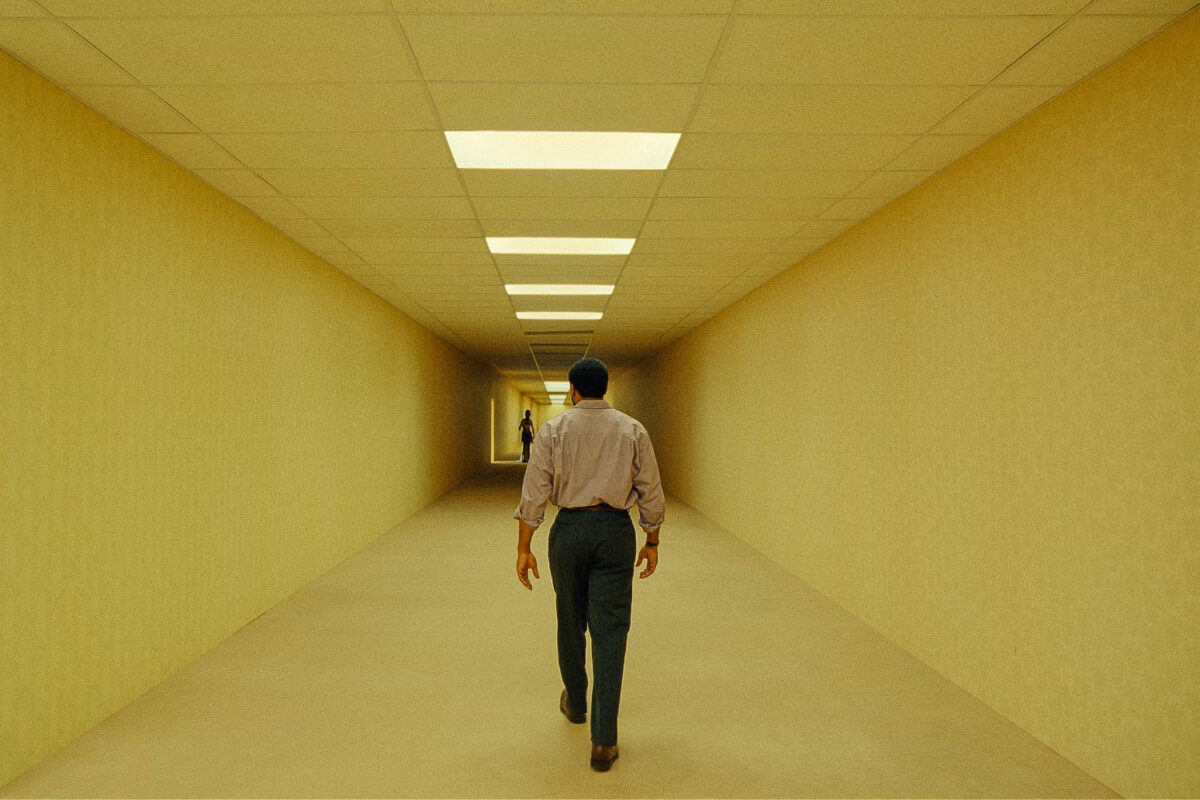
The film’s world disrupts that reading. The rooms retain a functional appearance, but it becomes difficult to understand what function they serve. Repetition promises a logic we never quite manage to grasp. We can recognise every element individually and still fail to understand the whole.
This is where much of what is known as liminal horror lies: in spaces associated with transit, waiting or the passage between situations, whose familiarity becomes unsettling when the context that made them comprehensible disappears. An empty corridor can seem perfectly normal for a few seconds. If it continues indefinitely, the same image acquires a different meaning.
The yellow, the carpet and the suspended ceilings belong to a visual vocabulary far removed from the exceptional. That banality makes it possible to imagine that the entrance could be found in any building. Unease takes hold within the recognisable, in the suspicion that behind an ordinary wall there might be something our experience of the world cannot explain.
Physically building an impossible place
One of the most interesting details of the production is the effort to give material substance to a world associated with digital creation. Production designer Danny Vermette and his team built sets across four soundstages, incorporating platforms and changes in level so that the performers could interact physically with their surroundings.
As Vermette explained to The Credits, reproducing the appearance of the original image required studying how the wallpaper, carpet, suspended ceilings and different skin tones interacted on camera. He even pointed out that the photograph’s characteristic yellow came from a white-balance issue: the real space was probably beige.
It is a revealing detail. A photographic error ended up providing the visual identity for an entire imagined world. The film works with that inherited perception, making tangible a place many viewers knew through a screen. Surfaces matter because fear, too, needs weight, texture and distance.
The sound of an empty space
The sound deserves as much attention as the sets. The hum of the lights, breathing and noises whose sources are not immediately apparent make the space extend beyond what we can see. Listening becomes another way of trying to find our bearings.
Sound designer Eugenio Battaglia explained that the found-footage sequences required adherence to a specific limitation: everything had to sound as though it had been captured by the camera’s microphone. Introducing sounds too independent of that listening position would have broken the illusion. Distortion, interruptions and irregularities in the audio helped sustain it.
That decision is effective because it turns an apparent technical flaw into dramatic information. When the recording fails, we also lose a tool for understanding what is happening. The camera and microphone seem to accompany us, although neither guarantees that we can anticipate what is coming.
Loneliness inside the labyrinth
The presence of Clark and Mary allows attention to shift from the spatial enigma towards a human relationship. He approaches the discovery from a place of discontent; she comes from a profession grounded in listening and interpretation. The situation confronts those positions with something that exceeds their usual frameworks of understanding.
One possible reading is that Backrooms addresses how easily we confuse isolation with autonomy. Having somewhere free from interference may seem liberating, until the reference points that allow us to test our own thinking also disappear. Being alone does not necessarily make us freer.
Nor is it necessary to turn every room into a psychological symbol. The space retains its power when we accept that it may have an existence independent of the characters. It is precisely that indifference that unsettles us: we want our surroundings to respond to our needs, and the labyrinth continues without giving any indication that our presence matters.
Where to watch Backrooms and why it is worth seeing
Backrooms is available on Filmin in Spain, whose edition includes the short film Liquidación total after the credits. It is worth keeping it playing to discover this extension of its world.
Our recommendation has to do with the premise’s ability to change how we look at something ordinary. The film combines a highly recognisable spatial imagination with questions that continue to resonate beyond the screen: why certain interiors make us uncomfortable, how much we depend on the signs around us and what we are looking for when we wish we could disappear for a while.
Attraction and aversion coexist throughout the journey: we want to find a way out, but we also want to know what lies around the next corner. Backrooms manages to sustain that tension and extend it beyond the screen. Afterwards, an empty corridor or a door left ajar can awaken a suspicion that was not there before.
Highly recommended.