“The Room Next Door”, the brilliant new film by Pedro Almodóvar
Synopsis
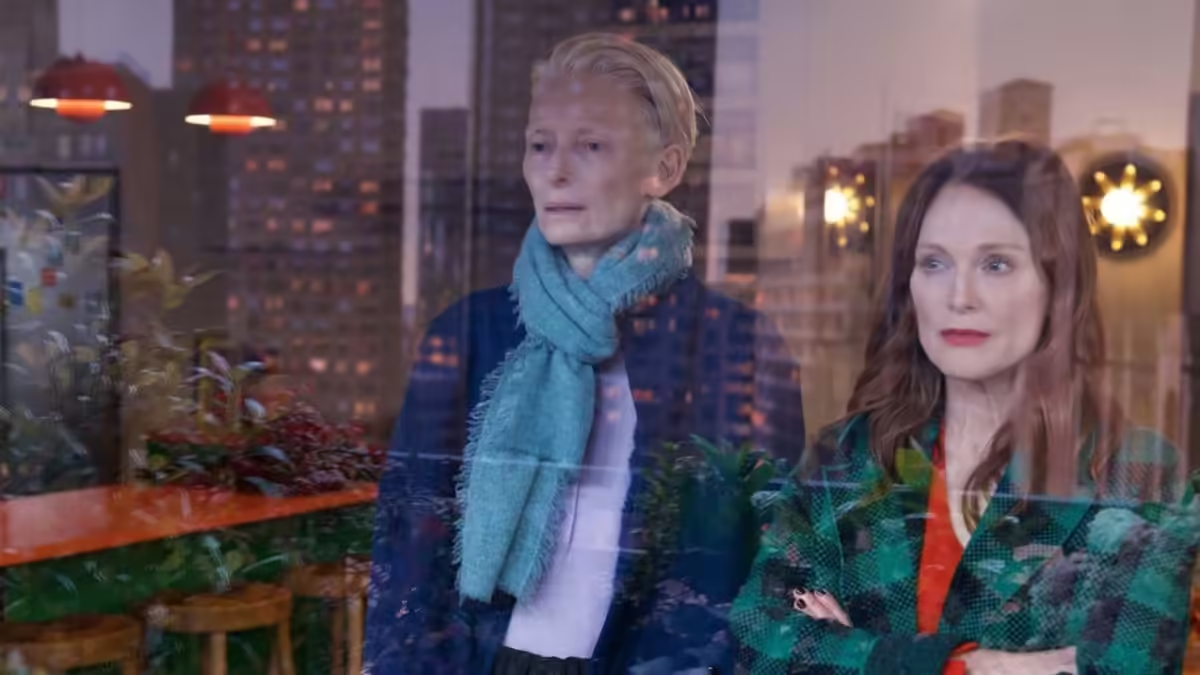
Ingrid is an autofiction novelist who fears death and has just published a book on the subject. On the day of her book launch, she learns from Stella, a mutual friend, that Martha, a war reporter and friend of both, is gravely ill. Ingrid decides to rush to see Martha. Once at the hospital, the two writers reminisce about old times, and despite the long time apart, the affection they once shared resurfaces. This first encounter will lead to profound conversations about life, fear, loneliness, friendship, family… and, of course, death, as well as in a revealing and decisive journey.
“I’ve had the death in my hands… I never imagined it would be so light.”
Tilda Swinton and Julianne Moore star in Pedro Almodóvar’s first English-language feature film
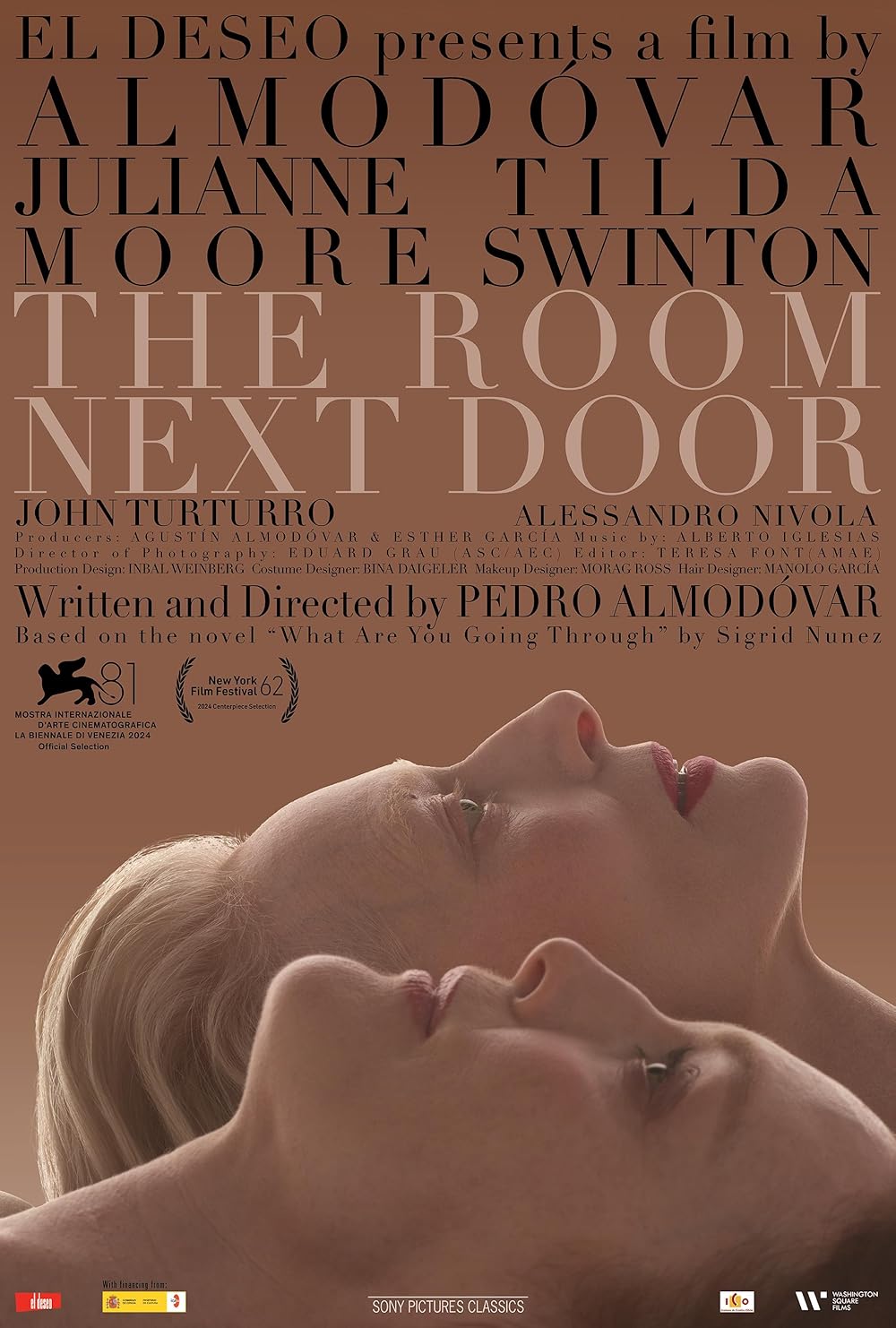
Tilda Swinton and Julianne Moore lead Pedro Almodóvar’s first English-language feature, which earned a historic and well-deserved Golden Lion at the Venice Film Festival.
The screenplay is based on the novel “What Are You Going Through” by New York writer Sigrid Nunez, in which a terminally ill woman with cancer asks a friend to accompany her through the final journey of her life.
Tilda Swinton and Julianne Moore deliver sublime performances, showcasing exquisite chemistry. They, along with Juan Diego Botto, Raúl Arévalo, Victoria Luengo, Melina Matthews, John Turturro, Alessandro Nivola, and Esther McGregor, carry the film.
A discussion on euthanasia
According to the law, euthanasia is defined as “the deliberate act of ending a person’s life, carried out at the express will of the individual, with the purpose of avoiding suffering.” It is also defined as medical assistance in dying.
On March 18, 2021, the Spanish Congress of Deputies approved, by absolute majority, the Organic Law for the Regulation of Euthanasia, which took effect on June 25, decriminalizing assisted death under certain circumstances. This means that adults experiencing intolerable suffering due to a terminal illness or irreversible condition limiting their physical autonomy can request euthanasia from their doctor.
Despite this, there remains considerable controversy, particularly from conservative and predominantly Christian sectors, whose arguments are often rooted in the belief that life is a gift from God and that human beings are made in God’s image.
Without intending to offend anyone and with full respect for the diverse perspectives on this topic, we personally agree that each person should have the right to a dignified death. This belief underpins Almodóvar‘s latest film, which, as one might expect, prompts us to consider the practical, moral, and ethical implications of choosing to end one’s life when the only foreseeable future after a terminal diagnosis is to fade away until death arrives. With this in mind, Almodóvar skillfully weaves a story that does not aim for easy tears —though they inevitably come— but seeks above all to connect us with our humanity, vulnerability, and love.
Acceptance, love, and compassion
One of the most outstanding aspects is each character’s stance. There is immense tolerance, resilience, and compassion in the face of a challenging and grim situation. It’s this respect, acceptance, and love that creates a kind of latent serenity. This state generated between the two characters transcends the screen. As a result, despite the profound sadness that illness and death bring, the film doesn’t dwell on it but goes beyond. Furthermore, as we mentioned, Almodóvar weaves into their conversations deeply meaningful topics that not only highlight the right to die, the ethics of suicide, legality, and consent but also delve into Martha’s relationship with her daughter, her connection with men, Ingrid’s fear of death, both women’s fear of loneliness, as well as the horrors of war, the rise of the far right, and the tragedy of climate change.
A refined taste for the little big details
The refined staging is filled with details and design pieces from Spanish designers like Casa Josephine, Javier Jaén (creator of the book cover presented by Julianne Moore), and Mayice, as well as flower paintings by Pedro Almodóvar and Jorge Galindo, the photograph “Italia” (Apulia, 2000) by Cristina García Rodero, or the portrait of Swinton painted by her partner, German artist Sandro Kopp. Other details include constant literary references —particularly to Dora Carrington, Lytton Strachey, and Virginia Woolf— and cinematic nods, such as “The Dead” by John Huston.
Moreover, the sophisticated, elegant, pictorial, and evocative cinematography by Eduard Grau, the art direction by Inbal Weingberg, and the exquisite costumes by Bina Daigeler seduce us as the film gradually finds its way deep inside us, beyond our control.
Caring is loving
Finally, among the many reflections the film offers us to ponder after watching, there is the idea of caring, both for ourselves and for our loved ones. Not because we are going to die—which is something we will all face —but because love is the true meaning of life. Love for oneself, for friends, for family, for a partner…
In short, “The Room Next Door” is not a melodrama. Martha and Ingrid have full control over their actions; they are not women on the verge of a nervous breakdown.
“The snow falling faintly through the universe and faintly falling, like the descent of their last end, upon all the living and the dead.” James Joyce
Highly recommended.
Enjoy it on board Air Europa flights from April to September 2025.