The Drama: love after the truth
Zendaya and Robert Pattinson star in The Drama, an uncomfortable yet brilliant reflection on identity, guilt and the truths that can change a relationship forever.
There is something deeply unsettling about the moment when a relationship stops relying on certainties and begins to coexist with doubt. It is not necessarily a betrayal, a break-up or a major external event. Sometimes, all it takes is a conversation, a confession or a question asked at the wrong moment for everything that once seemed solid to begin to crack.
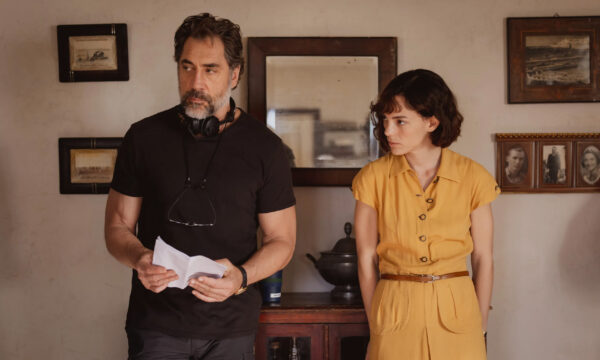
It is precisely within this uncomfortable territory, where intimacy collides with uncertainty, that The Drama, Kristoffer Borgli’s latest film starring Zendaya and Robert Pattinson, unfolds.
Following the success of Dream Scenario, the Norwegian director once again demonstrates his fascination with the mechanisms of identity and the ways in which we construct our sense of self. This time, however, he steps away from overt social satire and ventures into an apparently simple story that gradually reveals itself as a far more complex exploration of contemporary relationships.

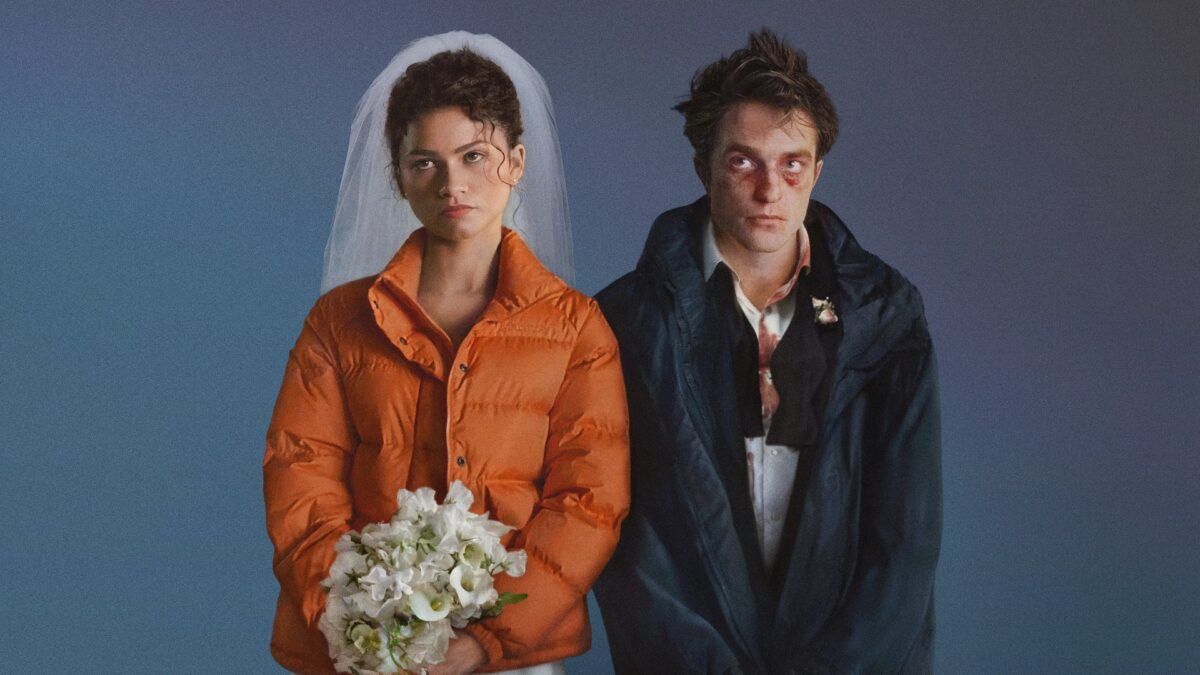
At first glance, the premise feels familiar. A couple are about to get married. Everything seems to be in place; the future has been mapped out and the plans have already been made. Then an unexpected revelation enters their lives, completely transforming the way they see each other and their relationship. From that moment on, every conversation, every silence and every glance takes on an unexpected emotional weight.
A couple are about to get married. Everything appears to be in place, but then an unexpected revelation transform the way they see each other and their relationship.
What makes Borgli’s approach so compelling is that he refuses to treat this revelation as a simple plot device. The event itself is far less important than the emotional consequences it unleashes. His real interest lies in observing how we respond when the idealised image we have built of someone begins to fracture, and how we deal with the discomfort that emerges when we realise love rarely fits the romantic narratives we have spent years telling ourselves.
An uncomfortable comedy about life’s greatest taboos
Although The Drama has often been described as a romantic comedy, the label barely captures what unfolds on screen. The film constantly plays with the audience’s expectations, moving effortlessly between humour, psychological drama and emotional discomfort.
One of its greatest strengths lies in its ability to make us laugh in situations where, in truth, we probably shouldn’t. Borgli crafts scenes that flirt with the absurd while exposing his characters’ contradictions with almost surgical precision.
The humour grows out of vulnerability, tense pauses and the protagonists’ inability to navigate certain conversations without resorting to emotional defence mechanisms. Rather than searching for sentimentality or easy emotional pay-offs, the film finds its greatest strength in ambiguity. There are no heroes or villains, nor are there any easy answers. Instead, we watch two people confronting a situation that challenges not only their feelings for one another, but also their understanding of concepts as complex as trust, commitment and fidelity.
In this sense, The Drama reflects an increasingly common trend in contemporary cinema: using romantic relationships as a lens through which to explore broader questions of identity and the social construction of the self.
Zendaya and Robert Pattinson: a magnetic pairing
While The Drama may not be a masterpiece, much of what makes it work comes down to its two outstanding leads and the chemistry they share.
Zendaya continues to establish herself as one of the most compelling actors of her generation. Following acclaimed performances in Euphoria, Challengers and Dune, she once again delivers a richly layered character capable of balancing emotional resilience with vulnerability without ever tipping into melodrama.
Her performance is particularly effective because she resists any temptation to turn her character into a moral compass or an idealised heroine. Instead, she fully embraces the contradictions and insecurities of a woman confronted with questions that have no comfortable answers.
Opposite her, Robert Pattinson delivers another performance built on restraint. Having spent years distancing himself from the labels attached to his early career, he has established himself as one of the industry’s most adventurous actors. In The Drama, he once again demonstrates his ability to communicate conflicting emotions through the smallest gestures, fleeting glances and carefully measured silences.
Discomfort as a cinematic language
One of the defining qualities of Kristoffer Borgli’s cinema is his ability to use discomfort as a storytelling device.
Rather than treating it as a side effect, he places it at the very heart of the experience. Many of The Drama’s most memorable scenes derive their power from forcing the audience to remain in emotionally uncomfortable situations for longer than conventional storytelling usually allows.
This formal choice is not simply an exercise in provocation. Borgli seems genuinely interested in questioning our instinct to avoid conflict and to simplify issues that rarely allow themselves to be simplified. The film reminds us that many of life’s most important conversations are uncomfortable by nature, and that we often prefer protecting comforting fictions to confronting painful truths.
The visual language reinforces this intention. Domestic spaces become extensions of the characters’ emotional states, while the camera observes with remarkable patience, allowing tension to develop naturally without relying on unnecessary stylistic flourishes.
The result is an unsettling sense of intimacy. We are not watching extraordinary people caught up in extraordinary circumstances; we are watching a situation that, in one form or another, could happen to almost anyone.
A reflection on modern love
Beyond its central premise, The Drama gradually reveals itself as a remarkably perceptive reflection on romantic relationships in the twenty-first century.
We live in an age obsessed with authenticity and transparency, yet equally shaped by carefully curated versions of ourselves. We present edited identities on social media, project impossible expectations onto our relationships and search for certainty in a space where certainty rarely exists.
The film explores precisely this contradiction. Can we ever truly know another person? How much of our identity do we share with those we love? To what extent are relationships built on truth, and to what extent do they depend on the stories we choose to tell ourselves?
Perhaps most importantly, Borgli never attempts to provide definitive answers. His aim is not to offer a moral lesson or a reassuring conclusion, but to invite an open conversation about the complexities of modern love and the fragility of the certainties upon which we build our lives.
Beyond intimacy: a portrait of contemporary America
Although The Drama is, at its core, the story of a relationship, Borgli also finds room to explore, with remarkable subtlety, some of the deeper fractures running through contemporary American society. Without revealing details that might spoil the experience, the film touches on one of the country’s most painful and persistent realities: gun violence involving teenagers and the lasting impact that school shootings have had on successive generations.
Rather than using the subject for shock value or as a sensational plot twist, Borgli weaves it naturally into the narrative, broadening the film’s emotional and thematic scope while reminding us that personal wounds are often inseparable from the society in which they are formed.
The result is a film that is unexpectedly funny at times and deeply unsettling when it chooses to confront us with difficult questions. It uses the story of a couple to examine something far greater, further reinforcing Kristoffer Borgli’s status as a filmmaker with a distinctive voice.
The Drama doesn’t rely on spectacle or grand set pieces to justify a trip to the cinema. Instead, it earns its place by asking uncomfortable questions that linger long after the credits have rolled. And if it also happens to offer the perfect excuse to escape the summer heat for a couple of hours, so much the better.