El ser querido: the price of genius
Rodrigo Sorogoyen and Isabel Peña turn the confrontation between an acclaimed filmmaker and the daughter he abandoned into an unsettling reflection on talent, power, memory and all those who end up paying the price for someone else’s genius.
There are people who have learnt to live convinced that their talent somehow exempts them from certain obligations. That creating something extraordinary, directing great films, winning awards or being admired by others grants them a kind of moral free pass.
El ser querido, the new film by Rodrigo Sorogoyen, co-written with Isabel Peña, ventures precisely into this uncomfortable territory: that of the brilliant creator whose artistic ability coexists quite comfortably with an enormous inability to truly see those closest to him.
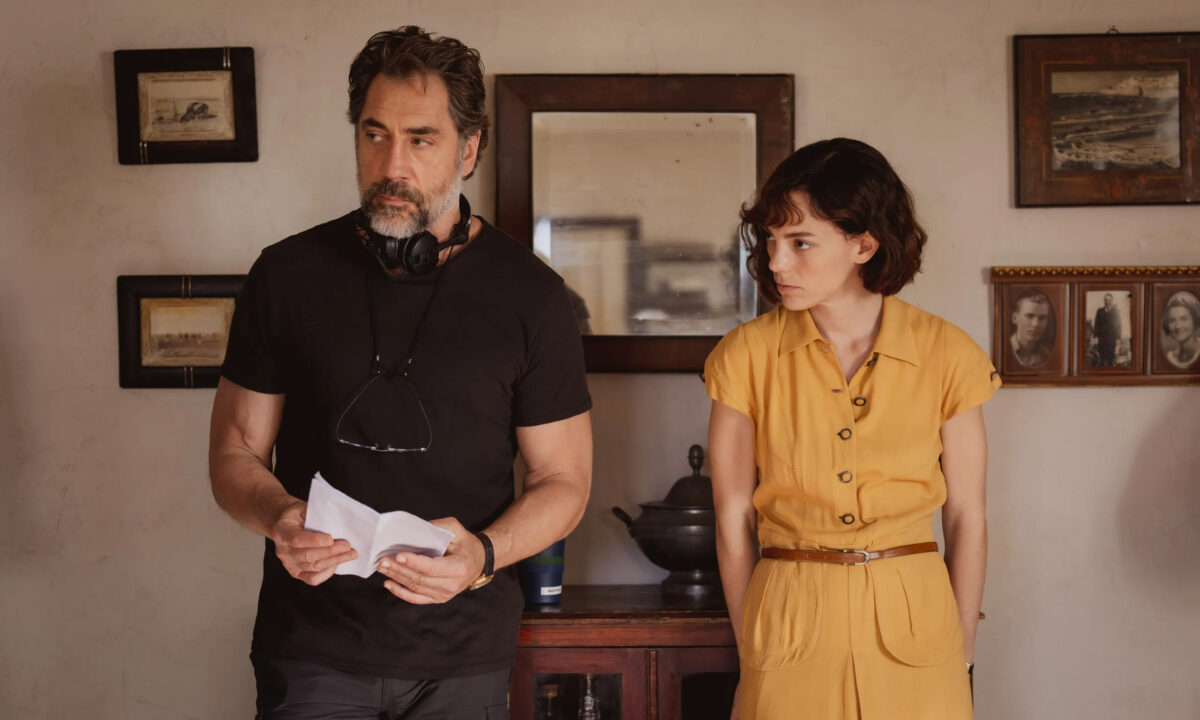
At its centre is Esteban Martínez (Javier Bardem), a prestigious Spanish film director based in New York, winner of two Academy Awards and transformed into one of those figures whose importance seems always to precede his presence. He returns to Spain to shoot a new film and decides to offer the leading role to his daughter Emilia (Victoria Luengo), an actress and, above all, a woman he hasn’t seen for thirteen years. What might initially appear to be an attempt at reconciliation soon becomes something far more ambiguous. Esteban wants his daughter back, but he intends to do so on his own terms, within his own film, on his own territory and using precisely the thing he knows how to control best: cinema.

Talent as an excuse
Sorogoyen and Peña don’t seem particularly interested in creating a monster. And therein lies much of the intelligence of El ser querido. Esteban can be seductive, funny, generous, magnetic and, at times, even vulnerable. He can also be profoundly selfish. The contradiction matters because the film is not simply asking whether we are looking at a good or a bad man, but rather to what extent we have learnt to tolerate certain behaviours when they are accompanied by talent, success or power.
An entire ecosystem is often built around certain creative figures to make their work possible. Someone organises, waits, cares, understands, gives things up, forgives or absorbs the consequences while the creator continues creating. For far too long, culture has romanticised this dynamic through the figure of the genius: the exceptional individual for whom the rules governing everybody else’s lives somehow seem too small.
El ser querido introduces a far more interesting question: what remains outside the frame when we look at an extraordinary career? Behind Esteban’s awards, films and recognition lies a biography also built upon absences and people who have had to reorganise their lives around his decisions. His success does not disappear because of this, but it ceases to be an exclusively individual story.
The film questions our fascination with powerful personalities without falling into the comfort of turning them into caricatures.
The film feels particularly contemporary because it questions our fascination with powerful personalities without falling into the comfort of turning them into caricatures. The problem is not simply that there are people capable of taking up all the space, but that for decades we have created professional, familial and cultural structures that encouraged them to do precisely that.
Fathers, daughters and versions of the past
If Esteban takes up space, Emilia has learnt to protect hers. Victoria Luengo builds the character with extraordinary restraint, allowing a look, a silence or the slightest shift in expression to reveal far more than any explanation could. Opposite her, Bardem uses precisely what makes Esteban so difficult to reject: his enormous capacity for seduction.
Their relationship works because El ser querido understands something essential about family conflicts: there is rarely a single version of the past. We remember from the position we occupied, from what we needed to understand and also from what we have had to tell ourselves in order to move on.
For Esteban, certain decisions belong to another time and can be explained by circumstance. For Emilia, their consequences remain part of the present. Between them lies a distance that cannot simply be resolved by reconstructing the facts, because knowing what happened doesn’t necessarily mean sharing an understanding of what it meant.
This is where one of the film’s central themes emerges: who has the right to construct the narrative. It is a particularly significant question when one of the characters is, precisely, a film director. Esteban has spent his entire life deciding where to place the camera, what enters the frame, what remains outside it and how a story should be interpreted. But his daughter refuses to become yet another character in a narrative written by him.
Cinema within cinema
Sorogoyen uses the shooting of Esteban’s film to continually blur the boundaries between representation, memory and reality. The film being made within El ser querido, entitled Desierto, is set in the Spanish Sahara and transforms the landscapes of Fuerteventura into colonial territory. This story, seemingly removed from the family conflict, eventually establishes a dialogue with it through a shared idea: abandonment.
Spain abandoned Western Sahara; Esteban abandoned his daughter. The point is not to establish an equivalence between these two realities, but to observe how a single word can operate across entirely different scales and force us to consider the responsibility of the person who leaves and the consequences that remain for the person left behind.
The decision also allows El ser querido to reflect on the very act of filmmaking. Film shoots appear as strange organisms in which, for a few weeks, temporary families, hierarchies, affections and dependencies are constructed around a work that inevitably places the director at its centre. Sorogoyen observes this world from within and, in a way, observes himself too.
Sorogoyen uses the shooting of Esteban’s film to continually blur the boundaries between representation, memory and reality.
There is something particularly suggestive about a director constructing a film around another director whose power contaminates his relationships. Sorogoyen has acknowledged that his own way of directing is the polar opposite of his protagonist’s, but the question raised by the film extends beyond Esteban: what does it mean to exercise authority within a creative process, and how far can demands be pushed when the ultimate objective is to make a great work?
Javier Bardem and Victoria Luengo
Much of El ser querido depends on our believing in the relationship between its protagonists, and Bardem and Luengo make that tension feel physical. He possesses an enormous presence, but the film never allows that presence to devour Emilia. Luengo doesn’t need to compete in intensity; she constructs her character from somewhere else entirely, ensuring that the daughter’s resistance carries as much weight as the father’s magnetism.
Bardem also embraces one of the character’s most interesting risks: making us understand why someone like Esteban can be irresistible without asking us to absolve him. Esteban knows how to make people laugh, how to enthuse a crew, how to recognise talent and how to make films. That is precisely what makes him so much more unsettling. Being brilliant in one area of life doesn’t automatically make anyone a good person in all the others.
Sorogoyen avoids offering a reassuring resolution. He doesn’t seem particularly interested in determining who wins the argument, nor in steering his characters towards a reconciliation designed to provide the audience with relief. He is interested in something more complex: observing what happens when two people who have spent years living with different versions of the same story are forced to share the same space again.
Who do we love when we love a genius?
The title then acquires a particularly interesting dimension. El ser querido can refer to the father, the daughter, the admired artist or even that person around whom everyone else has learnt to orbit. Loving someone doesn’t necessarily mean understanding them, just as understanding someone’s reasons does not oblige us to forgive them.
Perhaps that is why the film stays with you after leaving the cinema. Not so much because of the answers it offers, but because of the questions it leaves open. How much selfishness are we prepared to accept in the name of talent? Can someone repair an abandonment many years later? Who sustains the lives of those who decide to place their vocation above everything else? And how much of our memory is recollection, and how much is narrative?
These are questions that inevitably lead us to Monsters: A Fan’s Dilemma, the essay by Claire Dederer that we recommended some time ago in CC/magazine. Dederer begins with one of the great discomforts of contemporary culture: what do we do with the works we love when we discover morally questionable behaviour in those who created them?
But her reflection goes far beyond deciding whether we should continue reading a book, listening to a song or watching a film. She also questions the cultural construction of genius and the price that other people — all too often women, partners, children or those who take on the work of caring — have had to pay so that certain lives could be devoted almost exclusively to creation.
Seen from this perspective, El ser querido finds particularly fertile territory. Esteban is not presented as a monster we are expected to condemn, nor as a genius we are supposed to absolve. Instead, the film places us precisely within that far more uncomfortable space in which admiration and reproach can coexist. His talent is real; so too are the consequences his decisions have had on those around him. One doesn’t necessarily cancel out the other.
Loving someone doesn’t necessarily mean understanding them, just as understanding someone’s reasons does not oblige us to forgive them.
Sorogoyen and Peña talk about cinema, but above all they talk about power. The power we exercise within a family, at work, in a relationship or over the narrative of our own past. And they remind us that perhaps the true measure of a person lies not only in what they have been capable of creating, but also in what has happened around them while they were creating it.
Check your local cinema listings.