“Bird” by Andrea Arnold: Growing up among ruins and open skies
Following her powerful documentary “Cow”, Andrea Arnold returns to fiction with “Bird”, a bold film that defies narrative conventions and fully embraces the ineffable. Nominated for the BAFTA for Best British Film and presented at both the Berlinale and the 2024 Cannes Film Festival, this urban fable is rooted in British social realism, yet expands into the lyrical, the fantastical, and the deeply human.
With a visceral, sensory and poetic gaze, Arnold once again explores the most fragile corners of existence — not to judge or embellish, but to reveal. In “Bird”, raw realism merges with pure metaphor, and at the heart of this fusion is a young girl: observed, accompanied, and filmed with radical sensitivity, as only Arnold can.
Bailey: Childhood interrupted
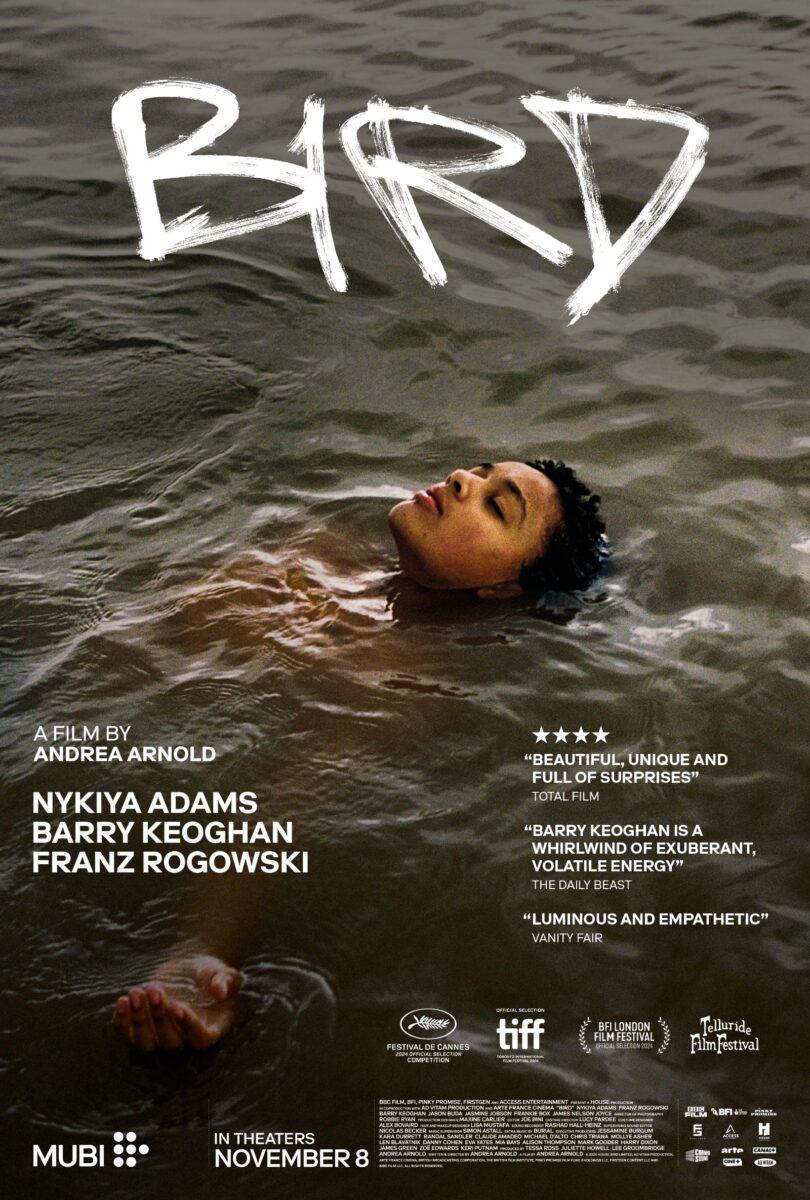
Bailey (an astonishing and luminous Nykiya Adams) is only 12, but her eyes already carry disillusionment. She lives in a squat in northern Kent with her young father Bug (a masterful Barry Keoghan), a man trapped in perpetual adolescence, incapable of shouldering the weight of parenthood. Alongside them is Hunter, Bailey’s teenage half-brother and already a father himself — together they form a family on the brink of collapse.
Their “home” is defined by chaos, instability, and a complete lack of stable adult figures. On the other side, Bailey’s mother repeats the same cycle: she lives with a violent, addicted man in a house where other “adults” take drugs in front of young children — perpetuating a chain of trauma that seems impossible to break.
“Bird” sheds light — without sensationalism or moralising — on the many children whose childhoods are stolen by being born into toxic, broken, and violent environments. Children forced to survive in a world where adults can barely take care of themselves. Parents who were once the children of other broken teenagers, raised in the same emotional and material precarity they now pass on. An invisible inheritance repeating across generations — everyone suffering, no one knowing how to stop the cycle. Arnold portrays this ecosystem with brutal honesty and immense empathy.
And yet, “Bird” is not a hopeless film. Through Bailey’s eyes — filming, running, watching, imagining — Arnold crafts a narrative about the possibility of dreaming different worlds. The camera clings to her body, breathing with her. Her rage, her confusion, her silences and her escapes become the film’s beating heart. Bailey is not simply a victim of the system: she is a girl searching for meaning, a presence resisting complete disappearance.
Franz Rogowski: The enigma who watches from above
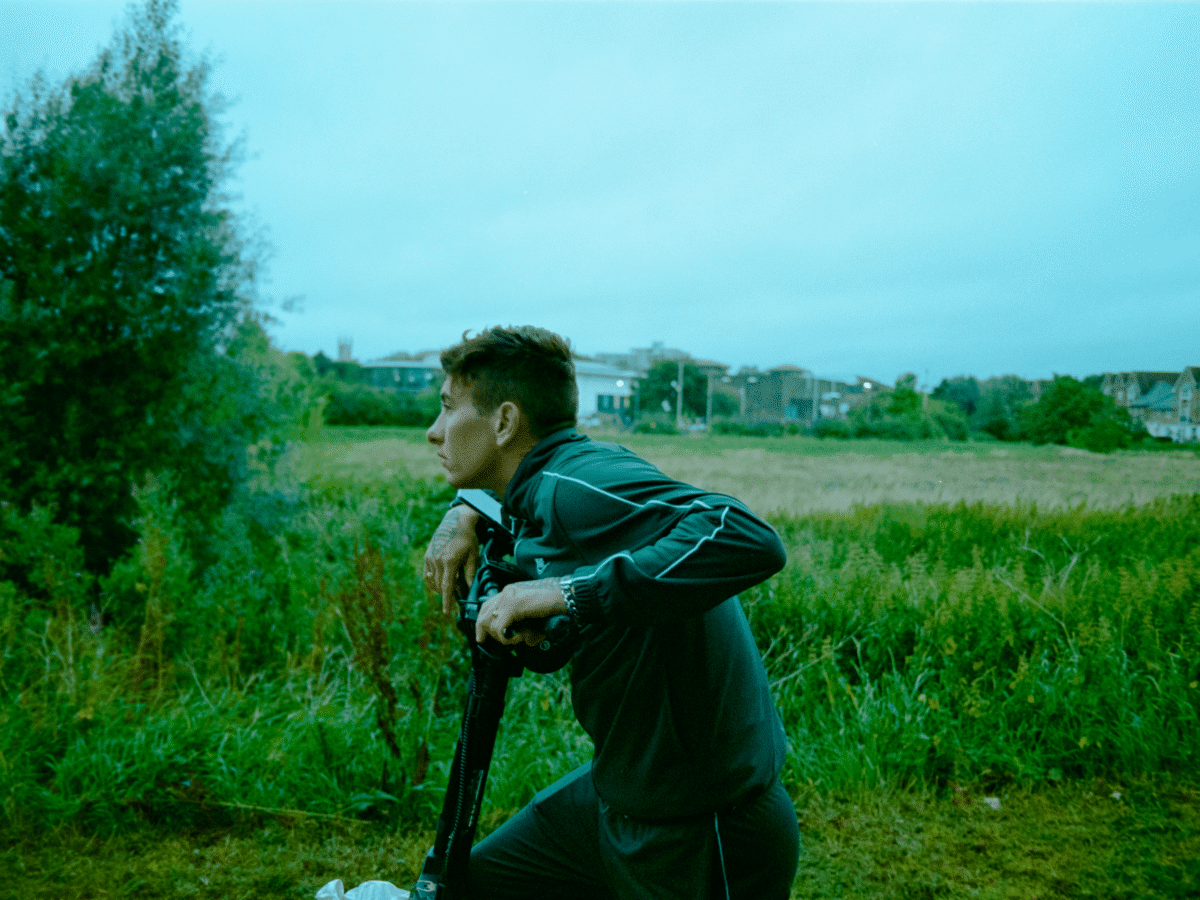
Into the chaos walks Bird (Franz Rogowski), a strange, ethereal figure who seems to observe the world from above, perched on rooftops as if searching the sky for something lost. He returns after years away in search of family, but his silent, unsettling, almost magical presence turns him into far more than a figure from the past.
His immediate connection with Bailey is deeply instinctive — a wordless complicity. Bird is no hero, no saviour, but he seems to embody the possibility of another kind of existence: freer, lighter, more soul-driven than earth-bound. At times, he feels like a guardian angel walking Bailey through her emotional turmoil with fierce delicacy.
Franz Rogowski, one of the most magnetic actors in contemporary European cinema, brings to Bird a unique blend of fragility, intensity and mystery. With a filmography that includes auteurs like Michael Haneke (“Happy End”), Terrence Malick (“A Hidden Life”), Christian Petzold (“Transit, Undine”) and Ira Sachs (“Passages”), the German actor and dancer once again proves his gift for inhabiting characters that straddle the line between the real and the dreamlike. His chemistry with Nykiya Adams is as powerful as it is inexplicable — an emotional dance suspended between abandonment and hope, between earth and sky.
“No matter what happens to you in your life, all around you there are amazing things.” Bird
Poetic realism that brushes up against the magical
The film moves effortlessly between stark realism and a visually symbolic, almost mythic poetry. Arnold masters this balance with a camera that smells of asphalt, vibrates with bodies, and breathes with its protagonists. The editing is electric, urgent — every shot pulses. And then, something changes. A gesture breaks the ground of reality: wings unfold. Not as artifice, but as emotional truth.
Bird, the man who watches from above, transforms. His body, his aura, his enigmatic presence fuse with the bird-like imaginary. He becomes something in-between: part flesh, part fable. A broken soul who, nonetheless, offers a glimmer of redemption. For Bailey, he is a guide, a comfort, an escape. Not a classic saviour, but an imperfect angel, born of pain yet carrying light. His dual nature — between the wild and the human, the fallen and the winged — makes him a symbol of a freedom that isn’t declared, but felt.
And when words no longer suffice, when the story empties itself of certainty, he appears: the fox. Silent, wild, untouched by human noise. Not a simple metaphor or poetic device, but a presence both real and magical. It’s what remains when all else has crumbled. In that final image, in Bailey’s steady gaze — wounded yet stronger — the fox acts as a mirror of her transformation. As if saying: “You’re not alone in your strangeness. Others survive too, in their own way”.
The fox is Bailey — her way of seeing the world, her untouched instinct, her will to move forward without being tamed. In her dark eyes is a fiercely silent promise: life goes on, even when it seems torn from its roots.
A soundtrack that beats with emotion
Music in Bird is much more than background. Featuring tracks by Blur, The Verve, Fontaines D.C., Sleaford Mods, Coldplay, and an original score by Burial — the master of emotional dubstep — the soundtrack becomes a sensory vessel for what words cannot express.
As in all of Arnold’s films, sound is part of the film’s emotional body. Here, it mingles with the characters’ breathing, the call of birds, the rhythm of their escapes, the silence of their wounds.
A coming-of-age with wings of its own
Yes, “Bird” is a coming-of-age story. But not an ordinary one. It doesn’t search for answers — it seeks questions. It doesn’t trace a straight path — it meanders with intuition, with shadows. Andrea Arnold doesn’t tame her stories. She lets them live.
Bailey isn’t saved. She doesn’t fully escape. But in her skyward gaze, in her instinct to film the world on her phone, in her connection with Bird and the fox, there is a will to keep imagining. To keep flying, even if only in the mind.
Is it a metaphor? Yes. Is it real? That too. Because in Andrea Arnold’s universe, reality and poetry embrace without asking permission. And the fox is perhaps the purest spirit of her cinema: fiercely free.
Highly recommended (available on Filmin).