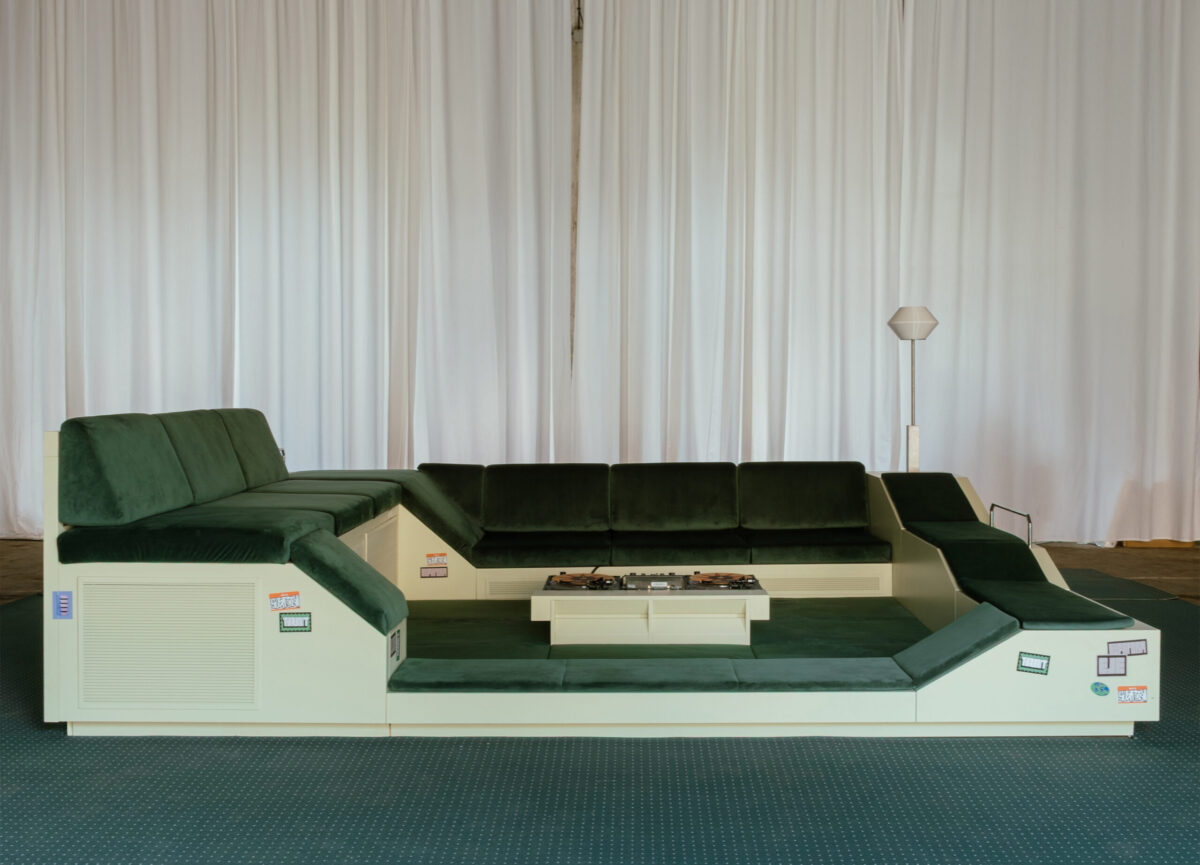
Transit Encounters: a sofa for sharing solitude
Sharing a seat with someone we do not know is an everyday experience we rarely consider closely. It happens on the underground, on a bus or in a park, where our bodies occupy the same space for a few minutes without that proximity necessarily leading to a conversation. We can remain absorbed in our thoughts while being aware of those beside us, taking part in a temporary intimacy that depends as much on the people as on the space that brings them together.
This coexistence is the starting point for Transit Encounters, a project by Maxim Shcherbakov, who heads the studio Supaform, which brings certain characteristics of transit spaces to a sofa. These references appear in the ventilation grilles, changes in height and an arrangement that allows people to settle in different ways, choosing how much they want to participate in what is happening around them.
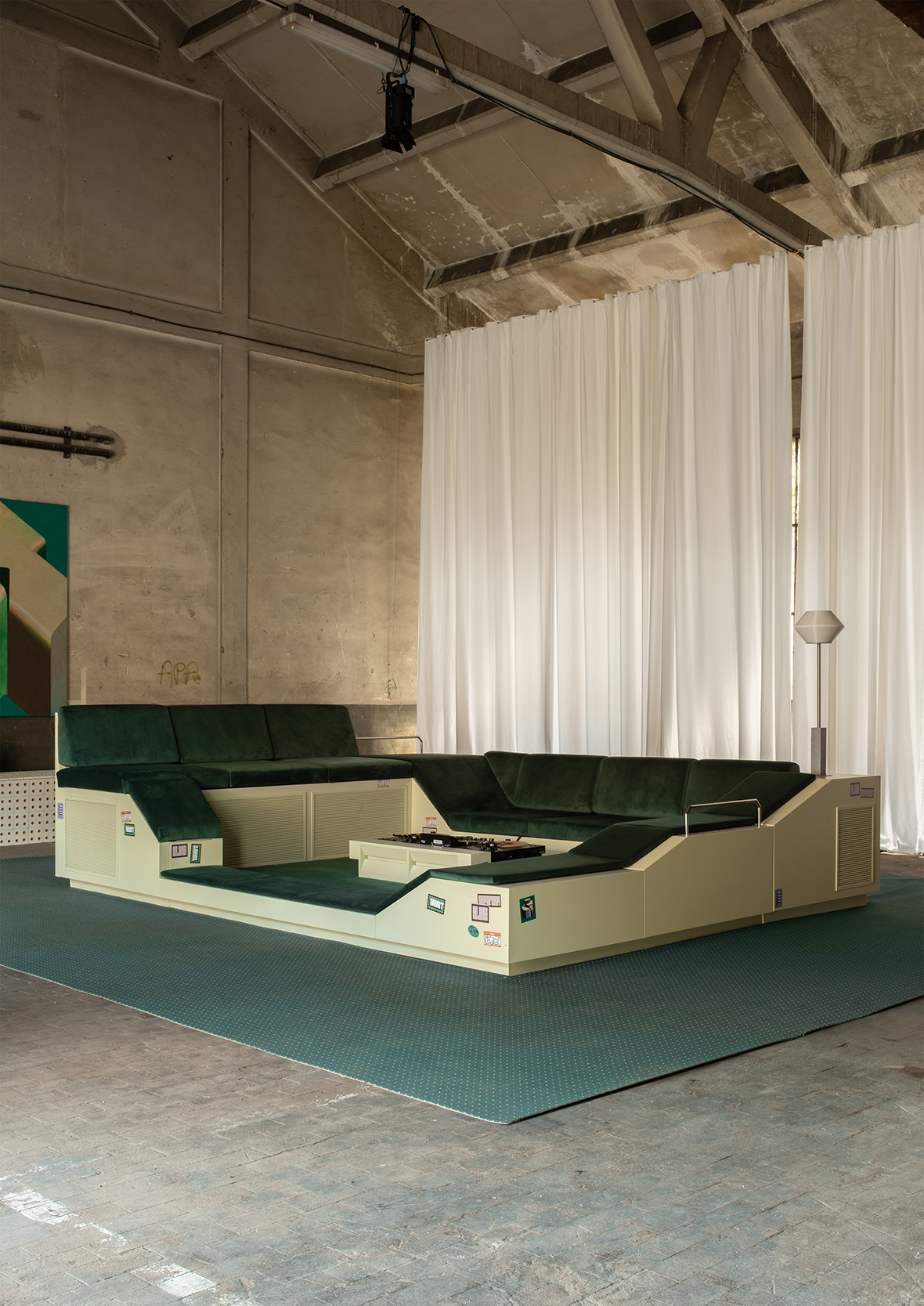
The piece is also interesting for the freedom it offers those who use it. Stepping inside, sitting on the edge or staying nearby are decisions that change the experience without requiring a particular way of behaving. For its creator, this possibility of being together without the obligation to interact is one of the project’s central ideas.
The collaboration with Esthetic Joys allowed that intention to be explored through music, turning the sofa into both a stage and a space for the audience. In our conversation, Shcherbakov explains how an observation from a taxi in Paris eventually shaped this shared space, and what he discovered when visitors began using it.
Do you remember the observation or specific moment that gave rise to Transit Encounters? Was there a public or transit space that prompted you to start thinking about how we temporarily share places with strangers?
Once, I was in a taxi in Paris at dusk, on my way to a party or something like that. It was late autumn, and the weather was grey, dark and rainy. While we were stuck in traffic inside a tunnel, I noticed a small, strangely cosy corner where several homeless people had gathered. Although, in fact, they seemed to be living there rather than simply spending time together.
I was struck by how that industrial setting, which had never been intended for anyone to inhabit, had been transformed into a refuge, a roof to shelter beneath.
I think that moment was probably the beginning of the idea that would become Transit Encounters. I was drawn to that kind of secluded space where several people spend time together, and I began recognising similar situations in underground carriages and, more broadly, in public parks, where chairs are arranged in groups and people end up sitting together.
Public transport and municipal spaces have a very recognisable visual language. Which elements did you want to bring to the sofa, and how did they influence its form, materials and construction?
It was important to me to capture that utilitarian character without exaggerating it. I wanted it to work as a subtle thread, recognisable in the details and small references. The ventilation grilles make the reference quite obvious, although I am more interested in the raised section of the sofa.
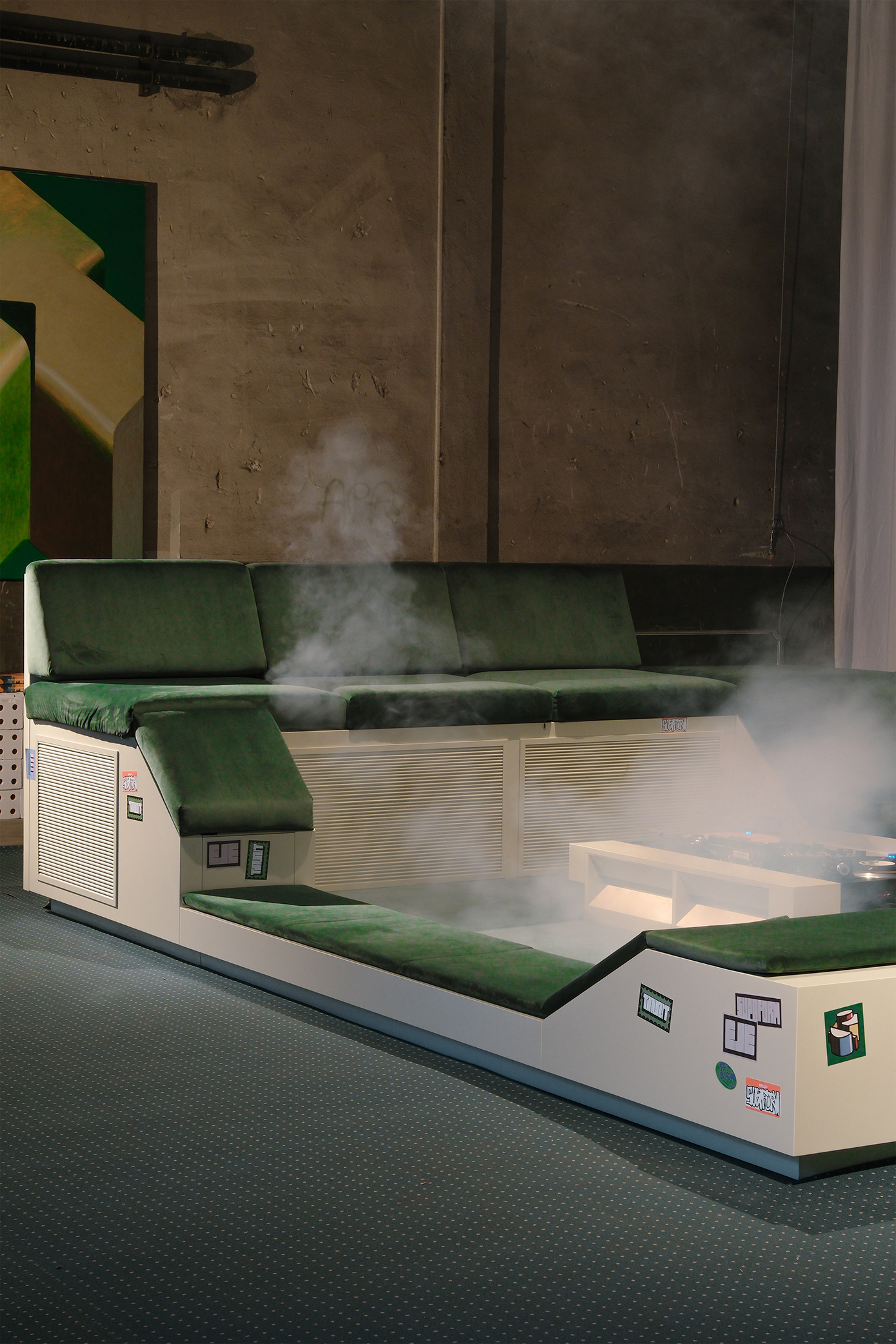
It is a little like sitting in the back row, in a small, adapted space that was not originally intended for sitting. There is also a small reference to the raised rear seats on buses, or those places on public transport where the engine or a wheel sits beneath the seat.
There is an interesting contradiction in the project: transit spaces are designed for people to pass through, while a sofa invites them to stop and stay. How important was that tension during the development of the piece?
Yes, I understand that the utilitarian character of those public spaces serves other functions, but that is precisely where the idea comes from: what if it were different? Imagine a sofa like this in a tax office; it would be quite funny.
The image Shcherbakov proposes introduces humour into a reflection on places whose conventions we largely take for granted. Simply imagining this sofa in an administrative waiting room reveals how much furniture influences our willingness to stay, the postures we adopt and the distance we keep from others. Much of the interest of Transit Encounters emerges from this shift between contexts.
The project also addresses physical proximity between strangers, something increasingly unusual in a world where so many experiences are individual. Do you see Transit Encounters as a reflection on how we relate to people we do not know today?
Yes, it is a reflection on human intimacy, although on a physical rather than a mental or intellectual level. In a way, it is an object that brings people together without forcing them to communicate, form groups, have endless conversations or pretend that everyone is having a wonderful time.
It is more about a kind of shared solitude. Of course, this is only a metaphor, and solitude should not be understood literally here.
This clarification helps explain the proposal: the sofa allows each person to decide how to be in the space, even when they are very close to someone else. Music, the presence of others or simply the opportunity to observe can be enough to take part in a shared experience, without needing to introduce yourself or find a topic of conversation.
How did the collaboration with Esthetic Joys influence the project? What did each party contribute, and which ideas emerged specifically from working together?
Yes, absolutely. We worked together and decided that the sofa would become a public space; essentially, an object hosting a small, intimate music festival organised by Esthetic Joys.
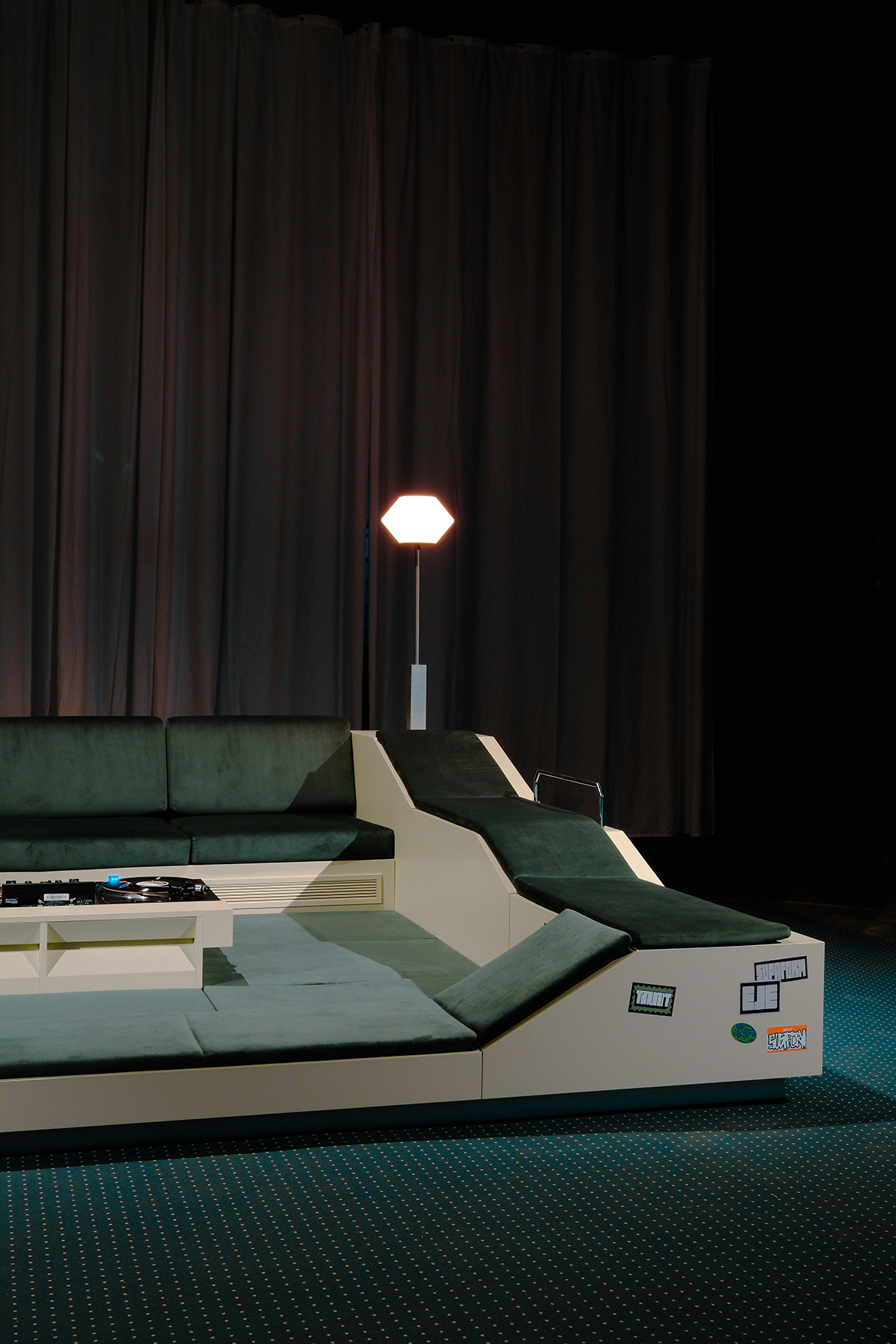
The sofa became a meeting point for musicians and visitors, who interacted spontaneously throughout design week. We arranged the exhibition space so that, apart from the sofa in the centre of the gallery, there was virtually nothing else. The piece therefore functioned as both a stage and a space for the audience.
People came and went; some visitors stayed, stepped inside the sofa and sat right next to the musician performing. Others stood a little further away, while some simply walked around it without stepping inside. There were no rules or restrictions.
I really liked the way everything came together naturally, creating a very harmonious dynamic.
You describe the sofa as a piece that opens up “new possibilities for being together”. What behaviours or interactions would you like to see emerge when people use it?
That is a good question. Honestly, I was not entirely sure how people would use it in a public space. Of course, we had designed different areas for spending time on the sofa, but the most interesting thing was seeing the variety of uses that emerged in practice.
In a way, visitors themselves decided how they wanted to engage with it, because they could step inside or sit on it as they would on a bench and remain on the outside.
In any case, I had always imagined that visitors would step inside the sofa, and to do so they had to take their shoes off. At first, not everyone was willing. Some people felt a little self-conscious about becoming the centre of attention, while others simply did not want to remove their shoes.
Eventually, we came up with a slightly playful solution: we took off our own shoes and left them beside the sofa. That gesture was enough to invite others to use it. A little trick.
That detail reveals one of the project’s most telling observations. Although the sofa offered different possibilities, some required a cue for visitors to feel comfortable exploring them. The shoes beside the piece made an invitation clear that its form alone had not managed to convey to everyone. From that point on, each person could find their place, and the design began to incorporate the decisions of those who inhabited it.
(*) Photographs supplied by Supaform.