Why is the 2026 total solar eclipse so special?
12 August 2026 will not be just another summer’s day. As evening approaches, the Moon will completely cover the Sun, casting its shadow across a broad swathe of the Iberian Peninsula. It will be the first total solar eclipse visible from mainland Spain in more than a century, and one of the most significant scientific and natural events of this generation. For just a few minutes, the landscape will change colour, the temperature will drop, stars will begin to appear, and millions of people will share an experience that very few have the chance to witness more than once in a lifetime.
When day turns into night
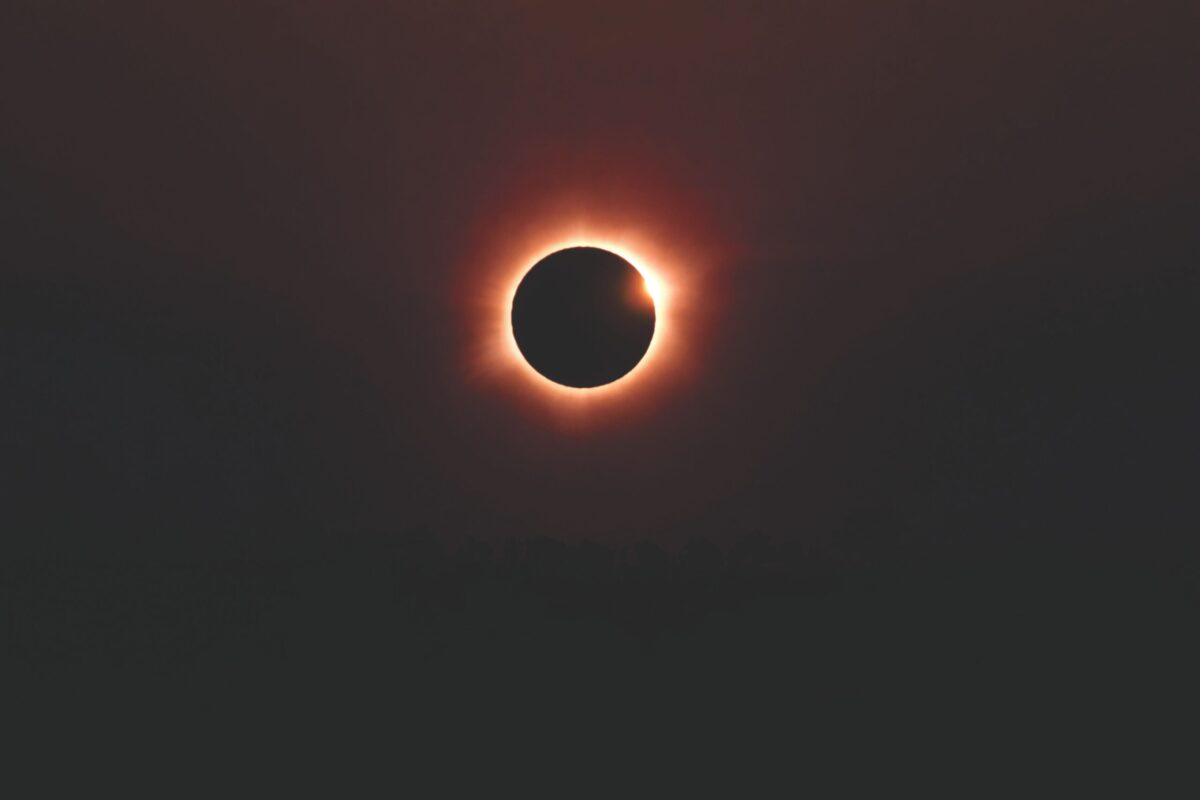
Few natural phenomena are as astonishing as a total solar eclipse. The light gradually fades, shadows become strangely sharp, the horizon takes on the colours of a 360-degree sunset, and, when the Moon completely covers the Sun’s disc, the solar corona appears: the Sun’s faint outer atmosphere, normally hidden by the overwhelming brightness of the star itself.
Totality lasts only a matter of minutes. Then, almost as quickly as it disappeared, daylight returns. It is a fleeting phenomenon, yet those who have experienced it often describe it as something they will never forget.
It is no coincidence that astronomers and photographers travel thousands of kilometres to stand beneath the narrow path of totality. Move just a few kilometres outside it, and the spectacle changes from a total eclipse into a partial one.
A phenomenon that has always shaped history
Long before science learned to predict eclipses with precision, they inspired both fascination and fear.
In ancient China, people believed that a dragon was devouring the Sun and beat drums in an attempt to drive it away. In Mesopotamia, eclipses could be interpreted as omens for the king, while other civilisations regarded them as divine messages or signs marking the end of an era.
Over time, eclipses ceased to be mysterious portents and became invaluable scientific opportunities.
One of the most famous took place on 29 May 1919. During that eclipse, British astronomer Arthur Eddington photographed stars positioned close to the Sun and demonstrated that their light was bent exactly as Albert Einstein had predicted only a few years earlier. Those observations provided the first major experimental confirmation of the theory of General Relativity and transformed our understanding of the universe.
Nor was that the only scientific breakthrough associated with eclipses. In 1868, while observing another eclipse, astronomers identified a previously unknown chemical element: helium, first detected in the Sun before it was ever discovered on Earth.
Why is the 2026 eclipse so special?
Spain will become one of the world’s finest places from which to observe the total solar eclipse of 12 August 2026.
The path of totality will cross the northern part of the Iberian Peninsula from west to east during the final hours of the afternoon, allowing observers to experience the eclipse while the Sun remains comfortably above the horizon. This will create exceptional conditions for both observation and photography.
Moreover, this eclipse marks the beginning of an extraordinary sequence. Further eclipses will be visible from Spain in both 2027 and 2028, an exceptionally rare occurrence.
It is no surprise that scientific institutions, observatories, universities and the European Space Agency have spent months preparing educational events and public activities to help people experience this remarkable phenomenon.
How to observe the sun safely
The excitement surrounding a total solar eclipse should never make us forget one essential rule: a partial eclipse, or the phases before and after totality, must never be viewed directly without proper eye protection.
The only safe option is a pair of eclipse glasses certified to the international ISO 12312-2 standard. Smoked glass, X-ray film, photographic negatives and CDs may once have been popular alternatives, but none provides adequate protection.
Telescopes, binoculars and cameras also require specialised solar filters fitted over the front of the lens. Using optical equipment without the correct filters can cause irreversible damage both to your eyesight and to the equipment itself.
Only during the brief moments of totality — when the Sun is completely covered — is it safe to remove eclipse glasses. As soon as the first rays of sunlight reappear, they should be put back on immediately.
Much more than an astronomical event
Solar eclipses have always been shared experiences, and the one on 12 August will be no exception.
Observatories, local councils, astronomical societies and research institutions are organising events along the path of totality to welcome thousands of visitors eager to witness this extraordinary spectacle. More than simply observing a rare natural phenomenon, they will be taking part in one of those exceptional moments that remain vividly etched in the memory of everyone fortunate enough to experience them.
NASA will stream the eclipse live starting at 1:15 p.m. EDT on Aug. 12: https://www.nasa.gov/live.
Save the date!