Studio Ossidiana reinvents the museum with The Fun Palace

What if a museum could travel without walls? What if art could be experienced barefoot, wrapped in folds of fabric — without marble or solemnity, but full of play, rest, and shared breathing?
With Soft Palace, the Dutch architecture and design studio Studio Ossidiana proposes exactly that: a radical reimagining of how we inhabit art, institutions, and togetherness.

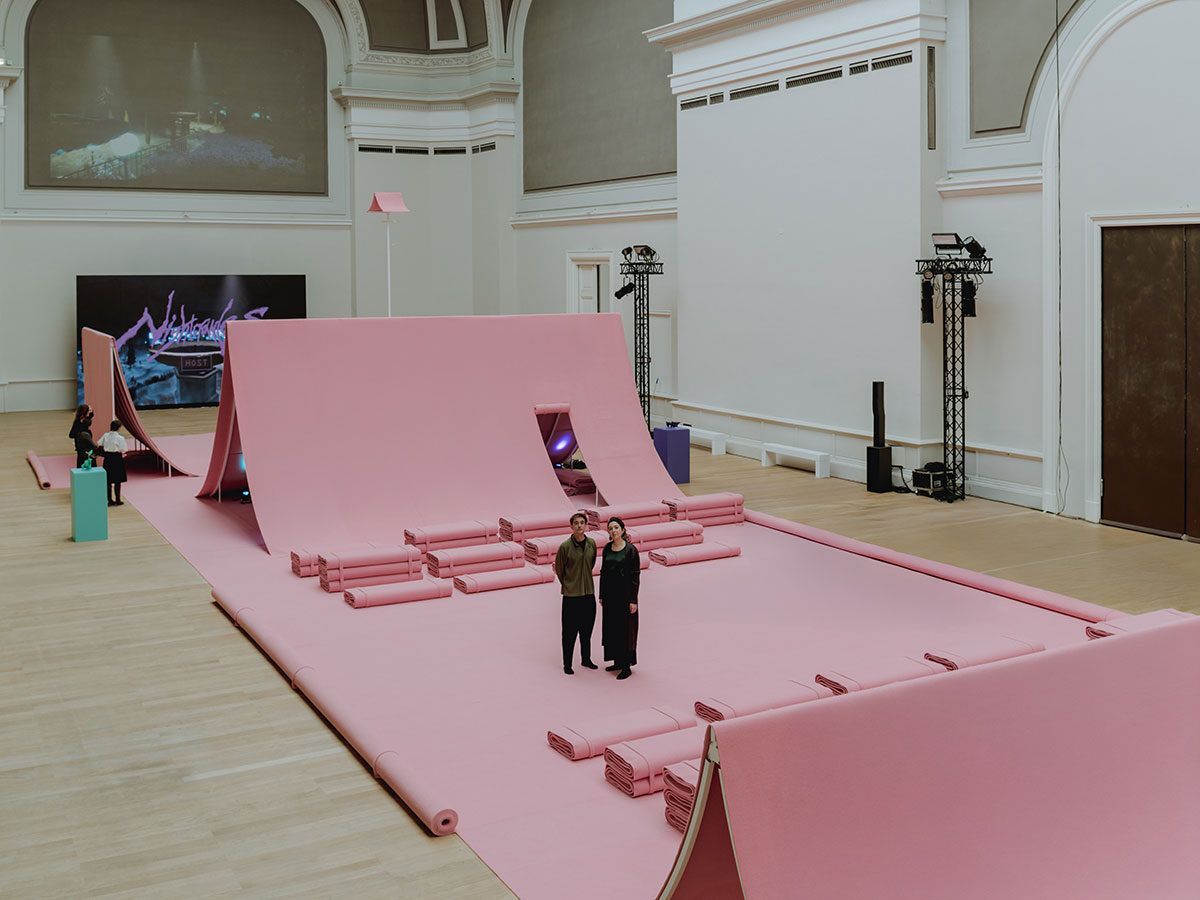
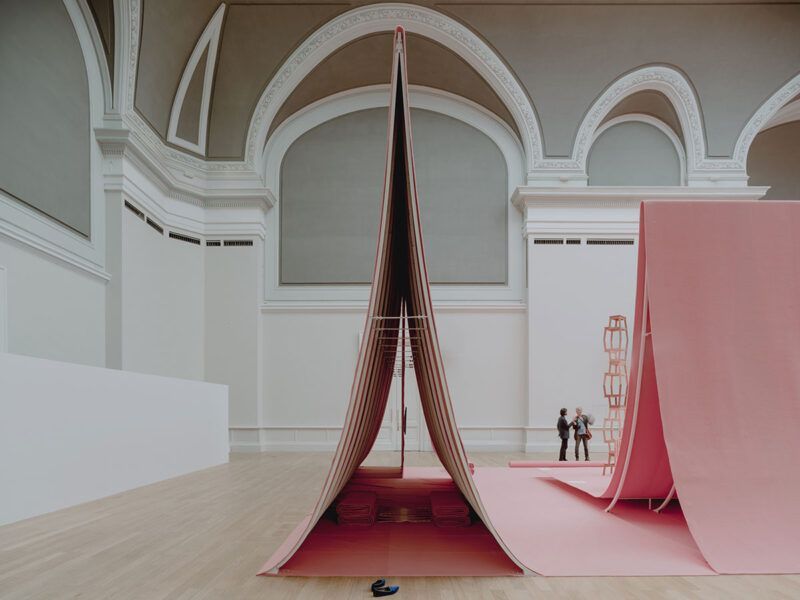
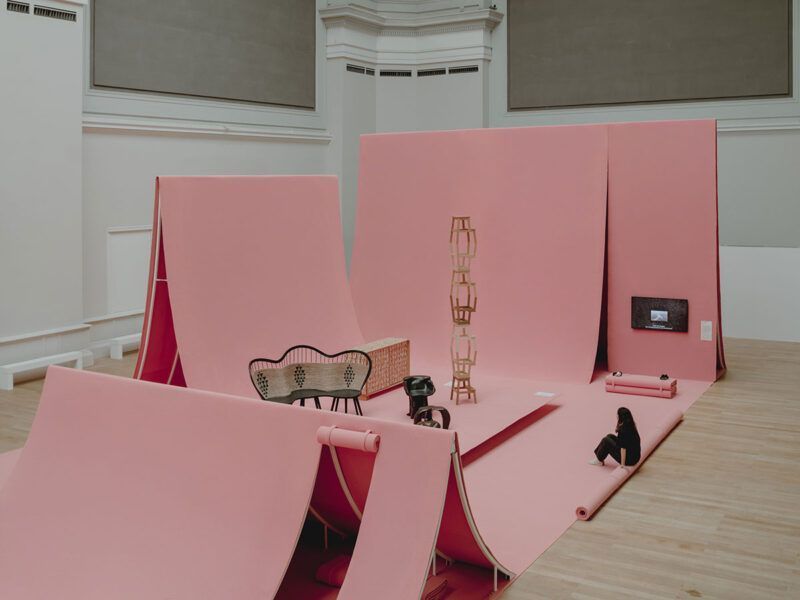
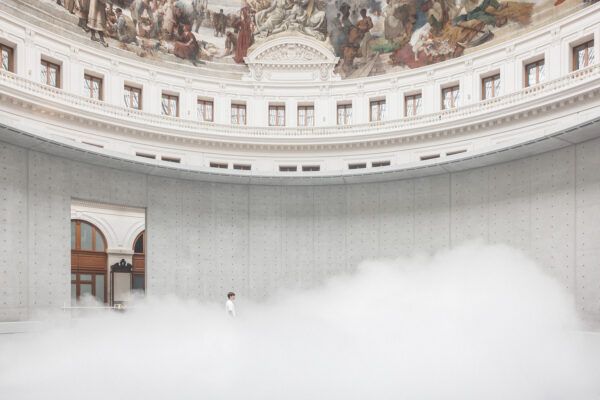
Commissioned as part of The Fun Palace, a joint initiative between the Centre Pompidou and GrandPalaisRmn, this ephemeral installation transformed the Salon d’Honneur of the Grand Palais into a nomadic cultural embassy for the Pompidou during its temporary closure. A proposal that could be experienced last June and which, although no longer standing, we at CC/magazine like to revisit as a source of inspiration. Because it was not just an exhibition: it was a landscape of softness, a scenography of possibilities, a dream made matter.
“It is a landscape of softness, a scenography of possibilities, a dream made material.”
A palace made of fabric, dreams and togetherness
The concept of Soft Palace is as poetic as it is political. Conceived by Alessandra Covini and Giovanni Bellotti, founders of Studio Ossidiana, the space unfolded as a gigantic textile structure: a rolled and folded carpet transformed into a monumental garment. Each fold, each pocket was designed to be inhabited, explored, or simply enjoyed.
Visitors were invited to walk barefoot, lie down, sit wherever they wished, or wander between exhibitions, performances, games, and moments of quiet solitude.
Soft Palace was both stage and shelter. It could host a collective assembly or offer the retreat of a fabric fold for a nap. A place where everyone could be spectator and actor at once, where everyday life and artistic expression merged into a shared choreography. In the words of its creators, it was a space “where one could choose to be with others, to play, discuss, listen… or to hide, rest, be alone and find intimacy only steps away from a public assembly”.
Beyond architecture: a landscape of radical hospitality
Studio Ossidiana is known for working at the intersection of architecture, landscape, and material narratives. Previous projects include floating gardens inhabited by birds, outdoor public kitchens, land art pavilions, and immersive worlds designed for both humans and non-humans.
With Soft Palace, this approach entered the heart of one of Europe’s most iconic cultural venues, proposing a new form of radical hospitality. The installation rejected hierarchy: no stages, no pedestals, no privileged rows. Every place was equally valid. Every person decided how to participate.
In doing so, it challenged the traditional idea of what a museum can be. Instead of permanence, it offered ephemerality. Instead of passive contemplation, active presence. Instead of exclusion, inclusion. The museum became a living, breathing organism.
A curated playground for art and imagination
Soft Palace was not an empty shell. Within its folds, multiple artistic interventions and contemporary narratives took place:
– Nightcrawlers, an experimental video game by artist Alice Bucknell, turned digital exploration into a narrative of speculative futures.
– A selection of design pieces from the Centre Pompidou collection, curated by Olivier Zeitoun and Marie-Ange Brayer, invited reflection on form, function, and sensory experience.
– Philosopher Emanuele Coccia, whose writings on ecology, perception and coexistence deeply informed the spatial narrative, contributed as a key collaborator.
– The overall curatorship was led by Jean-Max Colard, Joséphine Huppert and Alice Pialoux, who intertwined the artistic, philosophical, and architectural dimensions into a unified proposal.
This was not simply a multidisciplinary project. It was postdisciplinary. Art, philosophy, architecture, play and politics did not merely coexist: they collided, contaminated, and fertilised one another.
The politics of softness
In an era of sharp edges — with the rise of extremisms, cultural closures and hardening borders — Soft Palace offered a quiet yet powerful alternative: softness as strength. The ability to yield, to embrace, to welcome.
The installation became a tactile manifesto of what cultural space can mean in the 21st century. And this took on special significance in the context of the Centre Pompidou’s renovation, a symbolic pause for one of the world’s most important institutions of modern art.
Rather than disappearing, the museum reinvented itself through movement, mutability, vulnerability: qualities rarely associated with large cultural infrastructures.
A nomadic embassy of the imagination
As its authors underline, Soft Palace was also an embassy. But not of a nation — of imagination, collectivity and tenderness. It represented a temporary yet powerful alternative to fixed architecture and rigid curatorship.
Much like the original Fun Palace envisioned by Cedric Price in the 1960s — a never-built space designed for learning, play and continuous transformation — Studio Ossidiana’s proposal renewed that vision with contemporary urgency, for a world in need of more porosity, more play, more possibility.
A model for the institutions of the future?
Soft Palace was an ephemeral installation, but its message endures: what if our museums looked more like this? What if public spaces prioritised comfort and participation over spectacle and control? What if softness appeared in the blueprints of our institutions?
By asking these questions, Studio Ossidiana shows that it is not only designing spaces: it is designing possible futures. And perhaps that is the most necessary architecture of all today.
“Soft Palace is not an empty space. Within its folds, multiple artistic interventions and contemporary narratives found their place.”
(*) Photos: Riccardo de Vecchi.