“Black Dog”: a canine fable with a human heart
“Black Dog”, the latest film by acclaimed Chinese director Guan Hu, was awarded the Grand Prix Un Certain Regard at the 2024 Cannes Film Festival.
In his sixth solo feature, the filmmaker—widely recognised as a leading voice of China’s so-called “sixth generation” of cinema—tells a story of redemption through the unexpected bond between an ex-convict and a black dog, set against the backdrop of a post-communist landscape in flux.
An emptied China on the eve of the Beijing Olympics
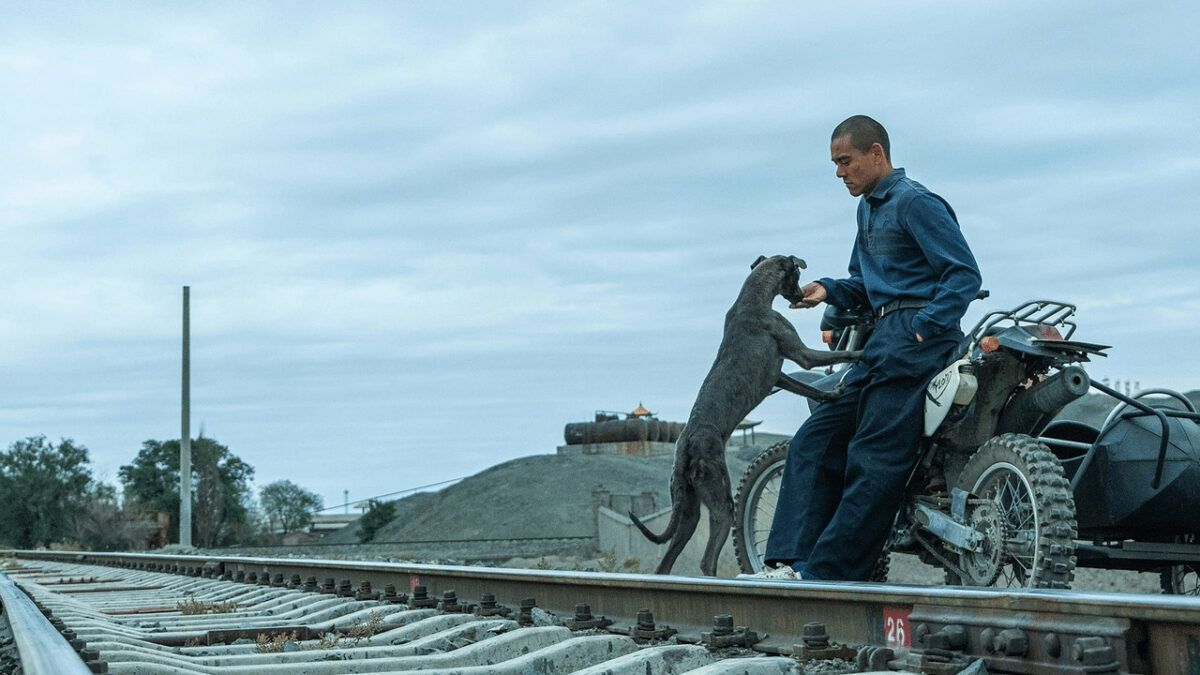
The film is set 50 days before the 2008 Beijing Olympic Games, in a ghost town on the city’s outskirts, devastated by breakneck development. Lang, played by Eddie Peng, returns to his hometown to find it almost deserted, inhabited only by stray dogs—thirsty, hungry, and aimless. This image serves as a potent metaphor for the contradictions of contemporary China: progress and neglect, power and disconnection.
The barren surroundings—empty hangars, crumbling factories, remnants of a defunct circus—enhance the sense of desolation, yet also provide the ideal stage for something unexpected to emerge: a connection between species that reignites hope. Guan Hu’s lens, working from a script co-written with Rui Ge, transforms this derelict space into a quiet testament to rebirth.
The dog as a mirror to the soul
The canine protagonist doesn’t just accompany Lang—he changes him. With his initial fierceness and loaded silence, the dog embodies the uncertainty of a socio-political environment marked by ambiguity and alienation. Both man and animal are outcasts, cast aside by the world, yet together they become reflections of one another: solitary, wounded, misunderstood.
“The canine protagonist doesn’t just accompany Lang—he transforms him.”
From this forced cohabitation between two broken beings emerges a spiritual road movie about loyalty, compassion, and forgiveness.
Their journey is not only physical, but deeply emotional—a near-sacred quest for a place in the world where rejection no longer lingers. What begins as a relationship based on fear and necessity gradually evolves into a powerful symbol of unconditional love.
Kindness, redemption, and unconditional love
The bond with the dog allows Lang to lower his defences and rediscover a part of himself he believed long lost. From the first bark, life with the dog gives him purpose: to care, to protect, to share. Amid a hopeless landscape, their bond injects an unexpected tenderness.
The dog doesn’t merely seek shelter or food; he offers warmth, companionship—and above all, a love that asks for nothing and judges no one. This deeply human contrast compels the viewer to reflect: if compassion can blossom even in emotional desolation, isn’t that very kindness—no matter how small—what can truly change the world?
Lang is no conventional hero; he’s a man with a troubled past who finds in the dog the reflection of his own wounds. Redemption doesn’t come in grand gestures, but in quiet acts: feeding the dog, staying with him, refusing to walk away.
He doesn’t redeem himself before society, but before a being as much in need of love as he is.
“The dog doesn’t merely seek shelter or food; he offers warmth, companionship—and above all, a love that asks for nothing and judges no one.”
Life beyond the screen: real adoption, real legacy
In a gesture that transcends fiction, Eddie Peng adopted the dog after filming wrapped. This act not only reinforces the film’s central message, but also reflects a genuine commitment to beings without a voice. Taking the dog home is also taking his story—bringing to life what the film had offered as possibility.
This real bond amplifies cinema’s power to inspire action: feeling isn’t enough within the cinema—it must continue beyond it. When honest, film doesn’t stay on screen; it lingers in our conscience.
“Lang doesn’t redeem himself before society, but before a being in need of love as much as he is.”
Aesthetic of emptiness: desert cinema and visual poetry
“Black Dog” makes its impact not only through story, but through a striking, emotional aesthetic. With clear influences from contemporary Chinese social cinema, the film draws from a tradition that documents the transformation of both human and urban landscapes with a measured, poetic gaze. The visual reference to Jia Zhangke’s universe—who even makes a brief appearance—reinforces its kinship with cinema that finds beauty in ruin.
Cinematographer Gao Weizhe, awarded at Seminci, brings a lyrical dimension to the narrative. The outdoor scenes—dusty, vast, and lonely—serve as an emotional extension of the protagonist and as silent witnesses to the bond with the animal. In contrast, interior scenes are bathed in a soft, almost spiritual light that mirrors the evolution of the relationship. Even on the margins, tenderness finds a place.
Lessons from a dog: empathy, care, and humanity
“Black Dog” invites us to see animals as silent teachers of essential values. Though they may not speak human language, dogs communicate: through gestures, barks, or a touch that can say more than a thousand words. The bond forged between Lang and his canine companion proves that, in the face of the unknown, empathy is our most powerful tool.
“Black Dog invites us to see animals as silent teachers of essential values.”
Caring for another—even a stray in the desert—is an act of courage and generosity. It’s a way of saying “I’m with you” in a world that often turns away. The film raises a deceptively simple yet profound question: who, in our own lives, needs us to care for them with such quiet devotion?
And perhaps, the most moving lesson of all: if a dog can love unconditionally, even in the harshest circumstances, what’s stopping humans from doing the same? In that call for simplicity, kindness, and boundless love lies the heart of this story.
A must-see visual and emotional journey
“Black Dog” goes beyond social drama or typical stray-animal tales. It is a contemporary fable that revives values long forgotten: kindness, loyalty, compassion, redemption. With a subtle script and exquisite visual direction, Guan Hu delivers a cinematic experience that stirs the soul and reminds us—through the innocence of a dog—of our need to reconnect with the profoundly human.
In an uncertain world, where cities empty and emotions numb, a black dog and a broken man show us that true rebuilding starts within. And, as the ending—real and off-screen—suggests, the story doesn’t end with the final frame: it lives on in every adoption, every compassionate act, every instance of unconditional love.
Highly recommended.