JAŸ-Z IN 8: Jay-Z, Rick Rubin and the art of revisiting a life
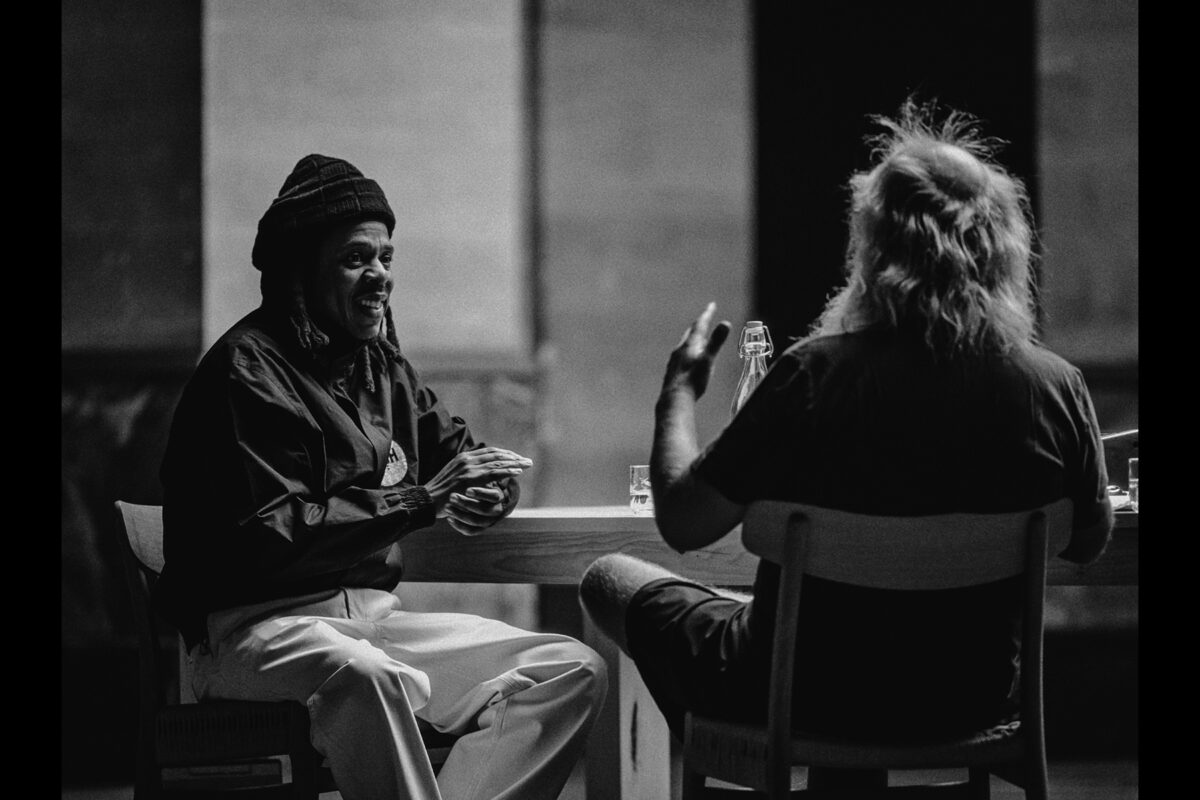
For two days in Paris, Jay-Z and Rick Rubin sat down together to listen to music. Not just any music, naturally, but the songs Shawn Carter has written over the course of a career that began long before his name became a global brand and which, thirty years after the release of Reasonable Doubt, offers a journey through much of hip-hop’s recent history and, at the same time, the transformation of the man who wrote them.
Those conversations became JAŸ-Z IN 8, the new HBO documentary series directed by Rubin himself and built around an apparently simple idea: return to the songs and allow them to trigger the memories. Across eight episodes, the pair revisit tracks from very different moments in Jay-Z’s career to talk about music and lyrics, but also childhood, life experiences and that difficult-to-explain territory that is the creative process.
The premise is particularly compelling because, on paper at least, it avoids the conventional structure of so many musical retrospectives. At this point, there seems little need to retell the story of how the boy born in Brooklyn in 1969 became one of the most influential artists and entrepreneurs in American culture. His biography is well known, and his place in hip-hop history ceased to require any vindication long ago. What is far less common is the opportunity to observe how that same man now relates to the words he wrote when his life was completely different.
Listening to the man you once were
There is something strange about returning to a work created decades earlier. For those who receive it, a song can remain practically intact: we return to it and recognise the same words, the same rhythm, even what we felt when we first heard it. For the person who created it, however, the experience must necessarily be different. The work remains while its author continues to live.
Thirty years separate the Jay-Z of Reasonable Doubt from the man now listening to those songs again. Between them lies an extraordinary transformation, not only in terms of success but also of identity. The young man who spoke about Brooklyn, drugs, survival, money and ambition would eventually write about power, racism, marriage, infidelity, fatherhood, regret and legacy. Listening to those songs together makes it possible to trace a life in a way that a conventional biography could hardly achieve.
Perhaps that is why the musical selection in JAŸ-Z IN 8 is so revealing. It is not simply a succession of greatest hits, but a mixture of instantly recognisable songs and tracks that offer access to more intimate areas of his writing. There is Can’t Knock the Hustle, Brooklyn’s Finest, 99 Problems and The Story of O.J., but also You Must Love Me, Regrets, Kill Jay-Z, Family Feud and Legacy. The journey ultimately sketches something resembling an autobiography constructed through fragments, in which a song written in 1996 can enter into dialogue with another composed twenty years later.
And somewhere along that journey comes 4:44, probably one of the most interesting moments through which to understand Jay-Z’s evolution as a writer. Released in 2017, the album revealed a man considerably more willing to examine his own contradictions. The confidence and control that had shaped much of his public persona made room for vulnerability, regret and the need to take responsibility. The writing remained autobiographical, but the perspective had changed.
That is precisely what makes the series’ perspective potentially more interesting than a celebration of a thirty-year career. It allows us to ask to what extent our work preserves earlier versions of ourselves, and what relationship we establish with those versions when we are no longer exactly the same person.
A writer who does not write
In Jay-Z’s case, there is another peculiarity that makes this return to the past even more fascinating: the way he writes.
For decades, his habit of constructing lyrics mentally rather than writing them down on paper has been well known. Verses are developed and organised in his head until the moment comes to record them. The page, which for so many writers acts as an intermediate space between thought and work, virtually disappears. The writing happens before it becomes visible and is ultimately fixed directly through the voice.
Rick Rubin had the opportunity to observe this process when they worked together on 99 Problems. Jay-Z would listen to the production, spend some time working on it mentally, and then enter the booth to record. For someone like Rubin, whose career has involved observing how radically different musicians create, that way of working must have been particularly striking.
Memory, in this case, is not merely the place Jay-Z returns to in order to remember what those songs meant. It is also the place where many of them were written.
His extraordinary relationship with words explains why it may be more accurate to approach him as a writer rather than simply as a rapper. For three decades, he has used music to narrate what was happening around him and, progressively, what was happening within him. His best songs function not simply as personal documents but as observations of a much broader social context in which race, class, violence, aspiration and power are constantly intertwined.
In one of the previews for JAŸ-Z IN 8, Jay-Z recalls that many people around him had lived through experiences similar to his own, but he possessed the ability to articulate them. That is probably one of the keys to his writing: transforming an individual experience into a language in which others can recognise themselves.
Why Rick Rubin?
The fact that it is precisely Rick Rubin sitting opposite him to revisit all this material seems logical until one looks at the professional history they share. Although both names may appear inseparable from a certain history of American hip-hop, Rubin has produced only one song for Jay-Z: 99 Problems, included on The Black Album in 2003.
A single collaboration which nevertheless became one of the most recognisable tracks of his career.
By then, Rubin had spent almost two decades transforming the sound of American popular music. He had founded Def Jam with Russell Simmons in the 1980s and helped shape a new way of understanding hip-hop, stripping away embellishment until rhythm, voice and the songs’ energy were laid bare. His work with Beastie Boys, LL Cool J and Run-DMC helped establish an aesthetic whose influence would eventually extend far beyond the genre.
When Jay-Z came to 99 Problems, he wanted precisely some of that rawness. Rubin’s production brought back a deliberately elemental force that contrasted with much of the commercial hip-hop of the early 2000s. The song seemed to connect two historical moments separated by almost twenty years and, in doing so, established a creative relationship between the two men far greater than the number of songs they made together might suggest.
More than two decades later, Rubin occupies a different space. He remains one of the most acclaimed producers of recent decades, but his public persona has gradually shifted into territory that is much harder to define. His interest in creativity, intuition and the way ideas emerge became particularly visible with the publication in 2023 of The Creative Act: A Way of Being, a book in which he deliberately avoided offering a methodology for creating and instead proposed a way of remaining attentive to the world.
Rubin seems particularly interested in listening to others explain things they may not entirely understand themselves. His role is less about imposing an interpretation than asking the question capable of opening a door. That quality may explain why Jay-Z chose someone with whom he has recorded so little to undertake such an extensive reconsideration of his work.
He does not need the producer who remembers how every album was made sitting opposite him. He needs someone interested in understanding why those songs came into existence.
Pain turned into material
One of the exchanges previewed by HBO neatly encapsulates the territory the conversation appears to be trying to reach. Rubin raises the relationship between pain and creative work, and Jay-Z introduces an important distinction: it is not about considering pain necessary or seeking it out, but about using it when it is present.
The distinction matters because it avoids one of the most persistent and problematic ideas surrounding creativity: the romanticisation of the tortured artist. Suffering does not guarantee a work of art, much less should it become a prerequisite for producing one. What is different is the ability to transform what inevitably happens in a life into material from which something can be built.
Jay-Z has been doing precisely that from the beginning. His childhood in Marcy Houses, his father’s absence, drugs, violence and the economic limitations of his surroundings entered his early songs, although rarely from the position of a victim. Over the years, circumstances changed, and so did what could be transformed into music. Success, money, fame and a form of power scarcely imaginable to that young man from Brooklyn arrived, but so did new contradictions, responsibilities and wounds.
What is interesting is observing how the writing changes when what is at stake changes. The hunger of someone trying to escape a particular place cannot be the same as that of someone who has managed to go much further than he ever imagined. Maintaining a creative voice for thirty years requires finding new questions once the old ones have been answered.
In that sense, 4:44 represents something of a turning point. Jay-Z no longer needed to prove that he had won. He could begin to ask himself what had happened along the way.
Looking without turning it into spectacle
The decision to entrust the series’ cinematography to Bradford Young is also significant. One of the most interesting American cinematographers of his generation, Young is responsible for the imagery of films including Arrival and Selma. His involvement suggests an aesthetic ambition that goes beyond simply documenting a conversation between two famous figures.
The material released so far opts for a restrained, monochromatic image that seems intent on reducing the noise surrounding Jay-Z. It is a particularly fitting decision when working with someone whose public image has grown to such enormous proportions that it can end up obscuring the person himself.
For decades, we have seen Jay-Z on enormous stages, surrounded by symbols of success and transformed into one himself. Here, the interest lies elsewhere. In the time that passes as he listens to a song, in what he remembers, in the connections he makes and in the questions that a lyric written many years ago can continue to provoke.
Rubin had already explored a similar device in McCartney 3,2,1, the 2021 series in which he sat down with Paul McCartney to listen to and dissect some of the songs by The Beatles and from his subsequent career. There, as here, the real appeal was not in revealing spectacular secrets, but in observing a creator revisit decisions made sometimes half a century earlier and discovering how much he could remember — or understand differently — by listening to them again.
With Jay-Z, there is also a generational and cultural difference that makes repeating the exercise particularly interesting. The history of hip-hop is considerably younger, and many of its protagonists are still able to tell it in the first person. Thirty years of a career allow us to observe not only the evolution of an artist, but the transformation of a genre that went from being regarded as a peripheral form of expression to becoming one of the dominant cultural forces on the planet.
An autobiography that remains open
JAŸ-Z IN 8 arrives precisely as Reasonable Doubt turns thirty and The Blueprint twenty-five. The coincidence might suggest a major retrospective exercise, although Jay-Z has explained that the series emerged in a far more organic way, from a shared desire with Rubin to sit down and talk about music and the process of writing it.
Perhaps it is better that way. Anniversaries tend to force us to look at a work through the place it occupies in history, whereas a conversation can return it to the uncertain moment when it was still being created.
Because when Jay-Z wrote Can’t Knock the Hustle, he did not know what that song would mean thirty years later. Nor could he have known what his life would become, or that one day he would be sitting with Rick Rubin listening to those words like someone discovering an old photograph and instantly recognising the person in it, even though he can no longer remember exactly what he was thinking at the moment it was taken.
That is probably where the most interesting promise of JAŸ-Z IN 8 lies. Not so much in discovering who Jay-Z is — a question too vast and perhaps impossible — but in observing what happens when an artist uses his own work to try to reconstruct who he has been.
Songs have that strange ability. They remain where we left them while we continue moving forwards. We can return to them years later and find exactly the same words, yet hear them from a completely different place.
In Jay-Z’s case, there are thirty years of words waiting to be heard again. And sitting opposite him is Rick Rubin, someone who, after a lifetime spent producing music, seems increasingly convinced that one of the essential parts of any creative process takes place long before we attempt to explain it: paying attention.
Available on MUBI from 18 September.