FREITAG: The circular revolution that transforms waste into designer bags

In a world where excessive consumption and planned obsolescence seem to be the norm, FREITAG stands as a beacon of innovation in the realm of sustainable fashion.
Founded in Zurich in 1993 by brothers Markus and Daniel Freitag, the Swiss brand has specialized in creating bags and accessories from upcycled materials, such as used truck tarps, seat belts, and airbags. Their approach not only challenges the conventions of industrial design but also fits within a circular economy model that seeks to minimize waste and extend the lifespan of products.


FREITAG is not just a fashion brand
FREITAG is not just a fashion brand; it is a commitment to the environment and a statement of principles against the culture of consumerism. Through a radically circular approach, the company has shaped a model that goes beyond simply reusing materials: their vision involves rethinking the entire lifecycle of their products, from design to recycling, including repair, exchange, and even bag loan services.
Interview with the FREITAG team
A few weeks ago, we spoke with some members of the FREITAG team to explore the brand’s impact on the world of design and sustainability, as well as to learn about their ambitious projects aimed at transforming the fashion industry from the ground up.
How did the idea of creating FREITAG come about? What inspired you to transform recycled materials into an accessory brand?
In 1993, graphic designers Markus and Daniel Freitag were looking for a robust, water-repellent bag to hold their creative work. Inspired by the multicolored heavy traffic that rumbled through the Zurich transit intersection in front of their apartment, they developed a messenger bag from used truck tarps, discarded bicycle inner tubes, and old car seat belts.

This is how the first FREITAG bags took shape in the living room of their shared apartment. What began as the idea of two brothers was soon to conquer the world of bags from Zurich across Europe and all the way to Asia.
Today, 250 people are employed by FREITAG lab. ag. Over 50 of them work at the Zurich-Oerlikon headquarters, dismantling, washing, and cutting truck tarps, among other things. The one-off bags and accessories are assembled by long-standing production partners in Portugal, the Czech Republic, Romania and Bulgaria, and also by a work integration program in Zurich.
The bags and accessories are available in 30 FREITAG stores, from over 300 retail partners in around 25 countries, and at freitag.ch.
Is it true that FREITAG is a holacracy?
Yes! FREITAG has not only committed to the circular economy but is also organized in circles: in 2016, our company, which is still owned by the Freitag brothers, abandoned the classical hierarchical structure and replaced it with holacracy, a form of organization based on self-management.
Can you tell us about the creative process behind each FREITAG piece?
Thinking and acting in cycles has been part of FREITAG for more than 30 years. Why take a new material when you can go for a used one and just give it a next life? What happens to a product at the end of its lifecycle?

“We produces where it makes the most sense ecologically and economically.”
Something that started with the recycling of discarded truck tarps has encouraged us time and time again to use resources and energy sparingly. Today, our main focus is keeping products and materials in circulation for as long as possible and working out how we can leave the linear economy behind us once and for all.
Life-extending measures we have already implemented, such as upcycling, one-time recycling, or repair, do not fully satisfy this goal. Instead, we are attempting to drive the circular economy by closing our material cycles and becoming a circular organization.
By taking a circular approach to material development and product design, FREITAG wants to show and pioneer ways from a linear to a circular economy.
To achieve this, we develop our products with their end of life in mind, in line with our values based on the circular economy and adhering to circular design principles that enable durability and repairability.

To meet these ambitions for future products, with regards to design and production, we try to implement the following elements of our product development strategy:
Design for durability: We give our products a long life by selecting robust materials and a timeless design that increases the product’s emotional value the older it gets.
Design for disassembly: We embrace modular design and reversible material connection, which simplify repairs, replacement, remanufacturing and – if possible – recycling of the product.
We enhance this by keeping the number of material groups to a minimum.
Choose purposeful materials: We select our materials in line with strict criteria.
We rely on circular, upcycled or recycled materials which are produced using environment-friendly methods.
Value the materials: We develop products that can be produced with minimal material waste, emphasize the unique character of products made from used truck tarps and declare the materials used on the products.
What specific measures do you take to reduce the ecological footprint?
We are taking responsibility for the climate and working conditions along the entire value chain. Here, the solid foundation of trust we have with our producers is ideal. Several of them have installed solar power systems, for example, thus reducing our CO2 footprint in Scope 3. We have also found a buyer for our tarp remnants. We have likewise invested heavily in improving the accuracy of our data. Although this does not have a direct positive impact on our CO2 balance, it will help us to identify further potential for reductions.
A further challenge lies in the fact that FREITAG still manufactures over 99% of its products in Europe, but sells almost half of them in Asia. Shipping routes to Asia are highly unreliable and we have not yet been able to switch back completely to sea freight in the wake of the pandemic, as a result of which our logistics emissions are too high.

Therefore our work on the “FREITAG Roadmap to Net Zero” goes on: We continue to evaluate projects to reduce CO2 in logistics, focus increasingly on sea freight, and tackle the issue of material strategy. We also aim to reduce CO2 emissions at our site in Zurich by installing a solar power system and converting completely to LED lamps.
More details can be found in our recently published Impact Report 2023.
We know your products are made from used truck tarps, vehicle seat belts, and airbag fabric. Have you explored using other recycled or sustainable materials?
We focus on the use of upcycled and, when possible, recyclable materials. We also adhere to design principles that enable durability and repairability but also consider the end of the product’s life cycle. But it’s not just about the material: To ensure that products live their potential life cycle to the full, we also develop appropriate circular services.
“Our signature material is used truck tarps.”
Our signature material is used truck tarps.These tarps are extremely durable, and after serving an average of six years on the road, we give them a second life as bags. This upcycling process not only extends the lifespan of the tarps but also reduces our CO2 emissions by 22% compared to using new materials, making it a cornerstone of our eco-friendly approach.
It’s not just truck tarps that eventually get discarded: when you’re looking for used materials that deserve a second life, road traffic can prove to be a real treasure trove. The most recent examples of this are the two ex-airbags-now-turned-bags launched in 2024: the small F700 ARROW and the extra-large F708 FIREBIRD. Both shoppers are made fromdiscarded airbags that are now serving their second purpose. They were once installed in cars but fortunately remained unused.
The material is lightweight but resilient, and thanks to the variety of colors, seams, and overprints available, comes in a surprisingly wide range of looks. Used tension belts, which become soft and supple after intensive periods of use on Europe’s truck routes, were converted into handles for the two airbag shoppers, each one of which is a one-off.

We also use fabrics made ofoutsourced, recycled PET, either to line some of our bags or as the main material for other models. They are dyed using spinneret technology, a process that dyes the yarn during spinning rather than after the fabric is made. This method is much more environmentally friendly, requiring 75% less water, 30-40% less energy, and 90% fewer chemicals than traditional dyeing processes.
For our smartphone protective cases, we use recycled thermoplastic polyurethane (R-TPU) sourced from old ski boots. This material is not only flexible and robust but also recyclable up to seven times, making it ideal for adapting to the rapidly changing sizes of smartphone devices.
Lastly, our Mono[PA6] Backpack launched in spring 2024 is a fully circular product made entirely from Polyamide 6 (PA6), also known as nylon. Since the entire backpack, from fabric to zippers, is made from this single material, it can be easily recycled at the end of its life. The recycled PA6 can then be used to create new items, further supporting our commitment to a circular economy.
Can you tell us about the production process of your products?
Every year, our tarp buyers (aka Truckspotter) buy around 280 tons of used truck tarps. We test the tarps and then take them apart ourselves in our Zurich production facility or through agents and direct suppliers, who then deliver them to us.
Following this step, the tarp sections are washed. And when we moved into our new Nœrd factory in Zurich Oerlikon in 2011 we had the opportunity to rethink our production processes from scratch and design them more sustainable – e.g. with our new ecological washing department, we can now wash the dirty truck tarpaulins with rain water that we collect on the roof top of the factory.
We also re-use the temperature of used water to heat up the rain water and use the relatively clean water of the last washing cycles of one load for the second cycle of the next load and so on.

At the next stage, the tarps are cut up in the Bag Design department to create unique pieces, partly by hand with a cutter knife and template and partly with the help of a machine, before being shipped to our European producers. There, the individual cut tarp pieces are sewn together with the other materials to form finished products, with producers in Bulgaria, Portugal and Switzerland also handling parts of the upstream cutting.
We purchase the necessary accessories and fabrics, such as recycled PET textiles or B-stock airbags, from selected suppliers. The finished items are then checked and photographed. This process is carried out partly by the producers but mainly takes place at our Nœrd headquarters. After that, they are ready for sale.
You created your manifesto in 2015 as a call for conscious and mindful consumption. How did it come about? Has it changed over time?
The manifesto came into being in October 2015 as part of the “FREITAG Ad Absurdum” exhibition at the mudac (Musée de design et d’arts appliqués contemporains) in Lausanne. Working with twin-brother artists Frank and Patrik Riklin, the Freitag brothers conceived an exhibition about the attitude behind FREITAG. They made this attitude visible by taking the FREITAG value chain to absurdity.
Created as an appeal for conscious, sensible consumption in our time, the FREITAG Manifesto is the guideline by which we now think and act, cooperate, develop products, produce, distribute, package, sell, etc.
On Freitag Manifesto, you will find additional information on it.
Is it true that you are developing a truck tarp fabric that can be recycled?
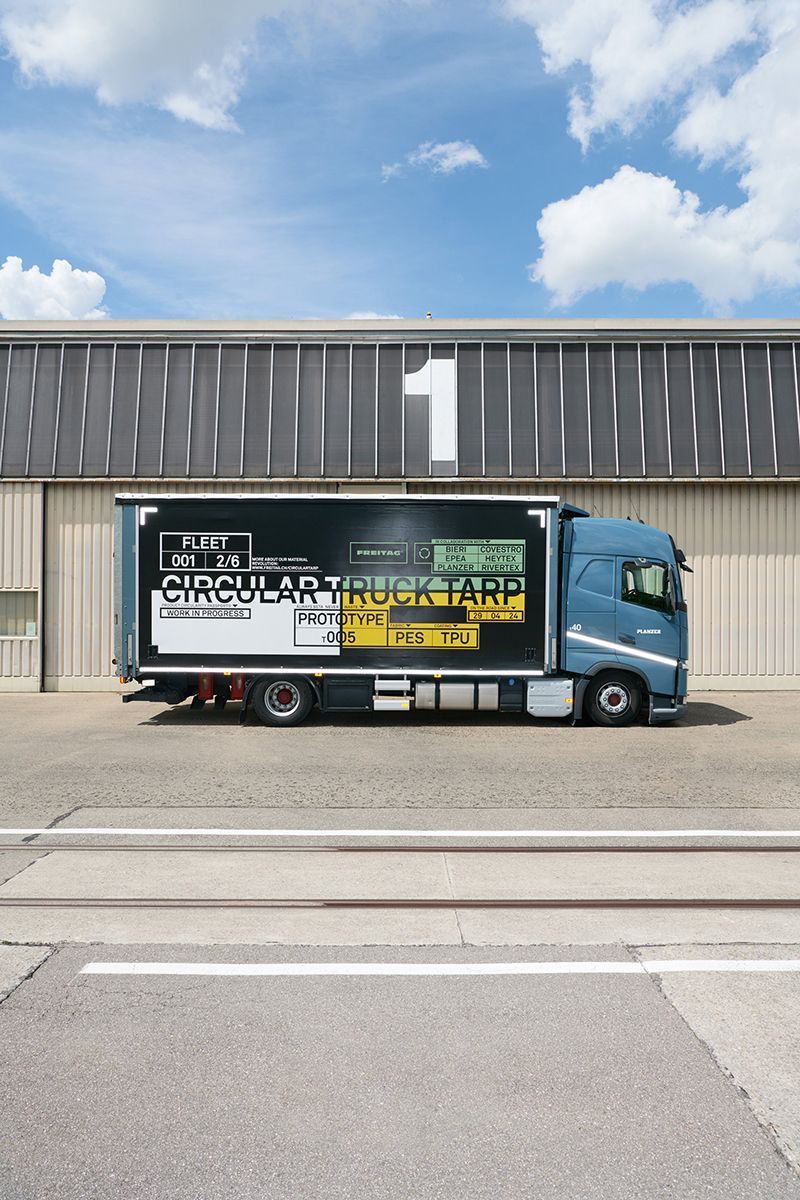
Yes! As part of our quest to ensure that FREITAG bags aren’t merely recycled but also recyclable, in 2020 we began developing a circular truck tarp as an alternative to the existing one made of PVC.
For its venture into the industry upstream of its bag-making business, FREITAG has strengthened itself internally with materials experts and circularity specialists. We found a wide range of interested industrial partners with knowledge of materials, chemicals and composites. And then we brought them together at a round table with the German EPEA‘s circularity experts and long-standing partners from the tarpaulin business.
The first prototype completed its two-year test drive on a delivery van in May 2024. At the same time, work continued apace on various material combinations and a first truck test fleet with circular tarps recently has been undergoing an endurance test on the road.
What is Freitag’s long-term vision?
Today, the transition from a linear, throwaway society to a circular economy that no longer wastes resources is essential. For this reason, we have further developed our sustainability strategy to create the FREITAG Circularity Roadmap and are now aligning our actions accordingly.
Based on our purpose, corporate values, and a materiality assessment, this should help us set the right priorities and identify the appropriate levers to achieve the greatest possible positive impact on our journey toward a circular economy.
“Our first goal is to extend the life cycles of our products.”
The roadmap shapes our everyday lives. We draw on holistic product design and well-thought-out repair, exchange, and take-back services in our declared aim to extend the life of our bags and accessories or, in a best-case scenario, even close material cycles. However, we also want to continue developing in our other key areas. We are striving to act as pioneers in actively shaping and promoting the circular economy.
An example of this mindset is our stance on Black Friday. We always ignored the absurd discount frenzy, but after a while, we felt like that wasn’t enough. Come 2019 we decided to shut down our online store for the first time. We wanted to take a stance against Black Friday, with an initiative that questions this day of retail frenzy in a bold, but also thoughtful and inspiring way.
For the first four years, we have only closed our online store and redirected all visitors to our free bag exchange platform S.W.A.P. (Shopping Without Any Payment). Since last year, so now for the second time, all FREITAG Stores from Zurich to Tokyo are closing their cash desks too, not selling anything.

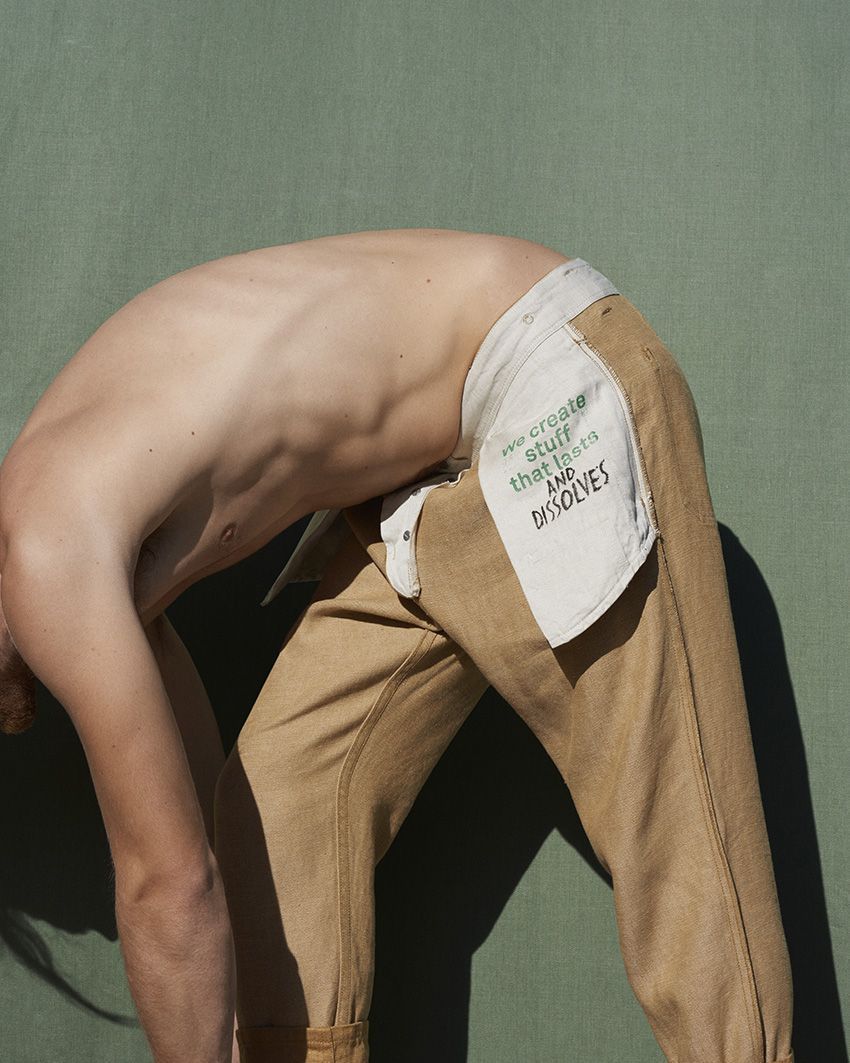
With this initiative, we want to show that the future lies not only in durable, resource-saving products but also in circular forms of consumption: swapping instead of buying, passing on instead of throwing away.
“We want to show that the future lies not only in durable, resource-saving products but also in circular forms of consumption.”
(*) Images provided by FREITAG.