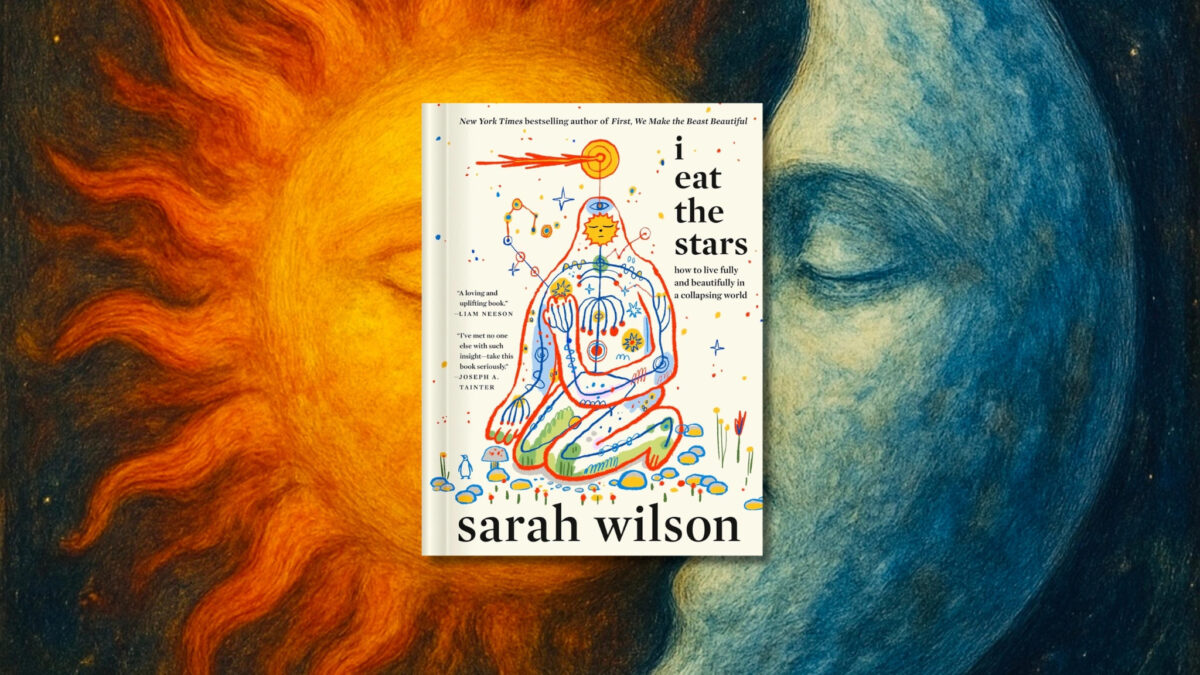
I eat the stars: Sarah Wilson and the value of continuing to create in an uncertain world
In I eat the stars (Penguin Life), Australian writer and journalist Sarah Wilson explores how to live meaningfully when the future no longer offers any guarantees. A personal essay on uncertainty, commitment and art’s ability to draw our attention back to what matters.
As she was finishing I eat the stars, Sarah Wilson felt the need to leave the house. Overwhelmed, she made her way to her neighbourhood café in Paris, where people were still finishing their desserts. A waiter showed her where to sit and, as she took out her notebook, Nina Simone’s four women began to play. The scene appears in the book’s final pages, after a long journey through the crises that trouble its author.
Yet this small return to the world outside helps us understand much of what she has been trying to convey: even when the future is difficult to imagine, we still need to meet others, listen to music and take part in the life unfolding around us.
Published by Penguin Life, I eat the stars: How to live fully and beautifully in a collapsing world grows out of an unease that Wilson turns into research and conversation.
She is concerned about the deterioration of the systems that sustain our shared lives, but also about the distance between what we perceive and the normality we try to maintain. The resulting book brings together the climate crisis, culture, philosophy and personal experience to examine how we respond to a present that is difficult to make sense of.
I eat the stars brings together the climate crisis, culture, philosophy and personal experience to examine how we respond to a present that is difficult to make sense of.
The hope Sarah Wilson calls into question
The opening is deliberately unsettling. After years of climate activism, Wilson explains that she no longer has hope. The statement disconcerts the people she shares it with and makes us pause before reading on. Shortly afterwards, she clarifies what she means: she has lost faith in our ability to change course while preserving a way of life built on continuous growth. Her desire to act, however, remains.
This distinction underpins the essay. When commitment depends on the promise that everything will turn out well, every setback threatens to render it pointless. Wilson asks us to consider what happens when we stop demanding that guarantee. Caring for someone, reducing harm or defending a cause retains its value even when we cannot foresee the outcome. From there, our attention shifts towards the person we choose to be and what our decisions mean for others.
It is a demanding idea because it interrupts a deeply ingrained habit: putting life off until the conditions are right. We wait until we have more time, until we feel ready, until uncertainty disappears. Meanwhile, the present remains dependent on a permission that never quite arrives. The author challenges that waiting and considers a form of commitment that can endure through difficult days too.
Thinking shaped through conversation
The book began as a series of instalments in This is precious, Wilson’s publication on Substack. Readers responded, raised objections and shared experiences that helped shape subsequent instalments. That conversation remains present in its pages, where comments from the community sit alongside the author’s memories, reading and reflections.
Wilson also explains that she interviewed more than two hundred people during the process, including scientists, economists, philosophers and spiritual figures. Yet her writing retains an intimate, at times impassioned voice, moving readily from a theory of complex systems to a conversation in a café. The wide margins, asides and interruptions reinforce the sense of accompanying a line of thought as it takes shape.
The result is energetic, although it also asks us to be willing to follow its digressions. Wilson revisits ideas, corrects herself, exposes her vulnerabilities and alternates between arguments and intuitions.
Her interpretation of the present as a systemic collapse is the thesis around which she organises the narrative; it is worth distinguishing that interpretation from the data and voices she gathers to support it. Indeed, one of the essay’s tensions lies in the force with which she announces the exhaustion of one world while inviting us to question certainty itself.
That tension deserves to remain part of our reading. We can challenge her conclusions while finding value in her reflections on how to act without definitive answers. The book is particularly thought-provoking when it leaves room for that conversation.
Continuing to make art when everything feels urgent
One of its most compelling chapters addresses a concern that anyone engaged in creative work may recognise: the doubt about whether their work is justified in the midst of suffering. Writing, composing, painting or developing a cultural project can seem secondary as urgent demands accumulate. Wilson argues that these very practices help preserve capacities we need in order to respond to what is happening.
Art asks for our attention. A novel requires us to stay with someone else’s experience; a poem can interrupt an idea we thought we had settled; an image makes us notice something we had learnt to overlook. Amid constant stimuli, that concentration has consequences: it broadens what we are able to perceive and makes it harder for indifference to become a habit.
This is why the defence of creative work occupies a central place in Wilson’s journey. Artists can detect changes that are still difficult to name and give form to feelings that others recognise without having been able to express them. They can also explore possibilities, open up conversations and question the narratives that organise our collective lives.
For those of us who work with images, words and ideas, these pages offer a valuable reflection on the responsibility that comes with the way we look at the world. Creating means deciding what we give our time to, what we make visible and what deserves a longer conversation. Beauty thus takes on a dimension that extends beyond immediate pleasure: it can bring us closer to a reality and encourage us to engage with it.
Learning to remain with uncertainty
Throughout the essay, Wilson returns to the difficulty of living with what we cannot resolve. Among others, she draws on John Keats and his concept of negative capability: the willingness to remain amid doubts and mysteries without rushing to close them down with an explanation. Within the book, that openness allows us to reconsider our convictions and listen to what falls outside our existing categories.
This shift also affects the idea of wellbeing. The author locates meaning in our relationships, responsibilities and the contributions we can make, even when they involve discomfort. From this perspective, simplifying means reconsidering how much we need, what we know how to do and how our skills might serve a community.
Wilson combines these reflections with a spiritual search that runs throughout the book: what connects us to others, what gives our lives meaning and how to face what lies beyond our control. These ideas gain strength when she connects them to everyday gestures. Going for a walk to regain a sense of calm, honouring a commitment despite feeling disheartened, or seeking company when we are tempted to isolate ourselves are tangible ways of continuing to participate in life, even when we do not know how to face what is happening.
Creating means deciding what we give our time to, what we make visible and what deserves a longer conversation.
The image behind the title I Eat the Stars
The title comes from Antidotes to fear of death, a poem by astronomer and poet Rebecca Elson. The image of eating stars expresses a desire to take the immensity of the world into ourselves, to receive it with an intensity made more urgent by the awareness of death. Wilson finds in it a way of naming the appetite for life that runs through her book.
By the time we reach the end, that scene in the café takes on a deeper significance. The music, the notebook and the presence of other people are still there, within the same world that troubles her. Recognising its fragility makes the author pay closer attention to them.
I eat the stars leaves us with a reflection that continues after we close its pages: how to give time and form to what we value while we still can. A conversation we have been meaning to have, a work yet to be started, a shared responsibility. Perhaps the book’s most enduring inspiration lies in that willingness to participate: to keep creating, nurture our relationships and make room in our days for the life we so often leave until later.