Nine literary recommendations
From Byung-Chul Han to Nora Ephron, via Nick Cave, Lynne Segal and Emmanuel Carrère, this selection brings together essays, fiction, memoir, photography and contemporary thought. Nine books that invite us to pay attention to other people, the passing of time and a world that keeps changing.
A good reading list need not bring together similar books. Sometimes it is more interesting to place works from seemingly different worlds in conversation and discover the questions they share. This selection includes a crime novel set in Benidorm, a savage satire of the United States and a book of photographs about Susie Cave. There are also essays on respect, waiting and ageing, alongside a family history spanning much of twentieth-century Europe.
Some have only just been published; others have been waiting years for us to find them. We have brought them together for what they can contribute today to a conversation about how we live, relate to one another and tell the stories of our lives.
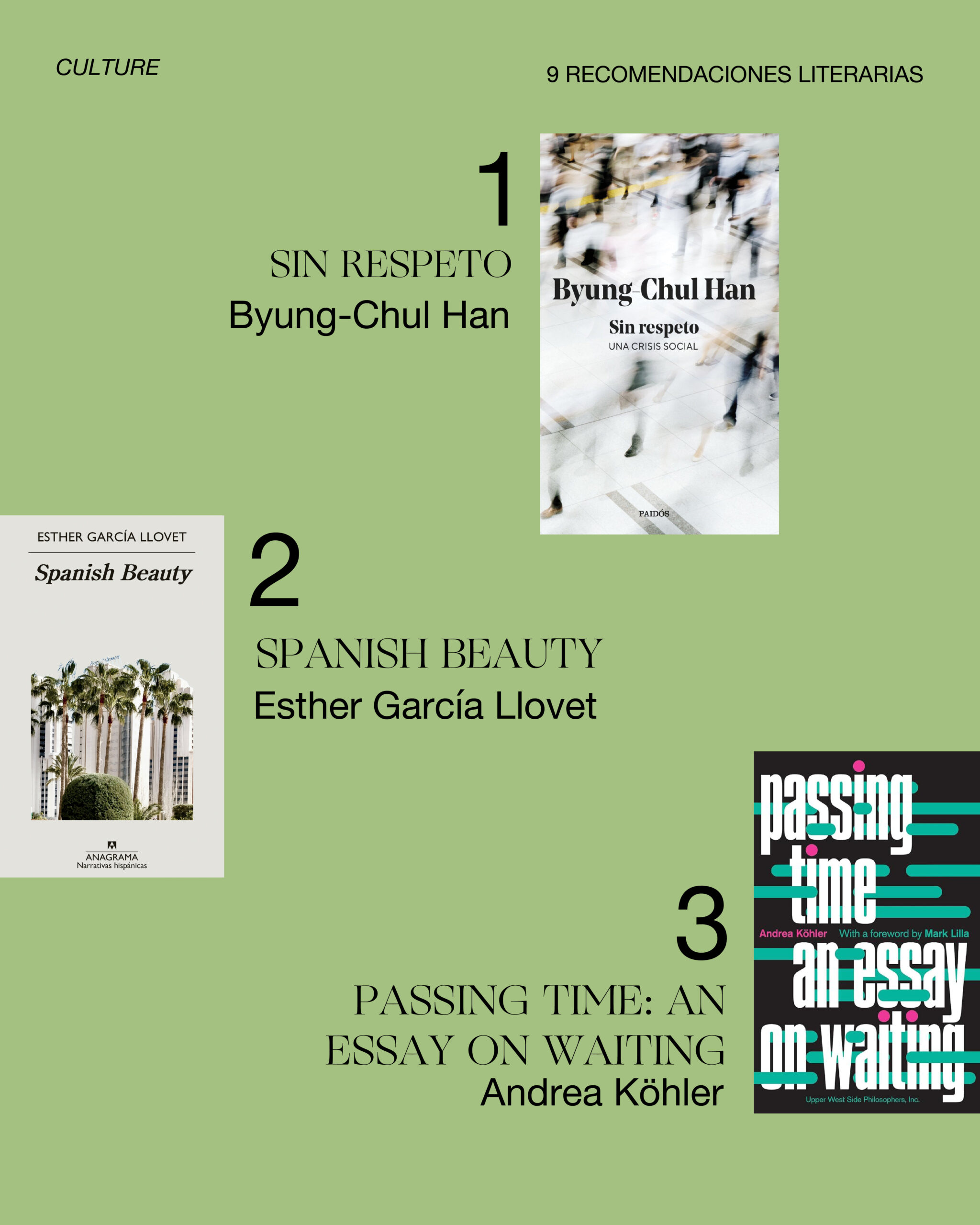
“Sin respeto”, Byung-Chul Han
At what point did we start treating other people as though they were easily replaceable? In Sin respeto, Byung-Chul Hanexamines the erosion of an attitude essential to living together: recognising that the person in front of us deserves our attention, even when they think differently or fail to meet our expectations.
The South Korean philosopher once again considers the habits of contemporary life, asking us to think of respect as something more demanding than good manners. The book’s value lies in bringing a word we use frequently into the realm of everyday gestures: how we listen, how we disagree and how much room we make for people we do not know. Published in September 2026, it is a short read that may stay with us far longer than it takes to finish.
“Spanish Beauty”, by Esther García Llovet
The Benidorm of Spanish Beauty is populated by gangsters, Russian millionaires, faded hotels and a corrupt police officer called Michela, who needs to recover a cigarette lighter linked to the Kray brothers. Esther García Llovet takes a recognisable city and turns it into the setting for a crime novel as spare as it is unpredictable.
Perhaps its greatest appeal lies in its perspective. Far removed from the summer postcard, Benidorm emerges through high-rise buildings, shady dealings and characters searching for money, love or a way out that never seems within reach. The novel encourages us to look again at landscapes we think we know because we have seen them hundreds of times. García Llovet finds a distinctive literary energy there, showing that a place can be fascinating without becoming prettier or more respectable.
“Passing Time: an essay on waiting”, Andrea Köhler
Waiting for a message, a reply, someone’s arrival or the right moment to do something often feels like wasted time. El tiempo regalado. Un ensayo sobre la espera, by Andrea Köhler, dwells on precisely those intervals we try to fill immediately.
Drawing on literature and philosophy, Köhler considers how waiting changes our perception of time and makes room for imagination, uncertainty and hope. Her approach is valuable because it does not turn slowing down into yet another obligation. Waiting can be uncomfortable, too; the book allows us to attend to that experience before dismissing it as an interruption. For anyone watching for the next notification or feeling they should always be doing something, it offers a chance to ask what happens while, apparently, nothing is happening.
“Adjustment Day”, Chuck Palahniuk
For a complete change of register, Adjustment Day takes us into a frenzied, violent version of the United States. A blue book circulates clandestinely, containing instructions for eliminating the country’s most hated figures and establishing a new order. Chuck Palahniuk turns that premise into a satire that pursues conspiracy theories and revenge fantasies to their most grotesque conclusions.
It is an uncomfortable, excessive and provocative read, as one might expect from the author of Fight Club. Its interest lies in examining what happens when collective frustration finds a simple narrative to cling to and someone proposes putting it into action. Palahniuk exaggerates to the point of absurdity, using that exaggeration to test ideas about power, belonging and the ease with which a society can divide into supposedly chosen people and enemies.
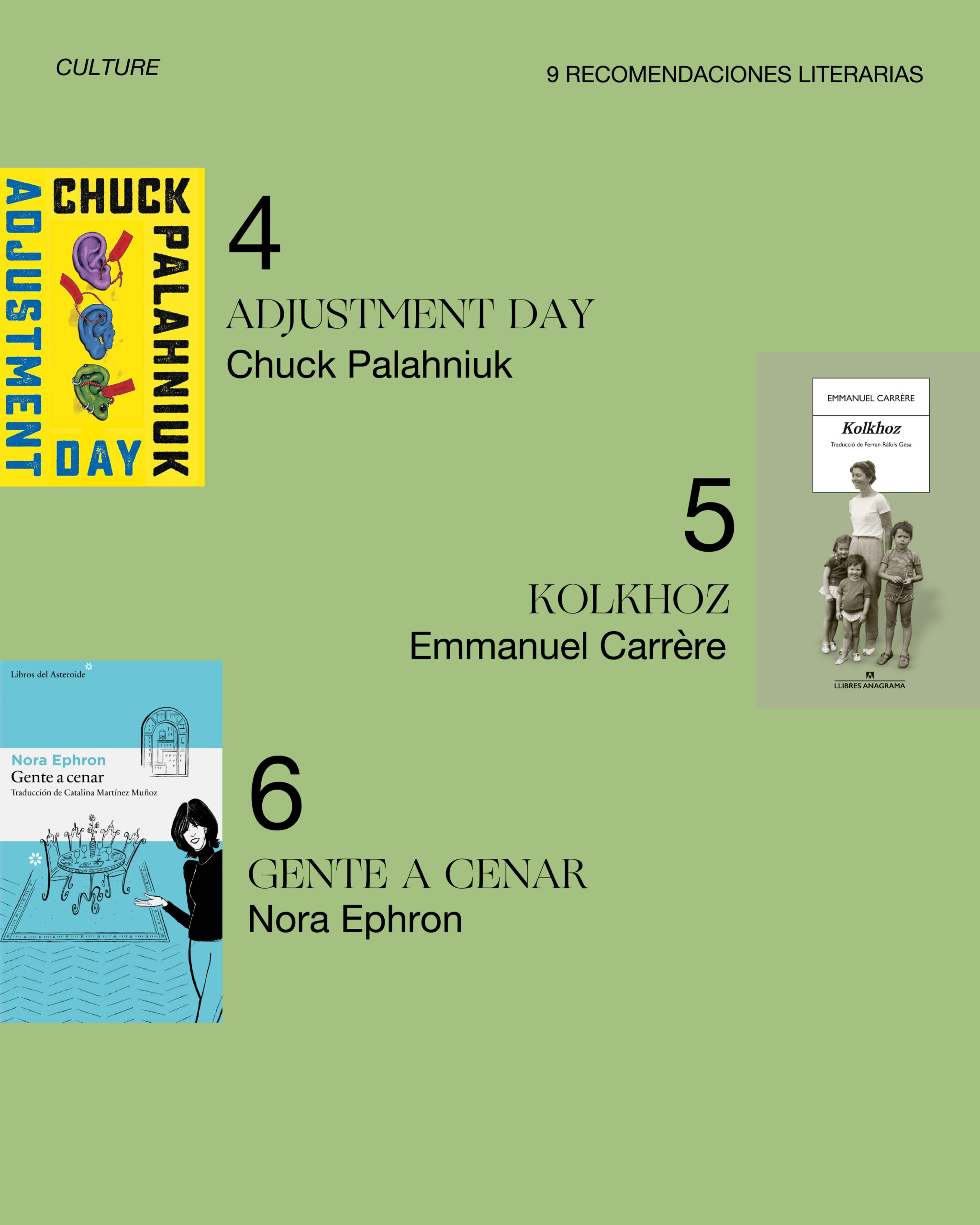
“Kolkhoz”, Emmanuel Carrère
Koljós begins with the death of Hélène Carrère d’Encausse, Emmanuel Carrère’s mother, a historian of Russia and a prominent figure in French intellectual life. Drawing on letters, photographs and documents gathered by his father, the writer reconstructs a family history stretching from Georgia to France and reaching into the conflicts of present-day Europe.
Carrère approaches his mother both as a public figure and as a defining presence in his life, making room for admiration, tensions and what he may never have fully understood. He also brings his more discreet father into focus. The book’s value lies in that dual perspective: major historical events affect individual lives, while the stories a family preserves or leaves untold shape how its members understand the present.
It is a book for readers who enjoy following archives and memories towards the discovery that investigating others also means looking at ourselves.
“Gente a cenar”, Nora Ephron
Nora Ephron had a rare ability to find a story in something we might otherwise dismiss as an anecdote. In Gente a cenar, a selection of articles previously unpublished in Spanish, she writes about the art of entertaining, making a good sandwich, makeovers and the contradictions of women’s magazines. She also examines her work as a journalist with an irony that allows her to laugh at herself while spotting something telling in others.
The pleasure of reading her lies in her voice: conversational, quick and capable of moving from a seemingly trivial concern to an observation about how we want to be seen. Ephron reminds us that social life is made up of small decisions, vanities and insecurities, and that looking at them with humour can help us understand them better. A book to turn to when you want an intelligent read that also offers companionship.
“Susie”, Dominique Issermann, Nick Cave and Susie Cave
Susie is a book to look at and read slowly. It brings together photographs taken by Dominique Issermann over the years with words and reflections from Nick and Susie Cave. Its pages explore their relationship, family, motherhood and the loss of Arthur, one of their sons.
Nick Cave has written about Susie in songs and texts since they met, but here he approaches her from a different position: as someone who loves her deeply and accepts that there will always be aspects of her that elude him. Issermann’s photographs add an intimacy that does not depend on explaining everything. The result is a visual portrait of love and grief, and of the difficulty — and beauty — of trying to truly know another person. As a physical object, it is also one of the most special books in this selection.
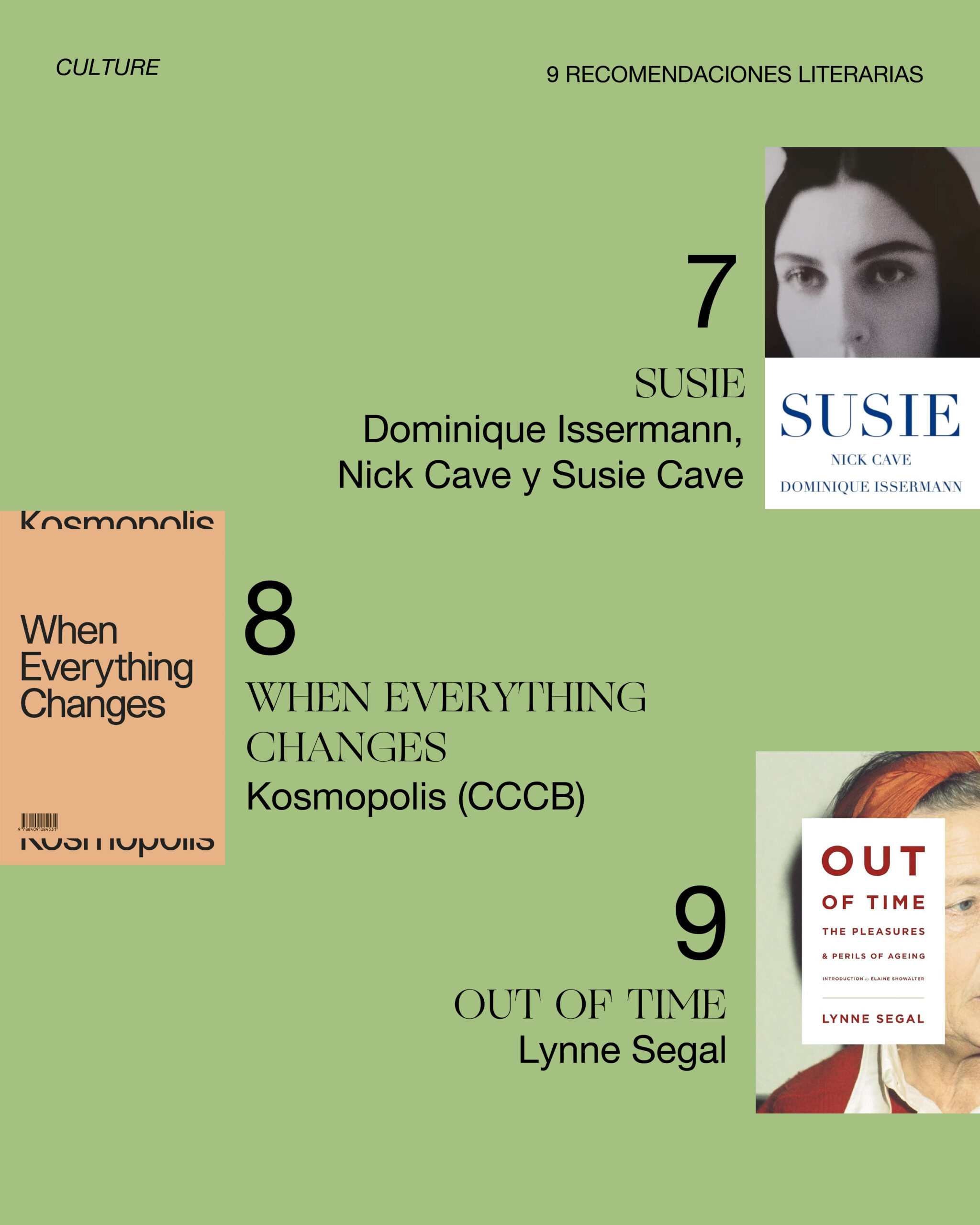
“Out of Time”, Lynne Segal
In Out of Time: The Pleasures and Perils of Ageing, Lynne Segal asks why so many conversations about growing older are dominated by the fear of losing youth, desire or relevance. To explore the question, she weaves her own experience together with literature, feminism and the lives of other writers and artists.
First published more than a decade ago, the book continues to raise pressing questions: what happens to ambition and sexuality as we grow older, how we face loss and why it is so easy to discuss other people’s age while avoiding our own. Segal writes about the difficulties without accepting that they tell the whole story. That is why the book deserves a place on this list: it broadens the ways we can imagine the stages ahead and helps us talk about them with greater curiosity and less embarrassment.
“When everything changes”, Kosmopolis (CCCB)
In 2017, the Kosmopolis festival brought writers, philosophers, scientists and artists together in Barcelona around a question that remains relevant: how to think and write about change while living through it. Cuando todo cambia, published by the CCCB in 2019, preserves some of those conversations in a volume that can be explored without following a single path.
Its contributors include Timothy Morton, Stefano Mancuso, Kim Stanley Robinson, Orna Donath, Lynne Segal, Werner Herzog and PJ Harvey. That variety is precisely its appeal: it allows readers to move from our relationship with nature to social and cultural transformations, then to the possibilities of literature and art for imagining what comes next. Read today, the book invites us to revisit questions already being asked almost a decade ago and consider which have become even more urgent.
Together, these books offer a selection that stays with us beyond the final page, leaving us with new questions about other people and ourselves.
Happy readings!
(*) Cover photo: Kristina Tarasenko.